
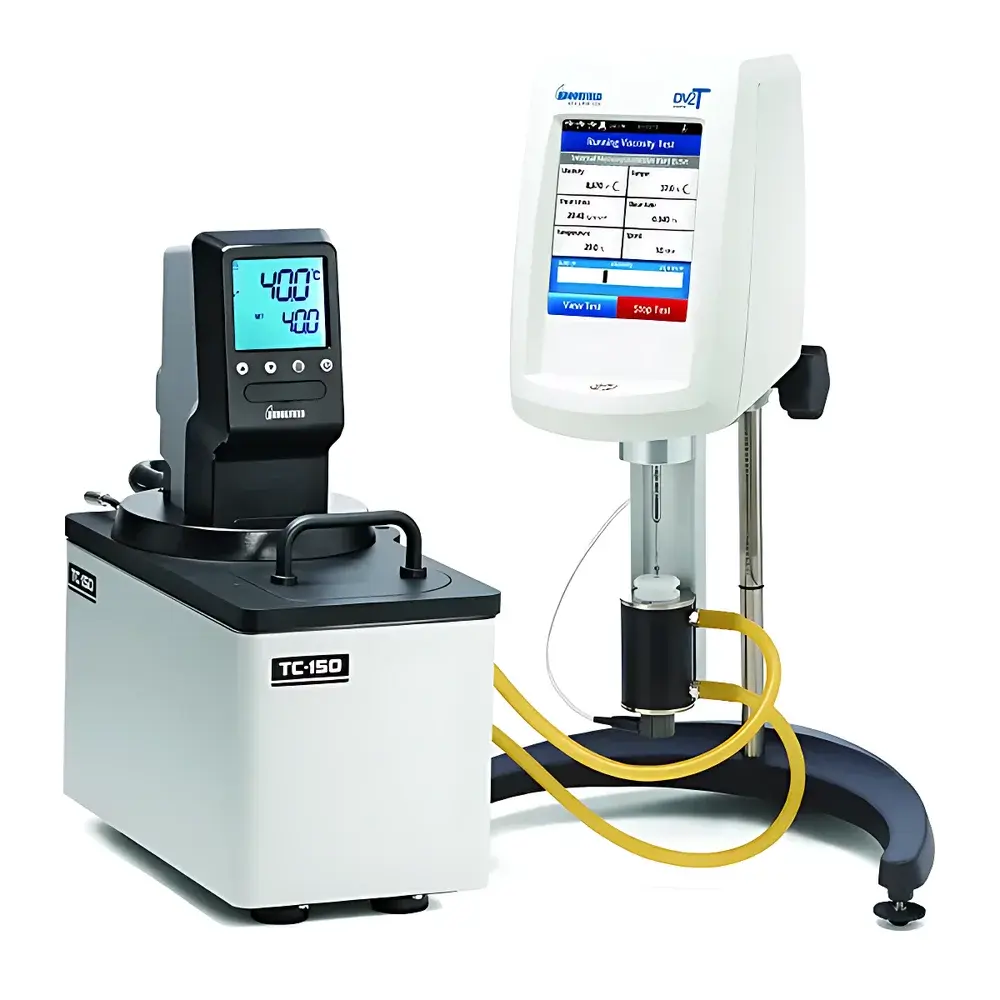
Brookfield TC-150 Precision Temperature-Controlled Circulating Water Bath
| Brand | Brookfield |
|---|---|
| Origin | USA |
| Model | TC-150 |
| Temperature Range (MX) | Ambient +10°C to 135°C |
| Temperature Range (SD/AP) | Ambient +10°C to 150°C |
| Temperature Stability (MX) | ±0.07°C |
| Temperature Stability (SD) | ±0.04°C |
| Temperature Stability (AP) | ±0.01°C |
| Controller Options | MX (basic digital), SD (dual-speed pump, PC-controllable via Rheocalc), AP (touchscreen, programmable, multi-language UI, variable-speed pump) |
| Pump Type | Single-speed (MX), Dual-speed (SD), Variable-speed (AP) |
Overview
The Brookfield TC-150 is a high-precision, circulating temperature-controlled water bath engineered for reproducible thermal conditioning of samples, calibration standards, viscometers, rheometers, and analytical instrumentation in regulated laboratory environments. Operating on the principle of forced convection via an integrated circulation pump, the TC-150 maintains uniform thermal distribution across its stainless-steel bath chamber through precise PID-controlled heating and real-time feedback from a calibrated platinum resistance thermometer (PT100). Unlike basic immersion baths, the TC-150’s closed-loop circulation system ensures minimal temperature gradients (<0.02°C spatial deviation at steady state), making it suitable for applications requiring traceable thermal stability—such as viscosity standardization per ASTM D2196, polymer melt conditioning per ISO 16750, or QC testing under GLP-compliant workflows.
Key Features
- Precision temperature control with three controller tiers: MX (entry-level digital display, single-speed pump), SD (enhanced stability with dual-speed circulation and PC integration via Rheocalc software), and AP (advanced touchscreen interface with full programmability, multi-language support, built-in help system, and continuously variable pump speed)
- Wide operational range: ambient +10°C to 150°C (SD and AP models); ambient +10°C to 135°C (MX model), enabling compatibility with both low-viscosity aqueous systems and high-temperature organic solvent protocols
- Thermal stability performance certified to ±0.01°C (AP), ±0.04°C (SD), and ±0.07°C (MX) at setpoint—validated using NIST-traceable reference thermometers per ISO/IEC 17025 calibration practices
- Robust stainless-steel bath tank (15 L capacity) with corrosion-resistant heater elements and over-temperature protection circuitry compliant with UL 61010-1 and IEC 61010-1 safety standards
- Integrated circulation porting (inlet/outlet) supporting external jacketed vessels, capillary viscometers, or inline sensor loops without auxiliary pumps
Sample Compatibility & Compliance
The TC-150 accommodates standard laboratory glassware (e.g., Ubbelohde viscometers, dilatometry cells, cuvettes) up to 300 mm in height and supports immersion depths up to 120 mm. Its sealed circulation path prevents evaporation-induced concentration drift during extended runs (>72 h), critical for long-term stability studies. The unit meets essential regulatory requirements for analytical instrumentation: temperature logs generated via Rheocalc satisfy FDA 21 CFR Part 11 audit-trail criteria when paired with validated PC configurations; AP-model event logging includes timestamped setpoint changes, alarm triggers, and pump speed adjustments—fully exportable as CSV or PDF for QA documentation. All variants are CE-marked and comply with electromagnetic compatibility (EMC) directive 2014/30/EU.
Software & Data Management
Rheocalc software (v4.2+) provides bidirectional communication with SD and AP controllers, enabling remote setpoint scheduling, ramp/soak profiling, real-time temperature graphing, and automated data export to LIMS-compatible formats (CSV, XML). The AP controller features on-device data storage (2 GB internal flash) retaining ≥10,000 timestamped readings with configurable sampling intervals (1 s to 60 min). Both SD and AP models support password-protected user levels (Operator, Supervisor, Administrator) aligned with ALCOA+ data integrity principles. Audit trails record all configuration modifications—including controller firmware updates—with immutable timestamps and operator IDs.
Applications
- Viscosity calibration of rotational and capillary viscometers per ASTM D445 and ISO 3104
- Temperature-dependent rheological characterization of polymers, emulsions, and pharmaceutical suspensions
- Pre-conditioning of reference oils and Newtonian standards prior to instrument verification
- Thermal equilibration of chromatography columns, detector cells, and autosampler trays
- Accelerated stability testing of formulations under controlled thermal stress (ICH Q1A)
- Supporting ISO 17025-accredited testing laboratories requiring documented thermal uncertainty budgets
FAQ
What is the difference between the MX, SD, and AP controller options?
The MX controller offers basic digital display and single-speed circulation; the SD adds dual-speed pumping, PC connectivity via Rheocalc, and improved stability; the AP delivers full touchscreen programmability, variable-speed circulation, multi-language UI, and comprehensive onboard data logging.
Can the TC-150 be used with external recirculation loops?
Yes—standard ½” NPT inlet/outlet ports support connection to jacketed reactors, inline sensors, or auxiliary cooling units via compatible silicone or PTFE tubing.
Is the temperature stability specification valid across the full range?
Stability values (±0.01°C to ±0.07°C) are measured at nominal setpoints (25°C, 60°C, 100°C, and 150°C) per manufacturer validation protocol; deviations remain within ±0.02°C of specified tolerance across the operating envelope.
Does the TC-150 support GLP-compliant electronic records?
When operated with AP controller and validated Rheocalc installation, full audit trails, electronic signatures, and data backup meet GLP Annex 11 and 21 CFR Part 11 requirements.
What maintenance is required to sustain calibration accuracy?
Annual verification using a NIST-traceable reference thermometer is recommended; pump impeller inspection every 12 months; bath fluid replacement (deionized water or silicone oil) based on usage frequency and thermal cycling history.



