
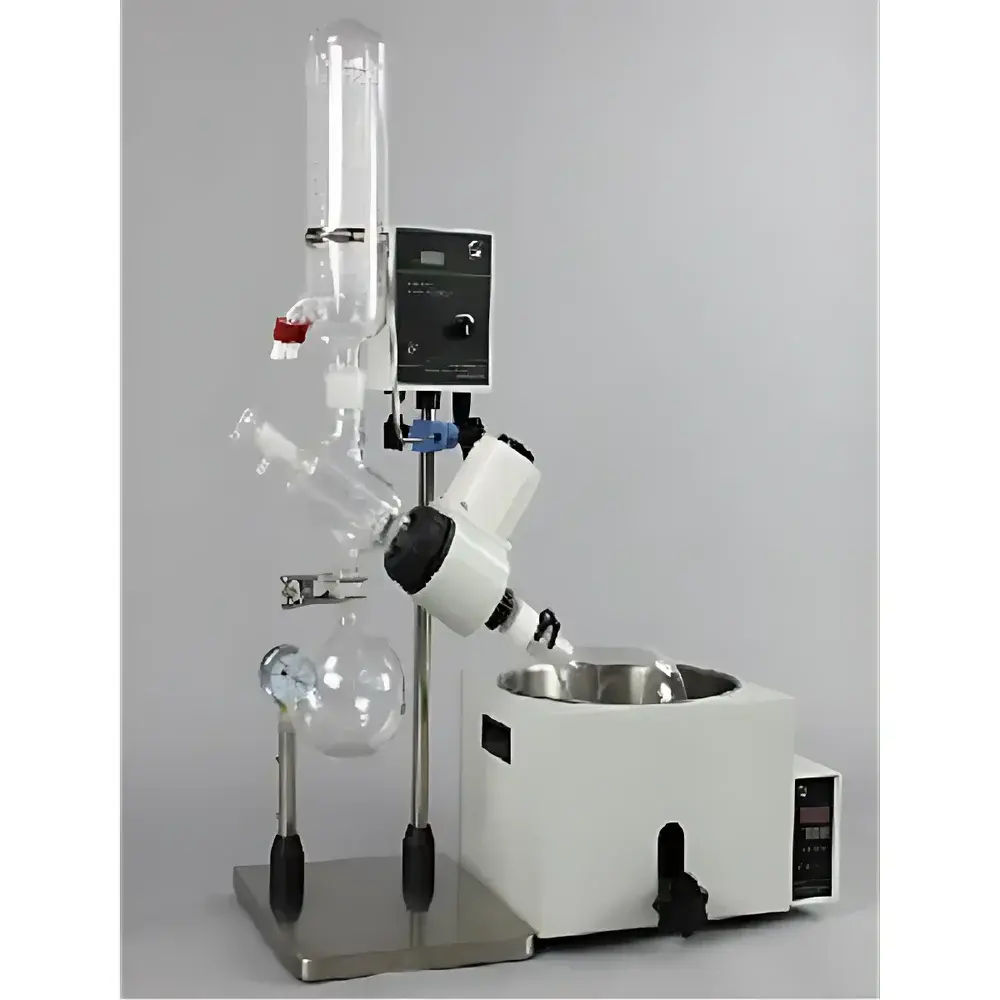
Santai RE-C3LEⅠ 3L Rotational Evaporator
| Brand | Santai |
|---|---|
| Model | RE-C3LEⅠ |
| Type | Water/Oil Bath Rotational Evaporator |
| Bath Volume | 5 L |
| Temperature Range | 0–99 °C |
| Temperature Stability | ±1 °C |
| Heating Power | 1.5 kW |
| Rotation Power | 40 W (Brushless Motor) |
| Rotation Speed | 0–200 rpm (Infinitely Variable) |
| Lift Stroke | 150 mm (Motorized Vertical Adjustment) |
| Condenser | Vertical Dual-Pass Glass Condenser (Φ100 × 510 mm) |
| Evaporation Flask Capacity | 3 L (GG-17 Borosilicate Glass, Ø50 Standard Taper) |
| Collection Flask Capacity | 2 L (35 Standard Taper) |
| Sealing System | Dual-Seal with PTFE + Fluoroelastomer Gaskets |
| Bath Material | Aluminum Alloy + PTFE-Coated Interior (200 × 130 mm Heating Area) |
| Control | Digital PT100 Temperature Sensor + LED Display |
| Input Voltage/Frequency | 220 V / 50 Hz |
| Dimensions (W×D×H) | 660 × 420 × 830 mm |
| Net Weight | 30 kg |
Overview
The Santai RE-C3LEⅠ is a benchtop 3L rotational evaporator engineered for reliable solvent removal, concentration, and recovery in research laboratories, quality control environments, and pilot-scale synthesis workflows. It operates on the principle of reduced-pressure evaporation: under vacuum, the boiling point of solvents is lowered, while simultaneous rotation of the evaporation flask forms a thin, uniform liquid film along the inner wall—maximizing surface area and heat transfer efficiency. The system integrates a thermostatically controlled water/oil bath (0–99 °C), a brushless DC motor drive for precise speed regulation (0–200 rpm), and a vertically oriented dual-pass condenser to ensure high condensation efficiency across volatile organic solvents including acetone, ethanol, dichloromethane, and ethyl acetate. Its all-glass path (GG-17 borosilicate) complies with standard laboratory glassware specifications for chemical resistance and thermal shock tolerance.
Key Features
- Motorized vertical lift mechanism (150 mm stroke) enables safe, repeatable flask immersion and removal without manual adjustment—critical for reproducible evaporation kinetics and operator safety.
- Digital temperature control using PT100 sensor feedback ensures ±1 °C stability across the full 0–99 °C range; heating element is fully enclosed within a PTFE-coated aluminum bath for uniform thermal distribution and corrosion resistance.
- Brushless 40 W motor delivers smooth, low-vibration rotation at speeds adjustable in 1 rpm increments—minimizing emulsion formation and bumping during sensitive extractions.
- Vertical dual-pass condenser (Φ100 × 510 mm) provides extended cooling surface area and optimized vapor flow path, supporting efficient condensate collection even at elevated bath temperatures or moderate vacuum levels (e.g., 10–50 mbar).
- Double-seal design using PTFE and fluoroelastomer gaskets at all ground-glass joints (Ø50 evaporation flask, 35 standard taper collection flask) maintains vacuum integrity and prevents cross-contamination during multi-step fractionation.
- Modular configuration supports optional upgrades including vacuum controller integration, continuous feed adapter (19/22 standard taper), and auxiliary chiller coupling for low-boiling-point solvents.
Sample Compatibility & Compliance
The RE-C3LEⅠ accommodates a broad range of sample matrices—including aqueous solutions, organic extracts, polymer solutions, and heat-sensitive natural product isolates—provided they remain chemically stable below 99 °C and are compatible with GG-17 glass and fluoropolymer seals. It meets mechanical and electrical safety requirements per IEC 61010-1 for laboratory equipment. While not certified for GMP production, its digital logging-capable interface (via optional RS485 module), traceable temperature/rotation setpoints, and sealed bath architecture support GLP-aligned documentation practices. Users performing method validation per USP , ASTM E2597, or ISO 17025 may incorporate this unit into validated workflows when paired with calibrated vacuum gauges and temperature verification probes.
Software & Data Management
Standalone operation requires no software; all parameters are controlled locally via front-panel LED display and tactile buttons. For integration into networked lab environments, an optional RS485 communication port supports Modbus RTU protocol, enabling remote monitoring and parameter synchronization with LIMS or ELN platforms. When used with third-party vacuum controllers (e.g., Vacuubrand VACUU·SELECT), real-time pressure data can be logged alongside temperature and rotation profiles. Audit-trail functionality is achievable through external data acquisition systems compliant with FDA 21 CFR Part 11 when configured with electronic signatures and time-stamped event logging.
Applications
- Solvent removal from reaction mixtures post-Suzuki or Grignard coupling.
- Concentration of natural product fractions from column chromatography eluates.
- Recovery of heat-labile active pharmaceutical ingredients (APIs) under mild thermal conditions.
- Preparative-scale dehydration of hydrosols and essential oil distillates.
- Removal of residual solvents from polymer films prior to DSC or TGA analysis.
- Standardized evaporation protocols in environmental labs for EPA Method 3510C (liquid-liquid extraction) sample preparation.
FAQ
Can the RE-C3LEⅠ be used with oil baths?
Yes—the bath chamber is compatible with silicone or mineral oil up to 99 °C; however, bath fluid level must be maintained above the heater element and below the condenser joint to prevent overheating or thermal stress on glassware.
Is vacuum control included?
No—vacuum regulation requires an external pump and optional vacuum controller; the unit features a standard 10/30 mm vacuum port compatible with most diaphragm and rotary vane pumps.
What maintenance is required for long-term reliability?
Monthly inspection of PTFE/fluoroelastomer gaskets for compression set, annual calibration of PT100 sensor against a NIST-traceable reference, and periodic cleaning of the PTFE-coated bath cavity with non-abrasive detergent.
Does it support continuous feed during evaporation?
Yes—via the optional 19/22 standard taper addition funnel port, enabling controlled reagent introduction without breaking vacuum or interrupting rotation.
Can the rotation speed be synchronized with vacuum level?
Not natively—but external programmable logic controllers (PLCs) or LabVIEW-based automation systems can coordinate speed and vacuum setpoints via the RS485 interface when enabled.



