
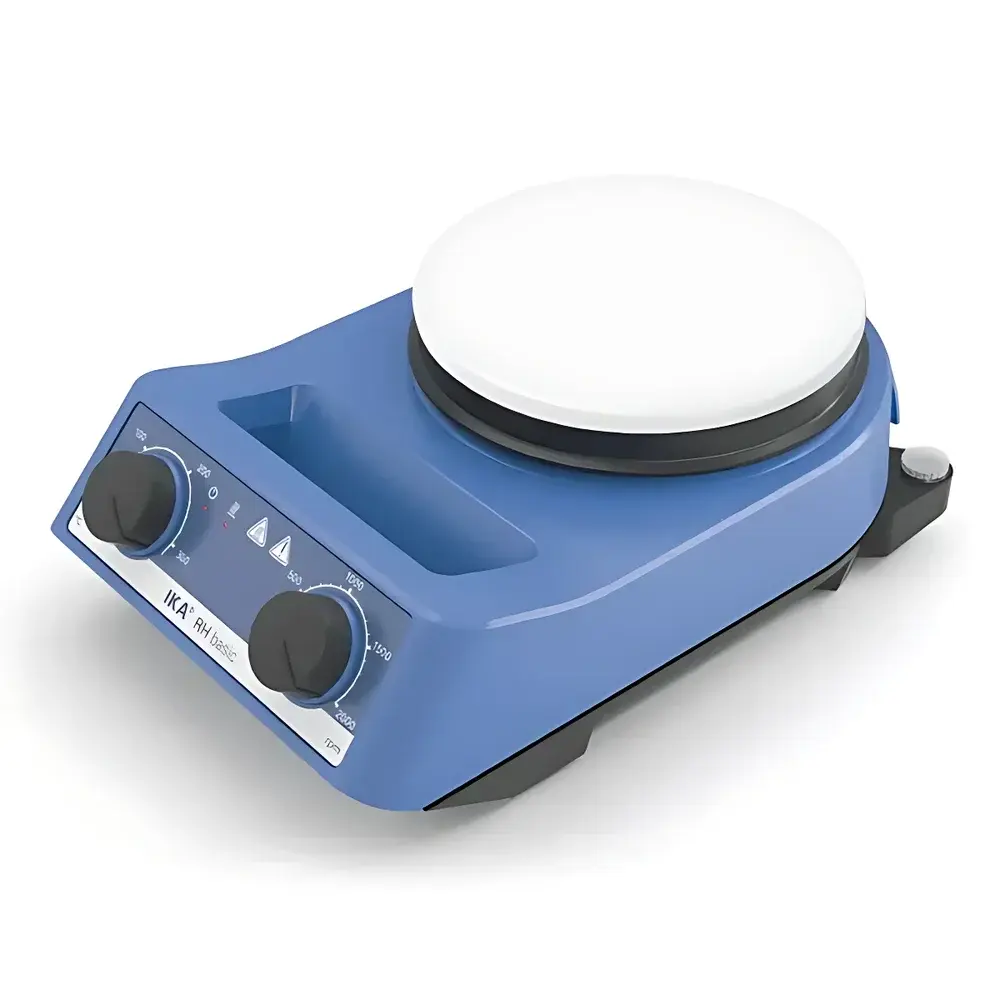
IKA RH basic white Magnetic Stirrer with Heating
| Brand | IKA |
|---|---|
| Origin | Germany |
| Model | RH basic white |
| Motor Output Power | 2 W |
| Max. Stirring Volume (H2O) | 15 L |
| Speed Range | 100–2000 rpm |
| Stir Bar Length Compatibility | 20–80 mm |
| Heating Power | 600 W |
| Heating Temperature Range | 50–320 °C |
| Adjustable Safety Temperature Limit | 100–360 °C |
| Plate Material | Enamel-coated Steel |
| Plate Diameter | Ø 135 mm |
| Dimensions (W × D × H) | 160 × 100 × 250 mm |
| Weight | 3.135 kg |
| Ambient Operating Conditions | 5–40 °C, ≤80 % RH |
| Protection Class | IP21 |
| Voltage | 230 V, 50/60 Hz |
| Input Power | 620 W |
| External Temperature Sensor Interface | ETS-D5 compatible |
| Compliance | DIN 12878, DIN EN 60529 |
Overview
The IKA RH basic white is a compact, benchtop magnetic stirrer with integrated heating functionality, engineered for precision, reliability, and chemical resistance in routine laboratory workflows. It operates on the principle of rotating magnetic coupling—where a rotating permanent magnet beneath the ceramic-coated plate induces synchronous rotation of a magnetic stir bar immersed in the sample. Heat is delivered via resistive heating elements embedded beneath the enamel-coated aluminum plate, enabling direct conductive heating of vessels placed on the surface. Designed for applications requiring simultaneous mixing and temperature control—including dissolution testing, buffer preparation, reagent synthesis, and sample conditioning—the RH basic white delivers stable thermal output and consistent rotational torque across its full speed range. Its DIN 12878-compliant interface supports external Pt100 temperature sensors (e.g., IKA ETS-D5), allowing real-time, vessel-integrated temperature feedback for closed-loop thermal regulation—critical for reproducible thermal protocols under GLP or ISO/IEC 17025 environments.
Key Features
- Enamel-coated steel heating plate (Ø 135 mm) offering high resistance to acids, alkalis, and organic solvents—ensuring long-term integrity in demanding chemical environments.
- Adjustable safety temperature limit (100–360 °C), independently configurable from operating setpoint, preventing thermal runaway during unattended operation.
- Soft-start motor control minimizes mechanical shock to sensitive samples and extends stir bar lifespan; motor output rated at 2 W with continuous duty cycle.
- Manual analog speed control via calibrated rotary knob (100–2000 rpm), with visual scale for repeatable setting recall—no digital electronics required for simplified maintenance and EMC robustness.
- DIN 12878-standard sensor port enables seamless integration with IKA ETS-D5 or other compliant Pt100 probes, supporting accurate media temperature measurement within the vessel—not just plate surface temperature.
- M10 threaded mounting port on rear panel for optional vertical support rod attachment—facilitating secure positioning of temperature sensors or pH electrodes during extended experiments.
Sample Compatibility & Compliance
The RH basic white accommodates standard laboratory glassware (e.g., beakers, flasks, crystallization dishes) up to 15 L volume when used with appropriately sized stir bars (20–80 mm length). Its enamel surface remains inert toward common solvents including ethanol, acetone, dilute HCl/HNO₃, and aqueous buffers. The unit complies with DIN EN 60529 (IP21 ingress protection), ensuring operational safety against vertically falling drops and solid objects ≥12.5 mm. Electrical design conforms to IEC 61010-1 for laboratory equipment, with reinforced insulation and thermal cutoffs meeting UL/CSA safety requirements. As a DIN 12878-compliant heater-stirrer, it satisfies regulatory expectations for temperature-controlled mixing in pharmaceutical QC (USP , ), academic research, and industrial R&D where traceable thermal control is mandated.
Software & Data Management
The RH basic white operates as a standalone analog instrument without embedded firmware or connectivity. All parameter settings—including speed and temperature—are manually adjusted and visually indicated via fixed-scale dials. While it does not feature digital logging or PC interface, its ETS-D5 sensor compatibility allows connection to third-party data acquisition systems (e.g., LabVIEW, MATLAB, or PLC-based SCADA) via standard 4-wire Pt100 output. This architecture supports audit-ready documentation when paired with validated external recorders, fulfilling 21 CFR Part 11 requirements for electronic records in regulated labs—provided the connected system implements appropriate user access controls, electronic signatures, and change-tracking mechanisms.
Applications
- Preparation of homogeneous aqueous and organic solutions in analytical chemistry labs.
- Controlled heating and agitation during titration standardization and calibration solution preparation.
- Accelerated aging studies requiring sustained temperature + mixing (e.g., polymer solubility testing, catalyst slurry conditioning).
- Cell culture media warming and pH buffer equilibration prior to sterile filtration.
- Supporting ASTM D2196 (viscosity of paints) and ISO 787-13 (dispersion stability) test methods where defined thermal-mixing conditions are specified.
- Integration into modular lab setups where analog simplicity, low EMI emission, and chemical resilience are prioritized over smart features.
FAQ
Does the RH basic white support programmable ramping or timer functions?
No. It is an analog-only device with manual speed and temperature adjustment. Ramp profiles and timed shut-off require external controllers or process timers.
Can the ETS-D5 sensor be used for both heating control and data logging?
Yes—the ETS-D5 provides real-time Pt100 resistance output suitable for both closed-loop temperature regulation (via compatible controllers) and archival logging when interfaced with DAQ hardware.
What is the maximum recommended vessel height for optimal stirring efficiency?
For consistent vortex formation and heat transfer, use cylindrical vessels with height-to-diameter ratios ≤2.5; taller vessels may require longer stir bars or reduced speed to maintain laminar flow.
Is the enamel coating resistant to hydrofluoric acid (HF)?
No. While highly resistant to most common reagents, enamel is vulnerable to HF and strong fluorides; alternative PTFE-coated or ceramic hotplates are recommended for such applications.
How often should the stir bar alignment and motor coupling be verified?
Periodic visual inspection every 6 months is advised; misalignment is indicated by audible vibration or inconsistent rotation at low speeds—especially after prolonged use above 1800 rpm.
Related Products



