
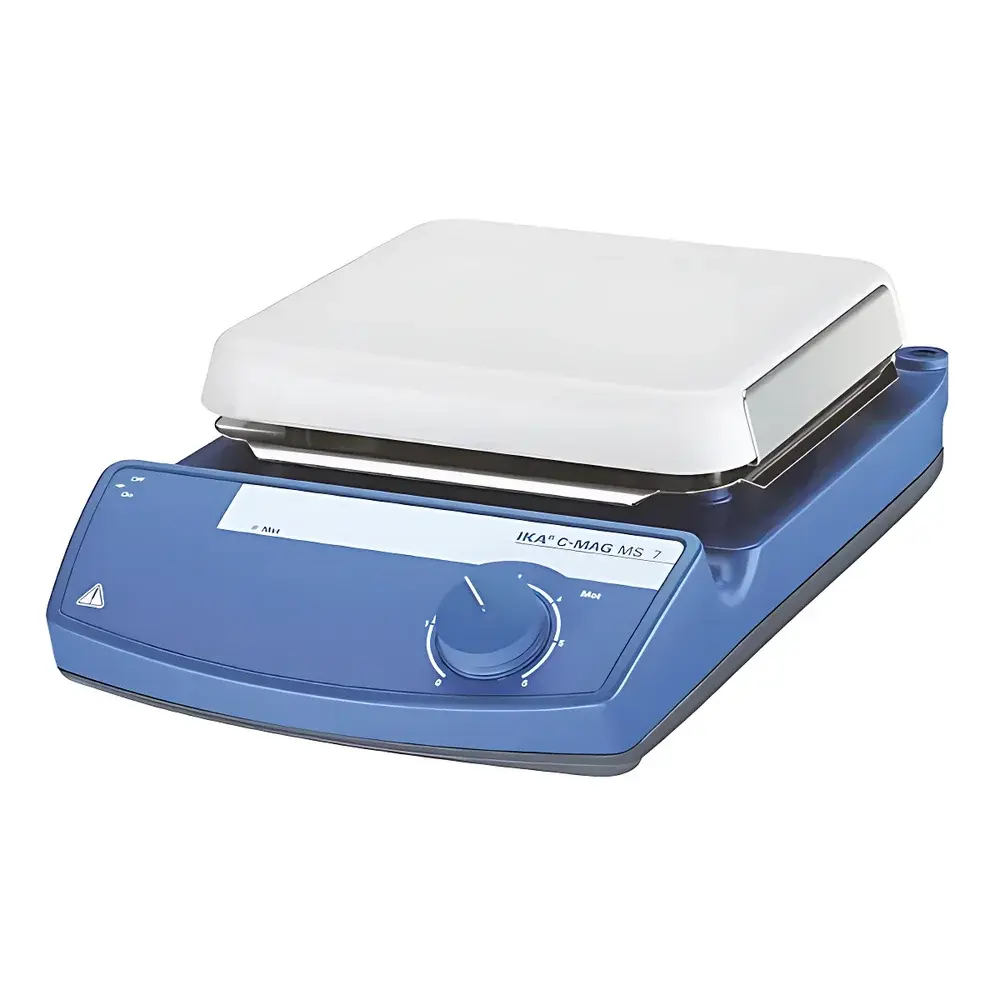
IKA C-MAG MS 7 Magnetic Stirrer
| Brand | IKA |
|---|---|
| Origin | Germany |
| Model | C-MAG MS 7 |
| Stirring Positions | 1 |
| Max. Stirring Volume (H2O) | 10 L |
| Motor Output Power | 1.5 W |
| Rotation Direction | Clockwise |
| Speed Control | Analog Dial (0–6) |
| Speed Range | 100–1500 rpm |
| Max. Stir Bar Length | 80 mm |
| Hotplate Material | Ceramic |
| Plate Dimensions | 180 × 180 mm |
| Overall Dimensions | 220 × 105 × 335 mm |
| Weight | 5 kg |
| Ambient Temperature Range | 5–40 °C |
| Relative Humidity Limit | ≤80 % RH |
| Protection Class | IP21 (per DIN EN 60529) |
| Voltage | 230 V AC |
| Frequency | 50/60 Hz |
| Input Power | 30 W |
Overview
The IKA C-MAG MS 7 is a compact, single-position magnetic stirrer engineered for precision and reliability in routine laboratory environments. It operates on the principle of rotating magnetic fields generated by internal permanent magnets driven by a brushless DC motor, inducing torque on ferromagnetic stir bars immersed in liquid samples. Unlike hotplate stirrers, the C-MAG MS 7 is a non-heating unit—designed exclusively for mechanical mixing applications where temperature control is managed externally or not required. Its robust architecture supports consistent rotational performance across viscous media, with closed-loop speed feedback ensuring minimal deviation (<±3% at setpoint) under load variations. The device complies with IEC 61010-1 for electrical safety in laboratory equipment and meets EMC requirements per EN 61326-1, making it suitable for use in GLP-compliant laboratories and regulated QC workflows.
Key Features
- Ceramic Work Surface: A monolithic, seamless ceramic plate provides exceptional resistance to acids, alkalis, solvents, and thermal shock—enabling safe operation with aggressive reagents and repeated cleaning using ethanol, acetone, or diluted nitric acid.
- Microprocessor-Controlled Drive: Real-time motor speed monitoring via Hall-effect sensor feedback maintains constant rotational velocity across varying viscosity loads, eliminating drift during extended operation.
- Elevated Control Panel: The raised analog dial and LED indicators are positioned above the plate surface to minimize liquid ingress risk and improve ergonomics during glove use or high-throughput bench work.
- High-Torque Magnet System: Optimized magnetic coupling ensures stable engagement with stir bars up to 80 mm in length—even in low-height vessels or high-viscosity solutions (e.g., polymer solutions, glycerol-water mixtures).
- IP21-Rated Enclosure: Protection against vertically falling drips and solid objects >12.5 mm ensures operational integrity in humid or splash-prone environments typical of wet chemistry labs.
- Energy-Efficient Design: With only 30 W nominal input power and 1.5 W motor output, the unit minimizes standby consumption while delivering sufficient torque for volumes up to 10 L of aqueous media.
Sample Compatibility & Compliance
The C-MAG MS 7 accommodates standard cylindrical, round-bottom, and flat-bottom glass or plastic vessels ranging from 50 mL to 5 L capacity. Compatibility extends to stainless steel, PTFE-coated, and borosilicate containers provided they do not exceed 180 mm base diameter. Stir bar selection must align with ISO 8573-1 recommendations for material inertness; common configurations include PTFE-coated bar magnets (e.g., IKA S15, S25) for pH-sensitive or trace-metal analyses. The instrument conforms to DIN EN 60529 (IP21), IEC 61010-1 (safety), and EN 61326-1 (EMC). While not certified for use in hazardous locations (ATEX/IECEx), its non-sparking motor and absence of heating elements permit deployment in general-purpose chemical fume hoods and ISO Class 7 cleanrooms when paired with appropriate containment protocols.
Software & Data Management
The C-MAG MS 7 operates as a standalone analog-controlled instrument without digital interface or data logging capability. No USB, RS-232, or Ethernet connectivity is provided; all parameter adjustments are performed manually via the calibrated rotary dial (scale 0–6, corresponding to 100–1500 rpm). As such, it does not support FDA 21 CFR Part 11 compliance features—including electronic signatures, audit trails, or password-protected settings—but remains fully compatible with paper-based SOP documentation and manual logbook entries required under basic GLP frameworks. For laboratories requiring traceable speed records, external tachometer verification (e.g., handheld optical tachometer per ASTM E1538) is recommended during method validation.
Applications
This stirrer is routinely deployed in pharmaceutical dissolution testing (USP Apparatus 2 pre-mixing), environmental water sample homogenization prior to filtration or digestion, buffer preparation for chromatography mobile phases, catalyst suspension in synthetic reaction screening, and cell culture media equilibration. Its stability under continuous operation makes it suitable for overnight stirring protocols in academic research labs and industrial R&D settings. Due to its lack of heating functionality, it is frequently paired with external thermostatic baths or jacketed reactors where precise thermal management is maintained independently of agitation.
FAQ
Does the C-MAG MS 7 include a heating function?
No. It is a non-heating magnetic stirrer. Temperature control must be achieved externally.
Can it be used with metal containers?
No. Ferromagnetic vessels will interfere with magnetic field coupling and may damage the drive mechanism.
What is the maximum recommended viscosity for reliable operation?
Up to 10,000 mPa·s (e.g., 40% w/w sucrose solution) when using an appropriately sized stir bar and vessel geometry.
Is calibration required before use?
While no formal calibration certificate is supplied, users should verify speed accuracy annually using a NIST-traceable tachometer per internal QA procedures.
How often should maintenance be performed?
Visual inspection of the ceramic surface and control dial function is advised quarterly; no lubrication or internal servicing is required under normal operating conditions.



