
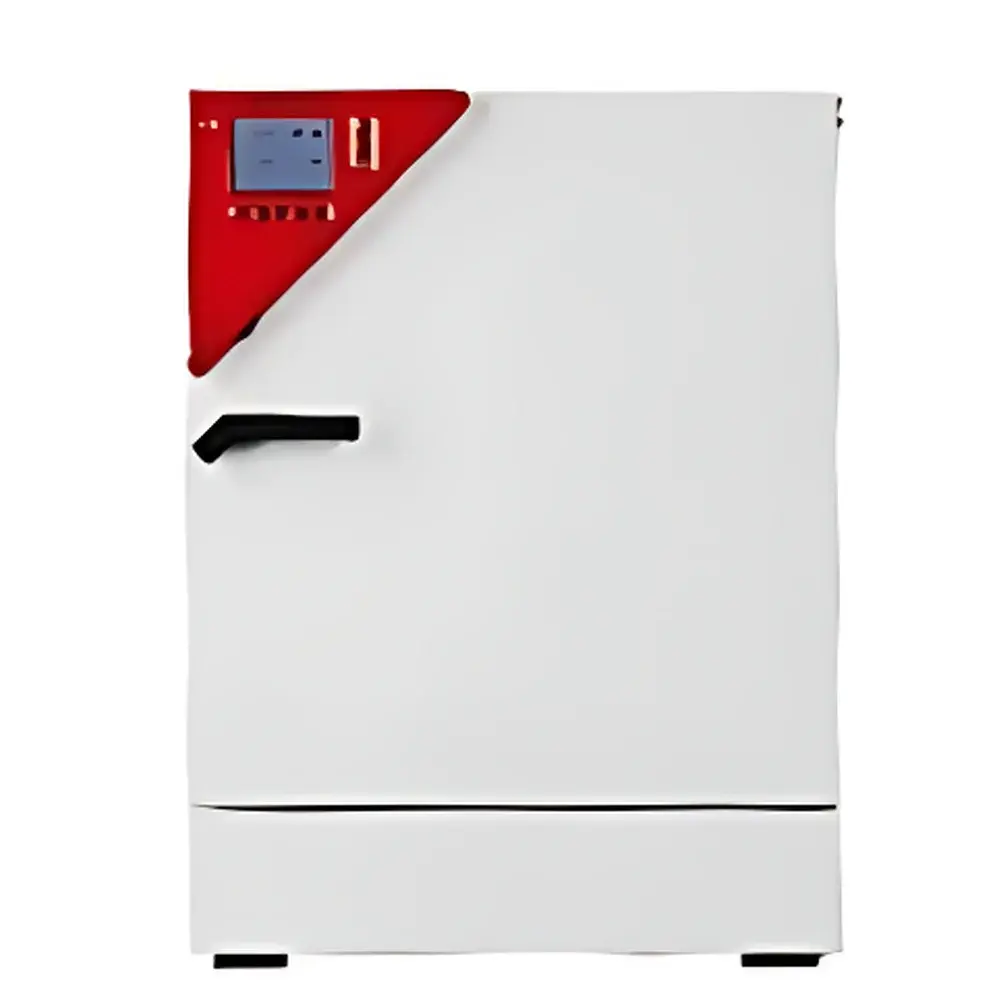
BINDER CB Series Carbon Dioxide Incubator
| Brand | BINDER |
|---|---|
| Origin | Germany |
| Model | CB Series |
| Sterilization | Dry-heat sterilization (180 °C, 2–4 h) |
| CO₂ Control Range | 0–20 % (±0.1 % typical accuracy) |
| Temperature Range | Ambient +5 °C to 50 °C (±0.1 °C stability at 37 °C) |
| Humidity Control | Active humidification with integrated water pan and saturation monitoring |
| Chamber Volume Options | 53 L to 216 L |
| Construction | Stainless steel interior (AISI 304), double-wall insulated chamber, HEPA-filtered air circulation (ISO Class 5 compliant) |
| Compliance | IEC 61010-1, EN 61326-1, CE marked for in vitro diagnostic use (IVDR Annex II) |
Overview
The BINDER CB Series Carbon Dioxide Incubator is a precision-engineered, laboratory-grade cell culture environment system designed for reproducible maintenance of mammalian, insect, and hybridoma cell lines under strictly controlled physiological conditions. Operating on the principle of infrared (IR) CO₂ sensing coupled with proportional-integral-derivative (PID) feedback control, the CB series maintains stable CO₂ concentration (typically 5 % for bicarbonate-buffered media), temperature (±0.1 °C at setpoint), and relative humidity (>90 % RH at 37 °C) across the entire chamber volume. Its fully stainless steel (AISI 304) interior—electropolished and seamless—minimizes microbial adhesion and supports rigorous decontamination protocols. The integrated dry-heat sterilization cycle (180 °C for 2–4 hours) eliminates mycoplasma, spores, and biofilm residues without chemical agents, meeting ISO 14644-1 Class 5 cleanroom air quality requirements during operation via HEPA-filtered internal recirculation.
Key Features
- Triple-sensor IR CO₂ monitoring with automatic atmospheric pressure compensation and drift correction—ensuring long-term measurement stability over 12 months without recalibration.
- Microprocessor-controlled Peltier-assisted temperature regulation with independent heating and cooling elements, enabling rapid recovery (<15 min) after door opening and minimizing thermal gradients (<0.3 °C max deviation).
- Active humidity management using a heated water reservoir and saturated steam injection, continuously monitored by capacitive RH sensor with dew-point validation.
- Double-walled insulation with vacuum-sealed chamber jacket and low-emissivity inner lining—reducing energy consumption by up to 30 % versus conventional incubators.
- Touchscreen HMI with multilingual interface (EN/DE/FR/ES), real-time graphing of all critical parameters, and configurable alarm thresholds with audible/visual alerts and relay outputs.
- Optional data logging module compliant with FDA 21 CFR Part 11: supports electronic signatures, audit trails, and encrypted export of time-stamped CSV files for GLP/GMP documentation.
Sample Compatibility & Compliance
The CB series accommodates standard tissue culture formats—including T-flasks (25–225 cm²), multiwell plates (6–96-well), Petri dishes, roller bottles, and bioreactor vessels—without airflow disruption. Its uniform laminar airflow pattern (0.1–0.2 m/s velocity) and absence of condensation-prone surfaces prevent cross-contamination and media evaporation. The system conforms to IEC 61010-1 (safety), EN 61326-1 (EMC), and EU IVDR Annex II requirements for in vitro diagnostic medical devices. Dry-heat sterilization validation reports are available per ISO 17025-accredited protocols. All models support integration into facility-wide environmental monitoring systems via Modbus RTU or Ethernet/IP.
Software & Data Management
BINDER’s optional *ecoLINK* software enables remote supervision of up to 32 incubators via secure web browser or mobile app. It provides centralized alarm management, historical trend analysis (up to 5 years of compressed data), and automated report generation aligned with ISO/IEC 17025 and GxP documentation standards. Audit trail functionality logs every parameter change, user login, sterilization cycle start/stop, and alarm acknowledgment—including operator ID and timestamp. Data integrity is ensured through SHA-256 hashing and TLS 1.2 encryption for all network transmissions.
Applications
- Long-term expansion of primary human keratinocytes and mesenchymal stem cells requiring stringent pH stability (via 5 % CO₂ / 37 °C / >95 % RH).
- High-throughput screening workflows where incubator-to-incubator consistency must meet ASTM E2919-22 criteria for inter-laboratory reproducibility.
- Regulated bioproduction environments supporting USP ancillary materials qualification and ISO 13485-certified cell banking procedures.
- Toxicology studies involving co-culture models exposed to volatile compounds—leveraging the CB’s sealed chamber design and VOC-resistant gasket materials.
- Veterinary vaccine development labs performing serial passage of avian influenza isolates under biosafety level 2 (BSL-2) compatible containment.
FAQ
What CO₂ sensor technology does the CB series use, and how often does it require calibration?
The CB series employs dual-beam non-dispersive infrared (NDIR) sensors with automatic zero-point referencing and pressure-compensated algorithms. Calibration is factory-performed and traceable to NIST standards; field recalibration is not required within 12 months under normal operation.
Can the dry-heat sterilization cycle be validated for mycoplasma elimination?
Yes—validation protocols per ISO 14644-2 Annex B confirm ≥6-log reduction of Mycoplasma hominis and Bacillus atrophaeus spores at 180 °C for ≥2 hours. Full validation kits and IQ/OQ documentation templates are available upon request.
Is the incubator suitable for use with phenol red-free or CO₂-independent media?
Absolutely—the precise temperature and humidity control remains fully functional regardless of CO₂ dependency; users may disable CO₂ regulation while retaining all other environmental parameters.
Does the system support integration with LIMS or MES platforms?
Yes—via optional RS485/Modbus RTU or Ethernet/IP interfaces, with preconfigured drivers for LabVantage, Thermo Fisher SampleManager, and Siemens Desigo CC.
What is the mean time between failures (MTBF) for the CB series under continuous operation?
Based on BINDER’s 2023 global field reliability database, MTBF exceeds 12,500 hours (≈1.4 years) for core control electronics and 8,200 hours for humidity generation subsystems under 24/7 usage at 37 °C.




