
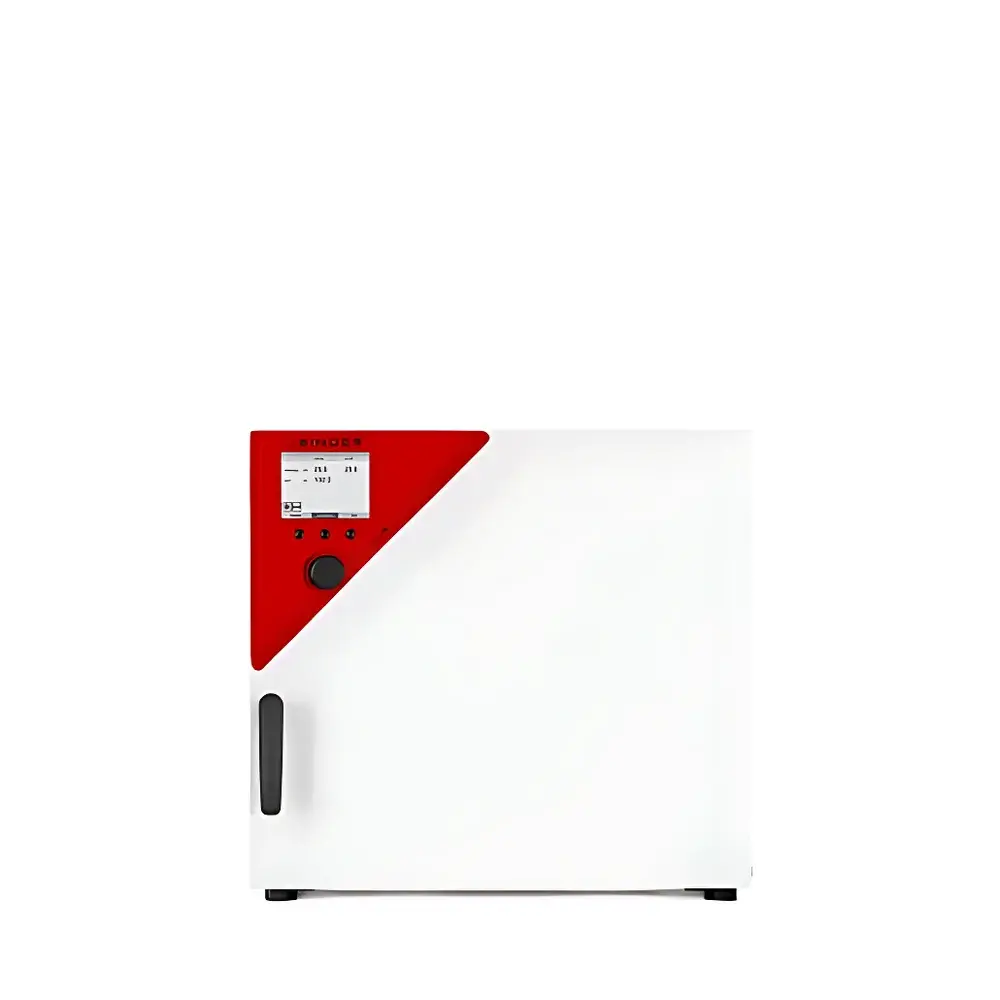
BINDER KT Series Semiconductor-Cooled Low-Temperature Incubator
| Brand | BINDER |
|---|---|
| Origin | Germany |
| Model | KT53 / KT115 / KT170 |
| Temperature Range | 4 °C to 100 °C |
| Internal Volume | 53 L / 102 L / 163 L |
| External Dimensions (W×H×D, mm) | 660×635×630 / 860×715×655 / 860×1025×655 |
| Internal Dimensions (W×H×D, mm) | 400×400×334 / 600×455×355 / 600×765×355 |
| Net Weight | 63 kg / 83 kg / 102 kg |
| Inner Door | Tempered Safety Glass (ESG) |
| Interior | Stainless Steel Construction |
| Shelving | 2 Removable Stainless Steel Trays |
| Stacking Capability | Up to KT115 Units |
Overview
The BINDER KT Series Semiconductor-Cooled Low-Temperature Incubator is an engineered solution for precise, stable, and contamination-controlled thermal environments in life science laboratories. Unlike conventional compressor-based incubators, the KT series employs solid-state Peltier cooling modules—enabling efficient, oil-free, and vibration-free temperature regulation from 4 °C up to 100 °C. This thermoelectric architecture eliminates mechanical wear, reduces maintenance requirements, and ensures silent operation—critical for sensitive cell culture workflows, enzymatic assays, and long-term stability testing. The core thermal management system integrates BINDER’s proprietary APT.line™ preheating chamber technology, which surrounds the inner chamber with a thermally insulated, actively controlled jacket. This design minimizes temperature gradients (< ±0.3 °C uniformity at 37 °C), suppresses condensation, and delivers rapid recovery after door openings—verified per DIN 12880 test protocols. All models comply with IEC 61010-1 safety standards and are designed for continuous operation under GLP-compliant laboratory conditions.
Key Features
- Thermoelectric (Peltier) cooling system: No refrigerants, no compressors, zero oil contamination risk—ideal for sterile applications and cleanroom-adjacent installations.
- APT.line™ preheating chamber: Uniform temperature distribution across full working volume; validated spatial homogeneity per ISO 15265 Annex C.
- Adjustable fan speed control: Optimizes airflow for heat-sensitive samples while minimizing shear stress on adherent cultures.
- Dual-stage temperature safety: Independent Class 3.1 (DIN 12880) over- and under-temperature cut-off with optical and acoustic alarm activation.
- LCD interface with rotary-push button navigation: Intuitive real-time parameter adjustment and interval programming (up to 10 segments, 99 cycles).
- Stainless steel interior (AISI 304), ESG inner door, and removable stainless steel trays: Fully autoclavable components support rigorous decontamination protocols.
- Ethernet (RJ45) and USB-B ports: Enable remote monitoring, firmware updates, and time-stamped data export compliant with FDA 21 CFR Part 11 audit trail requirements.
Sample Compatibility & Compliance
The KT series accommodates standard microbiological and mammalian culture formats—including Petri dishes, multiwell plates (6–96-well), T-flasks (25–225 cm²), roller bottles, and custom sample holders—without compromising thermal integrity. Internal chamber geometry supports ISO Class 5 laminar flow integration when installed downstream of biosafety cabinets. All electrical and thermal subsystems meet CE marking requirements under the EU Machinery Directive 2006/42/EC and EMC Directive 2014/30/EU. Temperature validation documentation (IQ/OQ/PQ templates) and traceable calibration certificates (NIST-traceable reference sensors) are available upon request. The incubators are routinely deployed in environments requiring adherence to USP , ISO/IEC 17025, and GMP Annex 11 data integrity standards.
Software & Data Management
BINDER’s optional *ecoLINK* software enables centralized configuration, real-time graphing, and automated report generation for up to 32 connected KT units. Logged parameters include chamber temperature (±0.1 °C resolution), setpoint history, alarm events, and fan status—all timestamped with UTC synchronization. Data exports are generated in CSV and PDF formats, with digital signatures supporting ALCOA+ principles (Attributable, Legible, Contemporaneous, Original, Accurate). USB logging provides offline backup independent of network availability, while Ethernet connectivity allows integration into existing LIMS or MES platforms via Modbus TCP or HTTP RESTful APIs.
Applications
- Mammalian and insect cell culture requiring tight thermal control between 4 °C and 37 °C.
- Enzyme kinetics and protein stability studies conducted across extended temperature ramps (e.g., 4 °C → 45 °C over 72 h).
- Microbial growth profiling under sub-ambient conditions (e.g., psychrophilic strain cultivation at 8 °C).
- Long-term reagent and standard storage at defined temperatures (e.g., 4 °C for antibodies, 25 °C for buffers).
- Accelerated stability testing per ICH Q1A(R2) guidelines, including intermediate and accelerated storage conditions.
- Pre-incubation and post-thaw equilibration of cryopreserved primary cells.
FAQ
Does the KT series require external ventilation or refrigerant servicing?
No. The Peltier-based cooling system operates without refrigerant gases or external exhaust ducting. Heat dissipation occurs passively through rear-mounted aluminum fins and requires only 100 mm clearance from walls.
Can multiple KT units be synchronized for parallel temperature profiles?
Yes. Using ecoLINK software and Ethernet networking, up to 32 units can be grouped, scheduled, and monitored from a single workstation with synchronized logging timestamps.
Is the internal volume usable for ISO Class 5 cleanroom applications?
The stainless steel chamber and ESG inner door meet particulate shedding requirements per ISO 14644-1 Class 5 when operated with filtered air supply (optional HEPA recirculation kit available).
What validation support is provided for regulated environments?
BINDER supplies IQ/OQ protocol templates, factory calibration reports (including uncertainty budgets), and on-site PQ execution support by certified field engineers.
How does APT.line™ improve temperature recovery after door opening?
By maintaining the outer jacket at near-setpoint temperature, APT.line™ reduces thermal inertia—achieving ≤3 min recovery to ±0.5 °C deviation at 37 °C following a 30-second door opening (per DIN 12880 Clause 6.3.2).




