
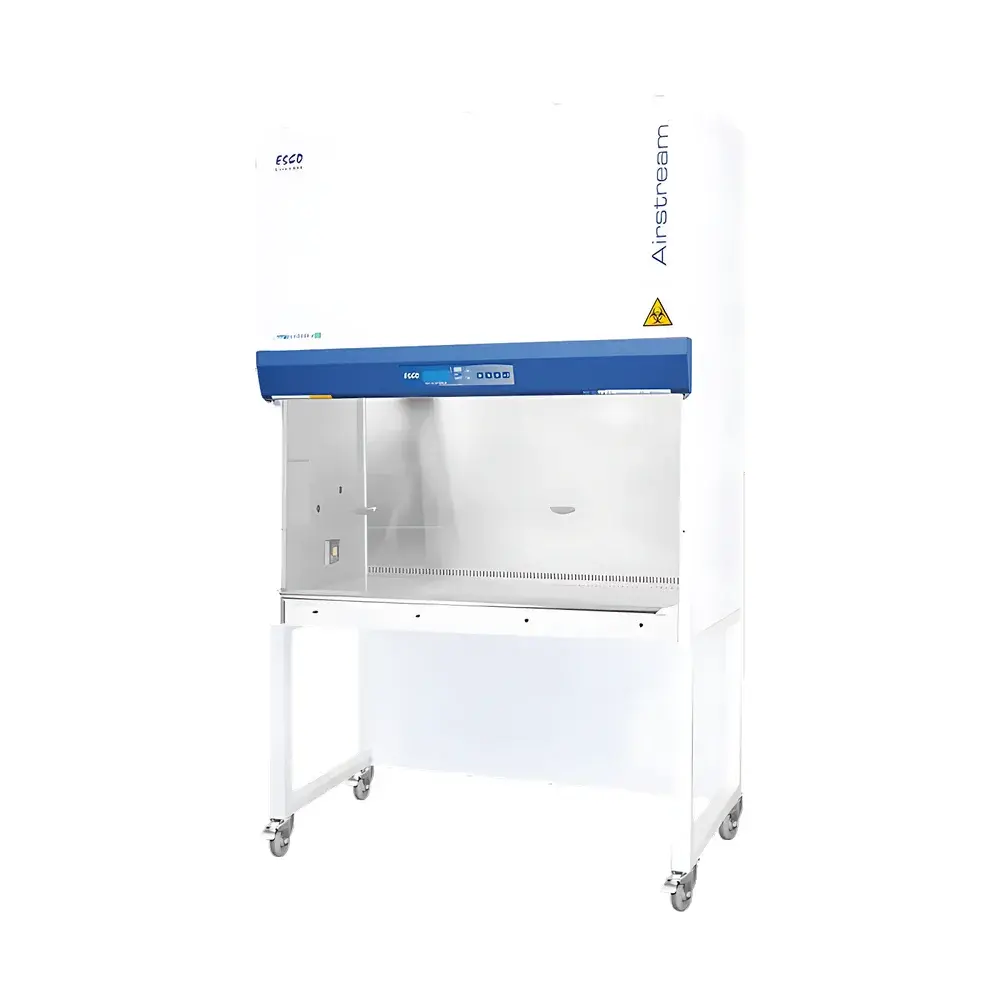
Esco Airstream® AC2-S Series Class II Type A2 Biosafety Cabinet
| Brand | Esco |
|---|---|
| Origin | Singapore |
| Certification | EN 12469, IEST-RP-CC001, ISO 5 (Class 100) |
| Filter Efficiency | ULPA ≥99.995% @ 0.1 µm, ≥99% @ 0.3 µm |
| Inflow Velocity | 0.45 m/s (90 fpm) |
| Downflow Velocity | 0.30 m/s (60 fpm) |
| Power Supply | 220 V, 50 Hz |
| Construction | Stainless Steel Work Surface, ISOCIDE® Antimicrobial Coating |
| Control System | Sentinel Gold™ Microprocessor-Based Display |
| Connectivity | RS-232 Interface for BMS Integration |
| Noise Level | ≤65 dB(A) |
| Compliance | Meets NSF/ANSI 49, EN 12469, and EU Directive 2014/34/EU (ATEX) for optional UV configurations |
Overview
The Esco Airstream® AC2-S Series Class II Type A2 Biosafety Cabinet is an engineered containment solution designed to protect personnel, products, and the environment during microbiological, pharmaceutical, and molecular biology procedures. Operating on the principle of laminar airflow with recirculation and exhaust via dual ULPA filtration, the cabinet maintains a continuous inward inflow at 0.45 m/s across the work opening—ensuring operator protection—and a downward vertical downflow at 0.30 m/s over the work surface—preserving sample sterility. Approximately 70% of the air is recirculated after passing through a ULPA filter, while the remaining 30% is exhausted externally via a dedicated ducted system or thimble connection. This configuration complies strictly with NSF/ANSI 49 and EN 12469 standards for Type A2 cabinets and supports applications requiring low-risk biological agents (BSL-1 to BSL-2), including cell culture, reagent preparation, and non-aerosol-generating manipulations involving low-to-moderate risk pathogens.
Key Features
- ULPA filtration system certified to retain ≥99.995% of particles ≥0.1 µm and ≥99% of particles ≥0.3 µm—exceeding HEPA H14 performance per EN 1822
- Sentinel Gold™ microprocessor-based control panel with large-format LCD display showing real-time inflow/downflow velocities, filter life status, UV exposure time, alarm history, and system diagnostics
- Energy-efficient DC ECM motor delivering stable airflow across 190–250 V input range with automatic voltage compensation—reducing power consumption by up to 70% versus conventional AC motors
- ISOCIDE® antimicrobial coating applied to all exposed external and internal surfaces—including side panels, front grille, and sash frame—to inhibit microbial colonization and support routine decontamination protocols
- Monolithic stainless steel shallow-dish work surface with seamless welds and coved corners, minimizing crevices where contaminants may accumulate
- Ergonomic design elements: full-length hand rest bar positioned above the work surface to prevent airflow obstruction; sloped front grille to reduce turbulence; acoustic damping materials limiting operational noise to ≤65 dB(A)
- Integrated airflow sensors continuously monitor inflow and downflow velocities, triggering audible/visual alarms and automatic sash lock if parameters deviate beyond ±10% of setpoints
Sample Compatibility & Compliance
The AC2-S Series accommodates standard laboratory workflows involving open vessels, pipettes, centrifuge tubes, Petri dishes, and tissue culture flasks. Its ISO 5 (Class 100) certified work area ensures particulate-free conditions suitable for aseptic processing of sensitive biological materials. The cabinet is validated for use with volatile organic compounds (VOCs) at concentrations below 5% of their lower explosive limit (LEL), provided proper exhaust ducting is installed. All models comply with international safety and performance standards including EN 12469:2000, NSF/ANSI 49-2022, IEST-RP-CC001.10, and EU Regulation (EU) 2016/425 for PPE integration where applicable. Optional UV germicidal irradiation (253.7 nm) is available with programmable timers to ensure consistent dosimetry while preserving lamp longevity—validated per ISO 15714 for UV dose delivery.
Software & Data Management
The Sentinel Gold™ control system logs operational data—including runtime hours, filter usage, airflow deviations, alarm events, and UV cycle counts—with timestamped entries stored in non-volatile memory. RS-232 serial output enables bidirectional communication with Building Management Systems (BMS) or Laboratory Information Management Systems (LIMS) for centralized monitoring and audit trail generation. Data export supports CSV format for offline analysis. While not inherently 21 CFR Part 11 compliant, the system can be integrated into validated environments when paired with electronic signature-enabled LIMS platforms and configured with user-access controls, change logs, and backup protocols aligned with GLP/GMP documentation requirements.
Applications
- Aseptic handling of mammalian and insect cell cultures in academic and contract research laboratories
- Preparation of sterile media, buffers, and diagnostic reagents under ISO 5 cleanroom-equivalent conditions
- Handling of genetically modified organisms (GMOs) classified under Risk Group 1 and 2 per WHO guidelines
- Pharmaceutical quality control testing, including sterility assay setup and environmental monitoring sample processing
- Vaccine development workflows involving viral vector propagation and purification steps
- Support of Good Manufacturing Practice (GMP)-aligned processes when installed in classified cleanroom suites (ISO 7 or better)
FAQ
Does the AC2-S Series require external ducting for safe operation?
Yes—Type A2 biosafety cabinets must be connected to a dedicated exhaust system or thimble vent to safely remove contaminated air. Recirculation alone is insufficient for operations involving volatile chemicals or infectious aerosols.
Can this cabinet be used for work with radioactive isotopes?
No—Type A2 cabinets are not designed for radionuclide handling. For such applications, a Type B2 total-exhaust cabinet or a dedicated fume hood with appropriate shielding and monitoring is required.
What maintenance intervals are recommended for ULPA filters?
ULPA filters should be integrity-tested annually per EN 1822 or at commissioning, after filter replacement, or following any physical impact to the cabinet. Replacement frequency depends on usage intensity and ambient air quality but typically ranges from 3 to 5 years.
Is the ISOCIDE® coating EPA-registered?
ISOCIDE® is registered under U.S. EPA FIFRA as a supplemental antimicrobial treatment (EPA Reg. No. 82311-1) and is effective against common Gram-positive and Gram-negative bacteria, yeasts, and molds on treated surfaces.
Can the cabinet be validated for ISO 5 classification?
Yes—the entire work area is certified to ISO 14644-1 Class 5 (≤3,520 particles/m³ ≥0.5 µm) at time of factory certification. Site-specific revalidation per ISO 14644-3 is recommended after installation, relocation, or major service interventions.



