
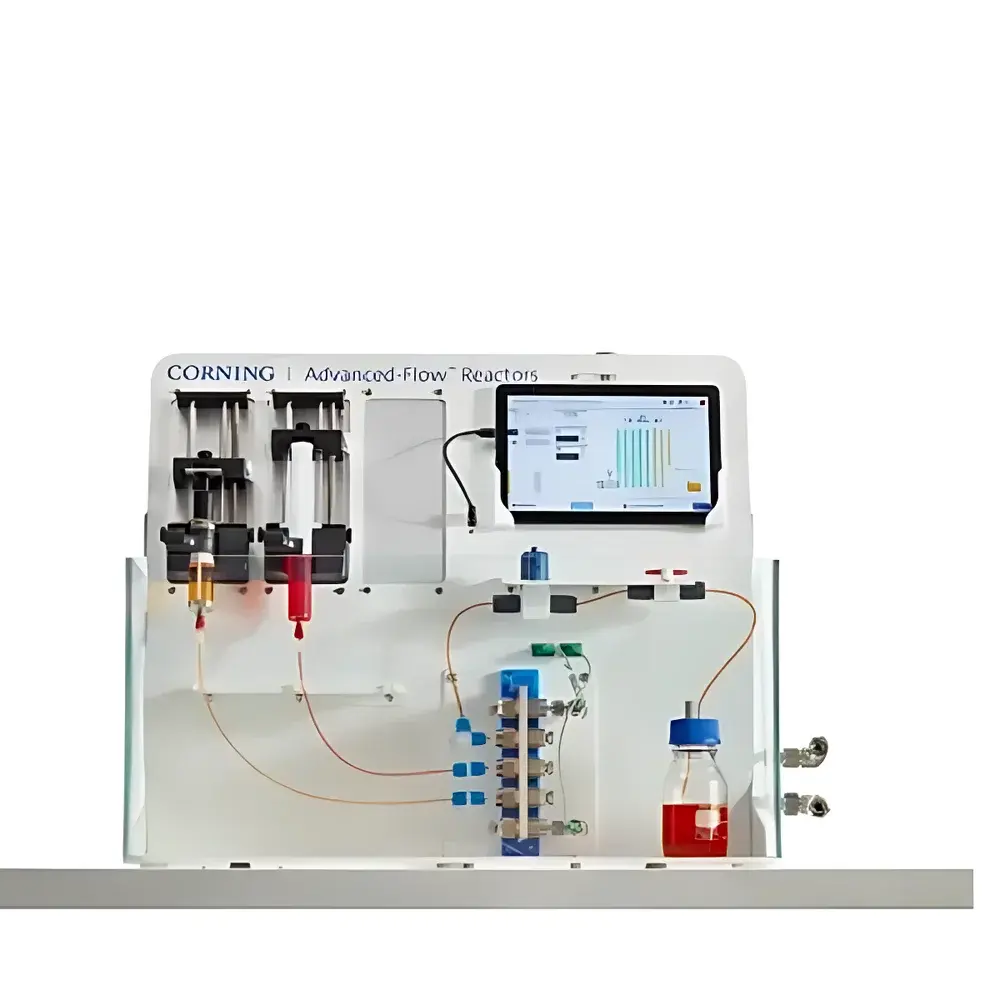
Corning Nebula™ Teaching Platform Reactor
| Brand | Corning |
|---|---|
| Origin | USA |
| Model | Nebula™ |
| Category | Flow Chemistry Equipment |
| Construction Material | Corning Specialty Glass |
| Channel Geometry | Patented Heart-Shaped Microchannels |
| Control Interface | Touchscreen + Wireless Connectivity |
| Scalability | Seamless Scale-Up Pathway |
| Application Focus | Undergraduate & Graduate Chemical Engineering Education, Flow Synthesis Pedagogy |
| Compliance Context | Designed for GLP-aligned lab instruction and ISO/IEC 17025–compatible teaching environments |
Overview
The Corning Nebula™ Teaching Platform Reactor is a purpose-built, benchtop flow chemistry system engineered to bridge fundamental chemical kinetics and unit operations education with modern process intensification principles. Operating on continuous-flow microreactor technology, it leverages laminar flow dynamics within precisely fabricated heart-shaped microchannels—designed using Corning’s proprietary glass microfabrication process—to deliver reproducible residence time distribution (RTD), enhanced radial mixing, and exceptional thermal management. Unlike conventional batch reactors used in undergraduate laboratories, the Nebula™ platform enables real-time observation of reaction progression, immediate parameter modulation (e.g., flow rate, temperature, reagent stoichiometry), and direct correlation between hydrodynamic behavior and chemical outcome. Its architecture supports both chemistry-focused curricula (emphasizing reaction mechanism exploration and selectivity control) and chemical engineering–focused modules (covering mass/heat transfer analysis, residence time distribution characterization, and scale-up logic). The system is not intended for industrial production but serves as a pedagogically validated instrument for developing process understanding aligned with IChemE learning outcomes and ABET-accredited program criteria.
Key Features
- Heart-shaped microchannel geometry—patented Corning design that promotes controlled Dean vortices for improved transverse mixing without mechanical agitation
- Corning specialty glass construction—chemically inert, optically transparent (350–2500 nm), thermally stable up to 200 °C, and resistant to thermal shock and corrosion by common organic solvents and aqueous reagents
- Integrated digital interface with capacitive touchscreen—enables intuitive configuration of pump profiles, temperature setpoints, and data logging intervals; supports multi-user session management with role-based access
- Wireless operational control via secure Wi-Fi 5 (802.11ac)—facilitates remote monitoring during lab sessions and integration into campus LMS platforms (e.g., Canvas, Moodle) through API-enabled status endpoints
- Modular fluidic architecture—standardized 1/4″-28 UNF ports and Swagelok-compatible fittings allow rapid reconfiguration for serial/parallel reactor arrangements, quenching modules, or inline analytics coupling (e.g., UV-Vis flow cells)
- Scalable design philosophy—microchannel dimensions, pressure drop characteristics, and heat transfer coefficients are dimensionally consistent with Corning’s larger-scale G1 and G3 flow reactors, enabling quantitative extrapolation exercises grounded in geometric and dynamic similarity
Sample Compatibility & Compliance
The Nebula™ Teaching Platform accommodates a broad range of liquid-phase reactions, including but not limited to nucleophilic substitutions, transition-metal-catalyzed cross-couplings, photochemical transformations (when paired with optional LED irradiation modules), and exothermic oxidations. Suspensions with particle sizes <50 µm and viscosities up to 500 mPa·s are compatible under laminar flow conditions (Re < 200). All wetted components comply with USP Class VI biocompatibility standards and meet ASTM E2915-21 requirements for laboratory glassware performance. The system’s control firmware includes audit-trail functionality conforming to ALCOA+ principles, supporting documentation practices required for GLP-aligned academic research and quality-assured lab instruction. While not certified for GMP manufacturing, its architecture aligns with FDA 21 CFR Part 11 expectations for electronic records in educational settings where data integrity training is embedded in curriculum.
Software & Data Management
The Nebula™ platform runs Corning’s NebulaControl™ v3.x software—deployed locally or via virtual desktop infrastructure (VDI)—which provides synchronized acquisition of flow rate (±0.5% FS), reactor block temperature (±0.3 °C), and optional external sensor inputs (e.g., pH, conductivity, UV absorbance). Data export is natively supported in CSV, HDF5, and MATLAB .mat formats, with metadata embedding per MIAME/MIAPE conventions. Built-in curve-fitting tools enable students to model first-/second-order kinetics directly from time-resolved concentration profiles. Software logs include operator ID, timestamp, parameter changes, and system health diagnostics—retained for ≥18 months unless manually purged under institutional data governance policy. Integration with Python-based JupyterLab environments is supported via RESTful API, permitting custom algorithm development for residence time distribution deconvolution or sensitivity analysis.
Applications
- Undergraduate kinetics labs: Quantitative determination of activation energy via Arrhenius plots across 15–65 °C operating range
- Process safety education: Visualization of thermal runaway onset using calorimetric flow cells coupled to the platform
- Reaction optimization workshops: DoE-driven screening of residence time, temperature, and stoichiometry using automated gradient methods
- Transport phenomena labs: Experimental validation of Graetz number correlations and Nusselt number dependencies in non-circular channels
- Green chemistry modules: Solvent-free or low-E-factor synthesis demonstrations with integrated solvent recovery loops
- Cross-disciplinary projects: Co-taught courses linking synthetic chemistry, process control theory, and data science fundamentals
FAQ
Is the Nebula™ platform suitable for research-grade kinetic studies?
Yes—its calibrated flow control, traceable temperature uniformity, and optical accessibility support publication-ready kinetic modeling when operated within specified Reynolds and Graetz number regimes.
Can third-party pumps or sensors be integrated?
Yes—the system features analog (0–10 V) and digital (RS-485, Modbus RTU) I/O ports, and its open communication protocol allows interoperability with major OEM peristaltic and syringe pumps, as well as industry-standard analytical sensors.
What maintenance is required for long-term academic deployment?
Annual calibration verification of flow sensors and temperature probes is recommended; glass microchannel chips are consumables with typical service life exceeding 500 operational hours under standard organic synthesis conditions.
Does Corning provide curriculum materials or instructor training?
Yes—registered academic institutions receive access to the Nebula™ Educator Portal, including 12 ready-to-deploy lab modules, safety protocols, grading rubrics, and quarterly virtual faculty development workshops led by Corning Applications Scientists.



