
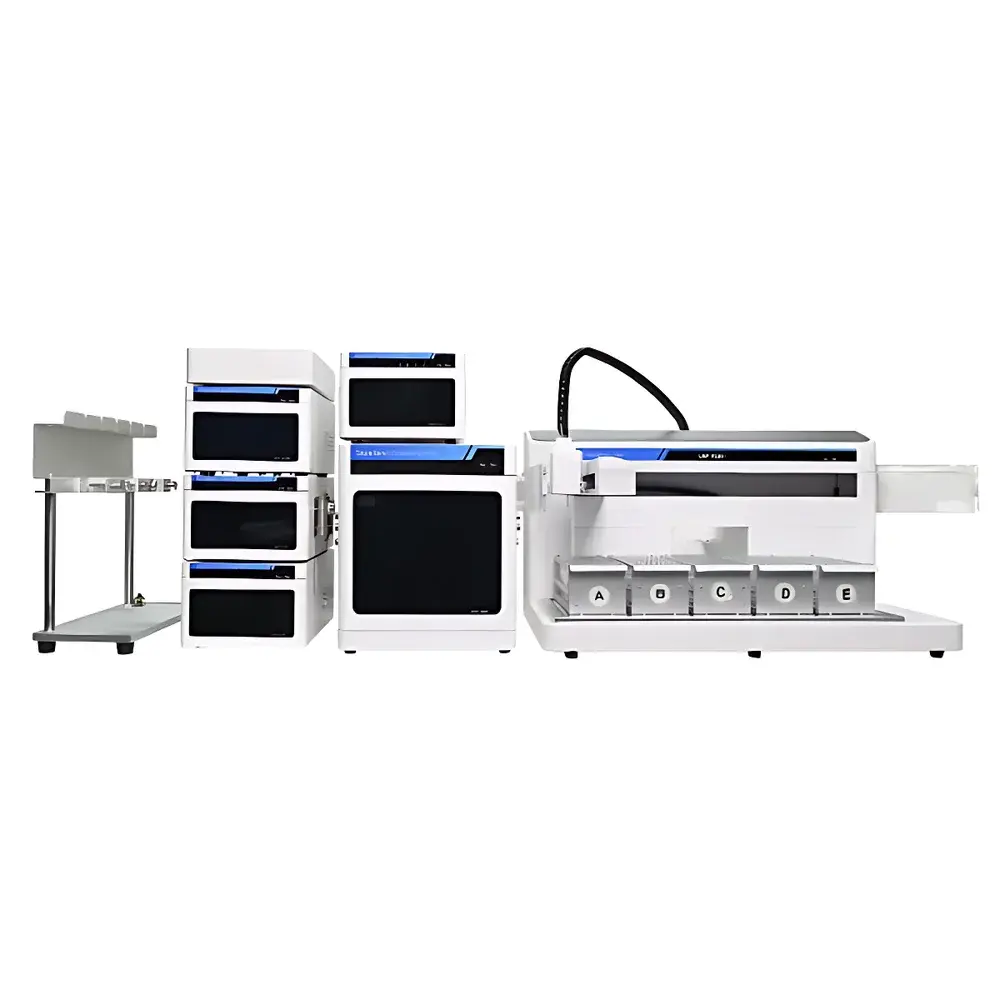
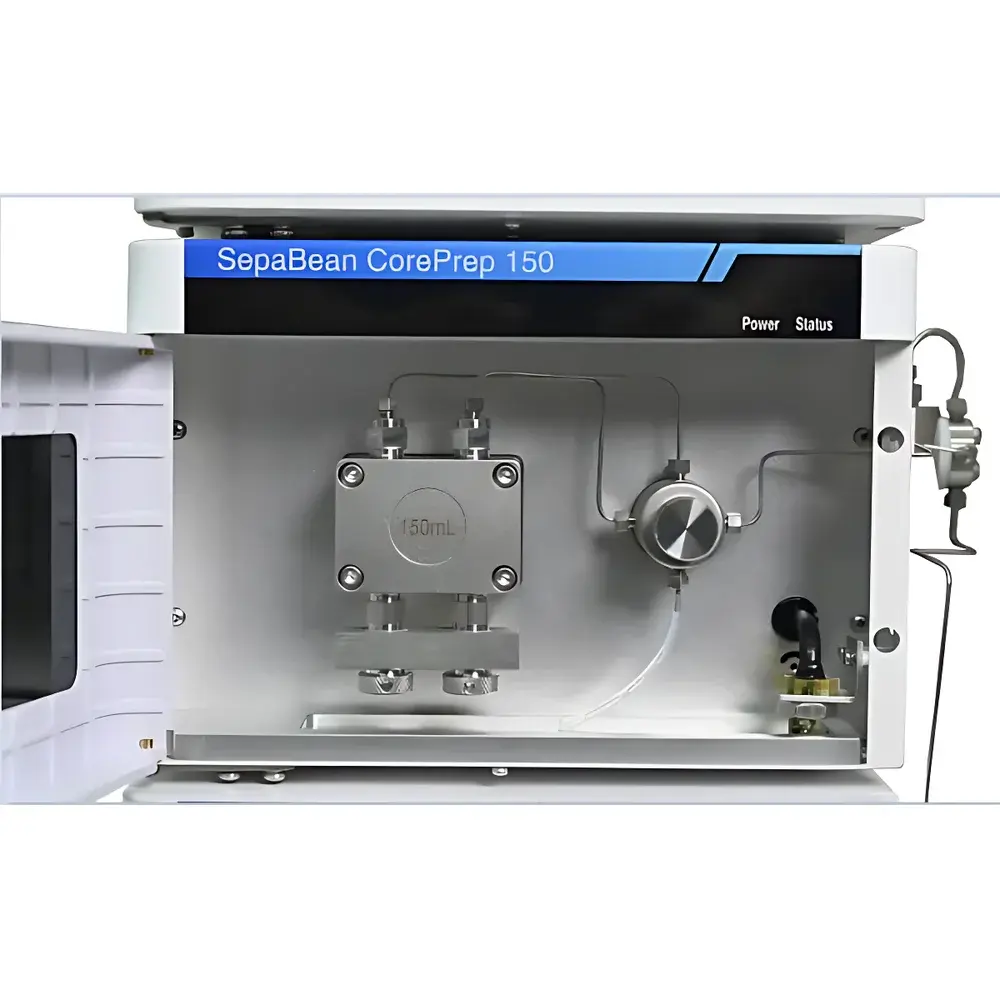
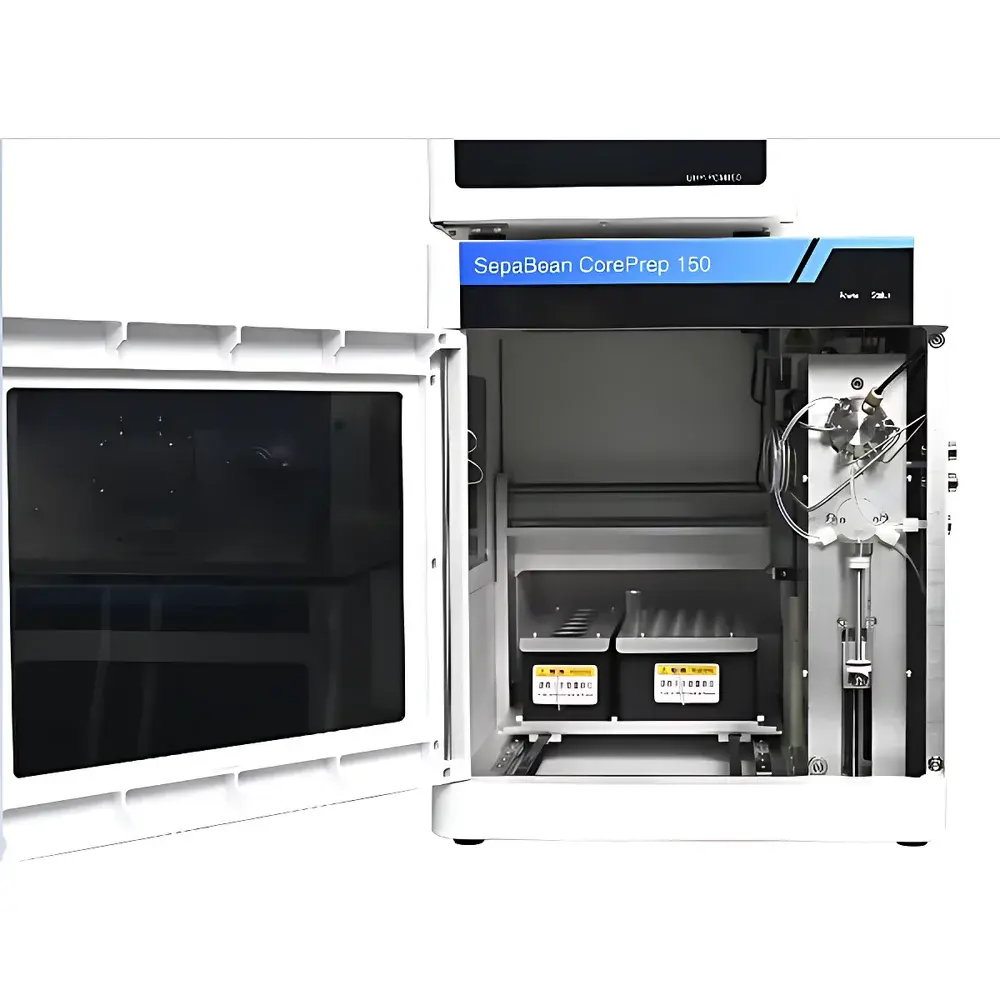
SepaBean CorePrep 150 Ultra-High-Pressure Preparative Liquid Chromatography System
| Brand | Santai |
|---|---|
| Origin | Jiangsu, China |
| Manufacturer Type | OEM Manufacturer |
| Instrument Type | Ultra-High-Performance Preparative LC System |
| Flow Rate Range | 1–150 mL/min |
| Maximum Operating Pressure | 40 MPa |
| Flow Accuracy | ±1% |
| Injection Volume Range | 100 µL–5 mL |
| Sample Tray Capacity | 112 × 5 mL, 72 × 9 mL, 50 × 15 mL, 6 × 40 mL |
| UV-Vis Wavelength Range | 200–800 nm |
Overview
The SepaBean CorePrep 150 is an ultra-high-pressure preparative liquid chromatography (Prep-LC) system engineered for robust, scalable, and reproducible purification of small molecules, natural products, peptides, and synthetic intermediates. Unlike analytical HPLC platforms, the CorePrep 150 operates under sustained pressures up to 40 MPa (5,800 psi), enabling high-resolution separations on sub-10 µm particle-packed columns at flow rates spanning 0.01–149.99 mL/min. Its dual-piston parallel pump architecture—featuring floating high-pressure seal cartridges, integrated plunger wash channels, and precision-machined 316L stainless-steel pump heads—ensures long-term pressure stability and minimal pulsation (±0.5 MPa). The system implements a servo-motor-driven cam mechanism with two-stage gear reduction to deliver enhanced torque and consistent gradient formation (gradient error ≤1.5%), critical for method transfer from analytical to preparative scale. All fluidic pathways comply with ISO 8573-1 Class 3 compressed air standards for solvent compatibility and are constructed from chemically inert, pressure-rated 1/16″ stainless-steel tubing.
Key Features
- Dual-plunger parallel pumping system with 700 µL single-stroke displacement and real-time pressure feedback control
- Floating high-pressure seal cartridge design reduces radial load on seals, extending service life by >3× versus fixed-bore alternatives
- Integrated plunger backwash channel enables in-situ removal of crystallized buffer salts without pump head disassembly
- Ball-bearing linear motion guide replaces conventional polymer slide rails, eliminating cam-induced tangential force drift at elevated pressures
- Modular high-pressure autosampler (UHP-AS01) with X-Y-Z robotic arm, 310 µL dead volume, and <0.01% carryover across all injection volumes
- Three interchangeable sample trays: 112-position 5 mL vial rack (10×75 mm), 72-position 9 mL rack (13×100 mm), and 50-position 15 mL rack (16×100 mm)
- Expandable injection range from 100 µL–5 mL (standard) to 100 µL–20 mL via optional large-volume syringe module
- UV-Vis detector with 200–800 nm spectral range, 10 nm bandwidth, and dual-wavelength simultaneous monitoring capability
Sample Compatibility & Compliance
The CorePrep 150 accommodates a broad spectrum of sample matrices—including crude reaction mixtures, fermentation broths, plant extracts, and peptide digests—without requiring extensive pre-filtration. Its high-flow, low-dwell-volume fluidics support rapid column equilibration and efficient gradient elution across C18, phenyl-hexyl, cyano, and HILIC stationary phases. The system meets mechanical and electrical safety requirements per IEC 61010-1:2010 and carries CE marking for laboratory equipment. All firmware and software modules adhere to ALCOA+ data integrity principles; audit trails, electronic signatures, and user-access controls are configurable to align with FDA 21 CFR Part 11 and EU Annex 11 expectations. Routine operation supports GLP-compliant method validation per ICH Q2(R2), including linearity, accuracy, precision, and robustness assessments across defined flow and pressure ranges.
Software & Data Management
Control and acquisition are managed through SepaBean ChromoLink v3.2, a Windows-based platform supporting both isocratic and multi-step gradient methods with real-time pressure/flow/UV trace overlay. Method files include embedded calibration coefficients for each pump and detector channel, ensuring traceable instrument performance. Raw data are stored in vendor-neutral .CDF format compliant with ASTM E1947-22 for chromatographic data exchange. The software integrates with LIMS via OPC UA and supports automated report generation (PDF/Excel) with customizable templates for purity assessment, peak integration, and fraction collection logs. All user actions—including method edits, sequence changes, and maintenance events—are time-stamped and cryptographically signed within an immutable audit trail accessible only to authorized supervisors.
Applications
- Gram-scale purification of active pharmaceutical ingredients (APIs) under cGMP-aligned workflows
- Isolation of bioactive natural compounds from complex botanical matrices with minimal degradation
- Parallel purification of combinatorial library members using time-triggered fraction collection
- Method development for chiral separations on polysaccharide-based columns at 30–50 mL/min flow rates
- Desalting and buffer exchange of oligonucleotides prior to lyophilization or formulation
- Process analytical technology (PAT) integration for continuous downstream processing via analog output triggers
FAQ
What is the maximum column backpressure the system can sustain during extended operation?
The CorePrep 150 maintains stable operation at up to 40 MPa continuously, verified per ISO 20487:2020 hydraulic endurance testing protocols.
Can the autosampler accommodate non-standard vial formats?
Yes—the UHP-AS01 supports custom tray configurations via user-defined coordinate mapping; third-party vials with O-ring-sealed crimp caps are compatible when mounted on adapter sleeves.
Is gradient delay volume compensated during method scaling?
Yes—ChromoLink v3.2 includes automatic dwell volume measurement and correction routines that adjust gradient start times based on actual system volume (measured at 1.5–3.2 mL depending on configuration).
How does the system handle high-salt mobile phases to prevent seal corrosion?
The floating seal design isolates salt crystals from direct contact with dynamic sealing surfaces; combined with the dedicated plunger wash channel using 10% methanol/water, seal lifetime exceeds 12 months under typical buffer-intensive workflows.
Does the UV detector support post-run spectral deconvolution?
Yes—the diode array module captures full 200–800 nm spectra at 10 Hz, enabling retrospective peak purity analysis and co-elution resolution using multivariate curve resolution (MCR) algorithms embedded in the software suite.
Related Products



