
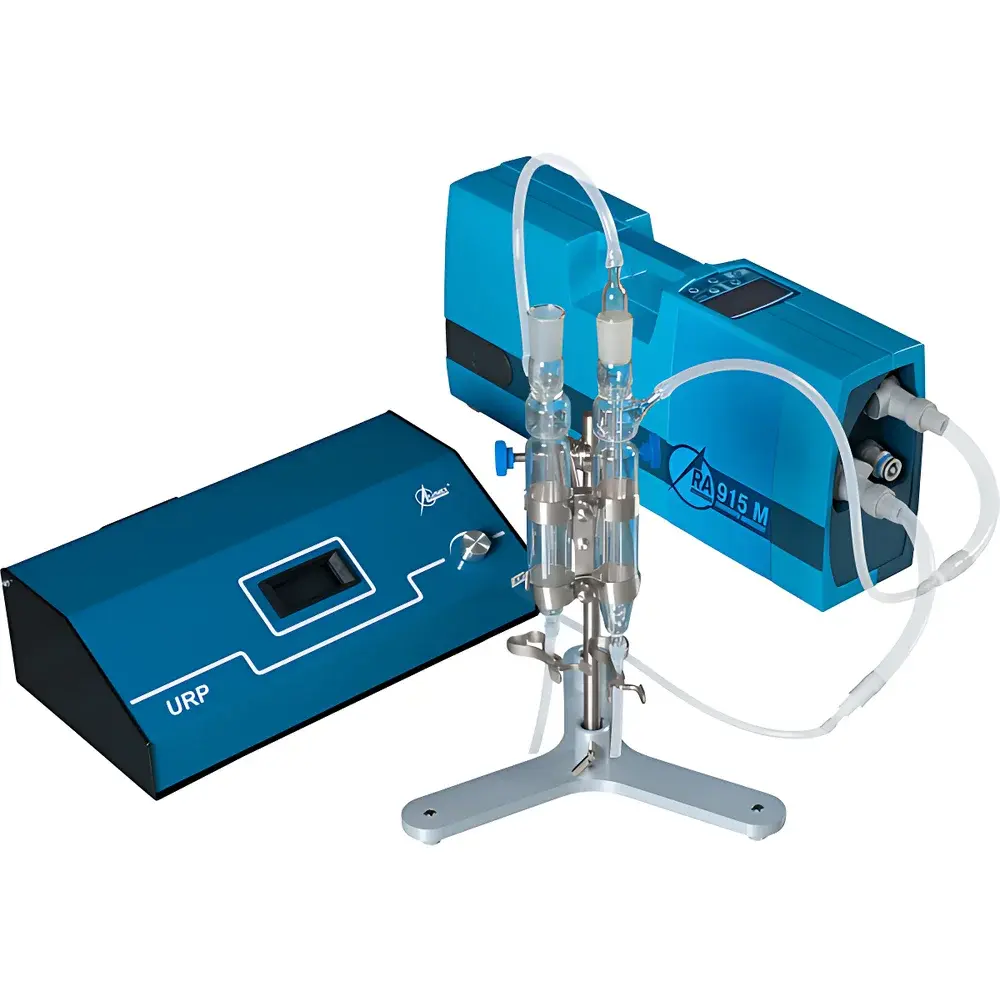
LUMEX UMA Portable Mercury Analysis Unit for Solid, Liquid and Gas Samples
| Brand | LUMEX |
|---|---|
| Origin | Canada |
| Model | UMA |
| Instrument Type | Portable Mercury Analyzer |
| Principle | Cold Vapor Atomic Absorption Spectrometry (CVAAS) with Zeeman Background Correction |
| Detection Limit | 1 ppb |
| Repeatability | <1% RSD |
| Linearity Error | ±1% |
| Sample Throughput | Solid/Liquid analysis completed in ≤60 s |
| Gas Response Time | 1 s |
| Dynamic Range | 6 orders of magnitude |
| Power Supply | 100–240 VAC, 50/60 Hz or internal battery (8 h continuous operation) |
| Dimensions (Control Unit) | 400 × 280 × 135 mm |
| Dimensions (Thermal Decomposer Module) | 430 × 340 × 135 mm |
| Weight | 17.5 kg |
| Air Pump Flow Rate | 0.8–4.2 L/min |
| Liquid Sample Volume (CV Mode) | 0.5–20 mL |
| Solid Sample Mass (Thermal Decomposition) | 5–300 mg |
Overview
The LUMEX UMA Portable Mercury Analysis Unit is a field-deployable, modular analytical system engineered for rapid, on-site quantification of total mercury in solid, liquid, and gaseous matrices. It operates as a sample introduction and pre-treatment module designed exclusively for integration with the LUMEX RA-915M mercury analyzer — a benchtop or portable Zeeman-effect atomic absorption spectrometer. The UMA implements two orthogonal sample introduction pathways: (1) cold vapor generation (CV) for aqueous and liquid samples via sodium borohydride reduction, and (2) thermal decomposition (TD) for solids, sediments, biological tissues, and filter media. Both methods convert matrix-bound mercury into elemental mercury vapor (Hg⁰), which is then swept by ambient air (no external carrier gas required) into the RA-915M’s optical cell. Detection relies on high-frequency modulated polarized light and Zeeman background correction at the 253.7 nm resonance line, enabling selective, interference-free measurement of ground-state Hg atoms. This architecture eliminates spectral overlap from molecular absorbers and scattering particles — critical for complex environmental and biological matrices.
Key Features
- Modular, lightweight design (17.5 kg total) optimized for field deployment, emergency response, mobile labs, and fixed-site monitoring.
- No chemical reagents, gold traps, or consumable cartridges required — direct injection of untreated samples reduces cross-contamination risk and operational cost.
- Simultaneous support for EPA Method 1631 (water), EN 1483 & 13806 (sludge/water), GB 7468-87 (water), and EPA Method 7473 (solids) compliance through validated CV and TD protocols.
- Integrated air pump with adjustable flow (0.8–4.2 L/min) using ambient air as carrier gas — no compressed gas cylinders or external supply infrastructure needed.
- Onboard data logging capacity for up to 122 hours of continuous measurements, with timestamped results stored internally and exportable via USB.
- Dual power options: universal AC input (100–240 VAC) or rechargeable internal battery supporting 8 hours of uninterrupted operation.
- Automated calibration verification sequence embedded in firmware to ensure long-term signal stability and traceability between analyses.
Sample Compatibility & Compliance
The UMA accommodates heterogeneous environmental and occupational health samples without digestion, extraction, or derivatization. Liquid analysis covers water, wastewater, urine, blood plasma, and leachates (0.5–20 mL volume range). Solid analysis includes soils, sediments, sludges, plant tissue, hair, and industrial dusts (5–300 mg mass range). Gaseous mercury is measured in real time via direct air sampling at 1-second response latency. All operational protocols align with internationally recognized regulatory frameworks: U.S. EPA Methods 1631 (mercury in water), 7473 (total mercury in solids), ISO 12846:2012 (mercury in water and soil), ASTM D6722-22 (total mercury in coal), and EU Directive 2009/90/EC (water quality). Data integrity meets GLP and GMP requirements; audit trails, user authentication, and electronic signatures are supported when paired with RA-915M firmware compliant with FDA 21 CFR Part 11.
Software & Data Management
The UMA operates under the LUMEX Mercury Software Suite v5.x, providing instrument control, method configuration, real-time signal visualization, and automated report generation. Raw absorbance traces, peak integration parameters, and calibration curves are archived in secure binary format with metadata tagging (operator ID, GPS coordinates if enabled, environmental conditions). Export options include CSV, PDF, and XML formats compatible with LIMS environments. Firmware updates are delivered via encrypted USB stick or authenticated cloud interface. All data handling conforms to ISO/IEC 17025:2017 clause 7.5 (control of records) and supports full traceability from raw signal to final concentration value.
Applications
- Environmental monitoring: rapid screening of contaminated soils, river sediments, landfill leachate, and atmospheric mercury deposition.
- Industrial hygiene: workplace air monitoring near chlor-alkali plants, coal-fired power stations, dental clinics, and fluorescent lamp recycling facilities.
- Public health surveillance: biomonitoring of mercury exposure via urine, whole blood, and hair specimens in epidemiological studies.
- Regulatory compliance: field verification of remediation endpoints, wastewater discharge limits, and hazardous waste characterization per RCRA and Basel Convention guidelines.
- Emergency response: on-scene assessment following mercury spills, broken thermometers, or industrial accidents where immediate decision-making is required.
FAQ
Does the UMA require external carrier gas or compressed air?
No. The integrated air pump draws and conditions ambient air as the sole carrier gas — eliminating dependency on gas cylinders or compressors.
Can the UMA analyze mercury in drinking water at sub-part-per-trillion levels?
The system achieves a 1 ppb detection limit under standard operating conditions. For ultratrace water analysis (<10 ppt), optional pre-concentration modules (e.g., gold trap enrichment) may be interfaced externally.
Is method validation documentation available for regulatory submissions?
Yes. LUMEX provides IQ/OQ/PQ protocols, method validation reports per ISO/IEC 17025, and application notes demonstrating performance against EPA, ISO, and EN standards.
How is calibration maintained during extended field use?
The UMA supports automated zero and span checks using onboard mercury vapor sources; calibration stability is verified every 24 hours or per user-defined interval.
What maintenance is required for the thermal decomposer module?
The quartz decomposition tube is designed for >10,000 cycles; routine cleaning involves ethanol rinse and air purge. No consumable parts require scheduled replacement within first 2 years of normal use.




