
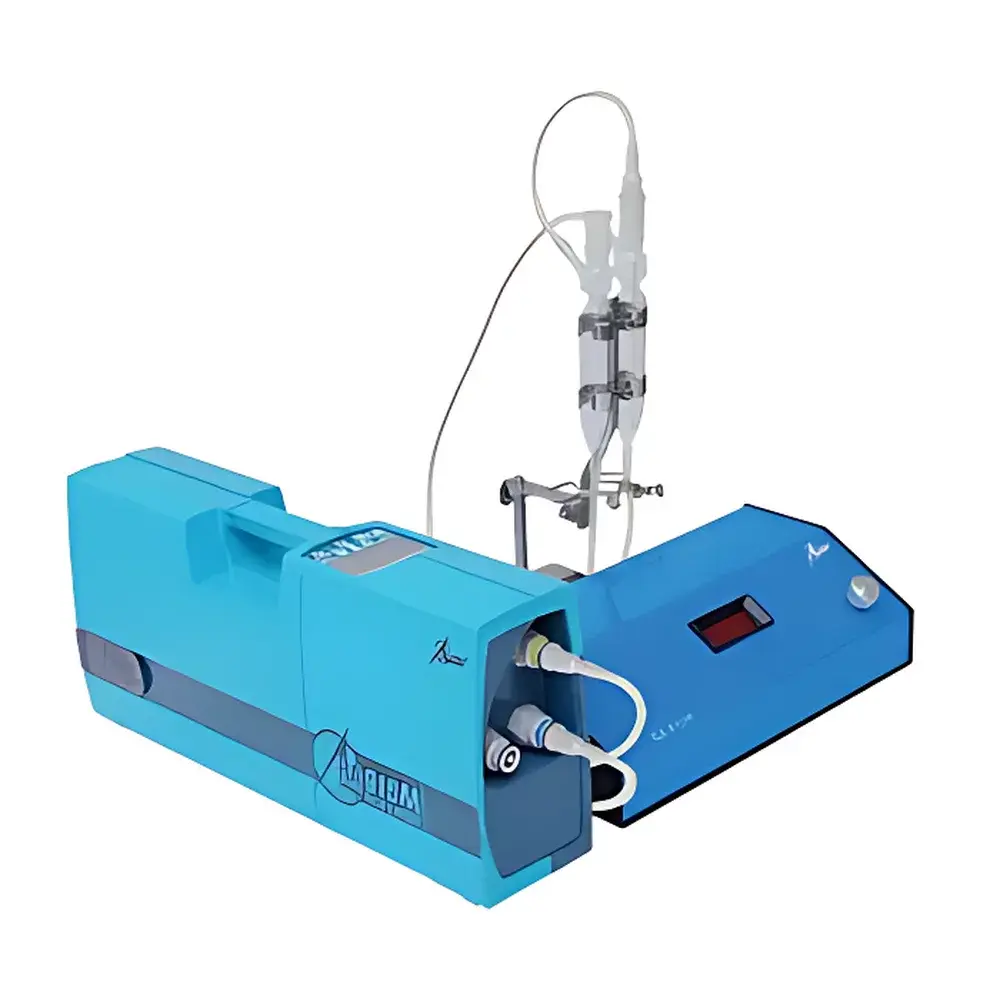
LUMEX RP-92 Liquid Mercury Reduction Unit
| Brand | LUMEX |
|---|---|
| Origin | Canada |
| Model | RP-92 Liquid Mercury |
| Instrument Type | Portable |
| Measurement Principle | Cold Vapor Atomic Absorption Spectrometry (CVAAS) |
| Sample Volume | 0.5–20 mL |
| Air Pump Flow Rate | 0.8–4.2 L/min |
| Power Supply | 100–240 VAC, 50/60 Hz |
| Power Consumption | 40 W |
| Pump Unit Net Weight | 3.0 kg |
| Pump Unit Dimensions | 360 × 225 × 125 mm |
Overview
The LUMEX RP-92 Liquid Mercury Reduction Unit is a dedicated sample preparation module engineered for seamless integration with the RA-915M mercury analyzer platform. It implements cold vapor atomic absorption spectrometry (CVAAS) — a reference-grade technique standardized under EPA Method 1631, EN 1483, ISO 13806, and Ontario Ministry of the Environment’s OHM method for fixed-source emissions. The RP-92 enables quantitative mercury determination in liquid matrices by chemically reducing ionic mercury (Hg²⁺) to elemental mercury vapor (Hg⁰) using sodium borohydride or stannous chloride reagents. This vapor is then swept by a precisely regulated carrier gas stream into the RA-915M’s optical cell, where absorption at the 254 nm resonance line is measured against a calibrated reference path. Unlike gold amalgamation-based systems, the RP-92 eliminates pre-concentration steps, significantly reducing analysis time, reagent consumption, and operational cost while maintaining sub-ng/L detection capability in aqueous and biological samples.
Key Features
- Optimized for direct liquid injection without prior gold trap enrichment — lowers consumable costs and shortens turnaround time
- Adjustable sample volume range (0.5–20 mL) supports both trace-level environmental water analysis and high-concentration clinical specimens
- Integrated air pump with digitally stabilized flow control (0.8–4.2 L/min) ensures consistent vapor transport and measurement reproducibility
- Modular design allows rapid field deployment: no external gas cylinders, high-voltage power supplies, or vacuum systems required
- Compatible with single-path and multi-path quartz cells on the RA-915M host — enabling dynamic linear range extension across three orders of magnitude (ng/L to µg/L)
- Self-contained power unit (100–240 VAC, 50/60 Hz) with low thermal load (40 W) permits operation from standard lab outlets or portable inverters
- Compact footprint (360 × 225 × 125 mm) and lightweight construction (3.0 kg net) support mobile laboratories, wastewater treatment plant audits, and occupational health field surveys
Sample Compatibility & Compliance
The RP-92 is validated for direct analysis of unacidified or mildly acidified aqueous samples including drinking water, surface water, wastewater, seawater, urine, whole blood lysates, and serum. Its chemical reduction protocol meets the procedural requirements of EPA 1631 (for ambient water), EN 1483 (for sludge and sediments), and ISO 13806 (for biological fluids). When paired with RA-915M’s GLP-compliant firmware, the system supports full audit trails, electronic signatures, and 21 CFR Part 11–ready data integrity controls. Routine calibration verification requires only daily stability checks — no frequent recalibration — ensuring sustained compliance during extended monitoring campaigns.
Software & Data Management
Data acquisition and reporting are managed through LUMEX’s MercurySoft v4.x software suite, which runs on Windows-based host PCs connected via USB or RS-232. The software provides real-time spectral visualization, automatic peak integration, drift correction algorithms, and customizable report templates aligned with ISO/IEC 17025 documentation standards. All raw absorbance traces, method parameters, and operator logs are timestamped and stored in encrypted binary format. Export options include CSV, PDF, and XML for LIMS integration. Audit trail functionality records user actions, method changes, and calibration events — supporting FDA, EMA, and provincial public health authority inspections.
Applications
- Regulatory monitoring of mercury in municipal drinking water and effluent discharge points per WHO and EU Drinking Water Directive thresholds
- Occupational toxicology screening: quantification of urinary mercury in workers exposed to dental amalgams, chlor-alkali plants, or fluorescent lamp manufacturing
- Environmental forensics: source apportionment of Hg contamination in river basins using spatially resolved field measurements
- Process validation in activated carbon or sulfur-impregnated adsorbent systems — tracking breakthrough curves and sorbent saturation levels
- Clinical research: longitudinal studies of methylmercury bioaccumulation in maternal blood and cord serum
- Emergency response: rapid assessment of mercury spills in hospitals, laboratories, or industrial facilities without laboratory backhaul
FAQ
Does the RP-92 require gold-coated traps or pre-concentration steps?
No — the RP-92 uses direct hydride generation and cold vapor transfer, eliminating reliance on gold traps and associated regeneration protocols.
Can it analyze solid samples such as hair or soil?
Not directly; solid matrices require prior acid digestion (e.g., EPA 7473) to liberate mercury into solution before RP-92 injection.
Is the air pump flow rate adjustable during analysis?
Yes — flow is digitally controlled and programmable within the MercurySoft interface to optimize signal-to-noise for varying sample matrices.
What maintenance intervals are recommended for field use?
Daily visual inspection of reagent lines and pump tubing; quarterly replacement of gas filter and reaction coil; annual verification of flow sensor accuracy per ISO 8573-1.
Is the RP-92 compatible with third-party CVAAS analyzers?
It is mechanically and pneumatically optimized for RA-915M integration; interoperability with other platforms requires custom interface validation and is not supported under warranty.
Related Products






