
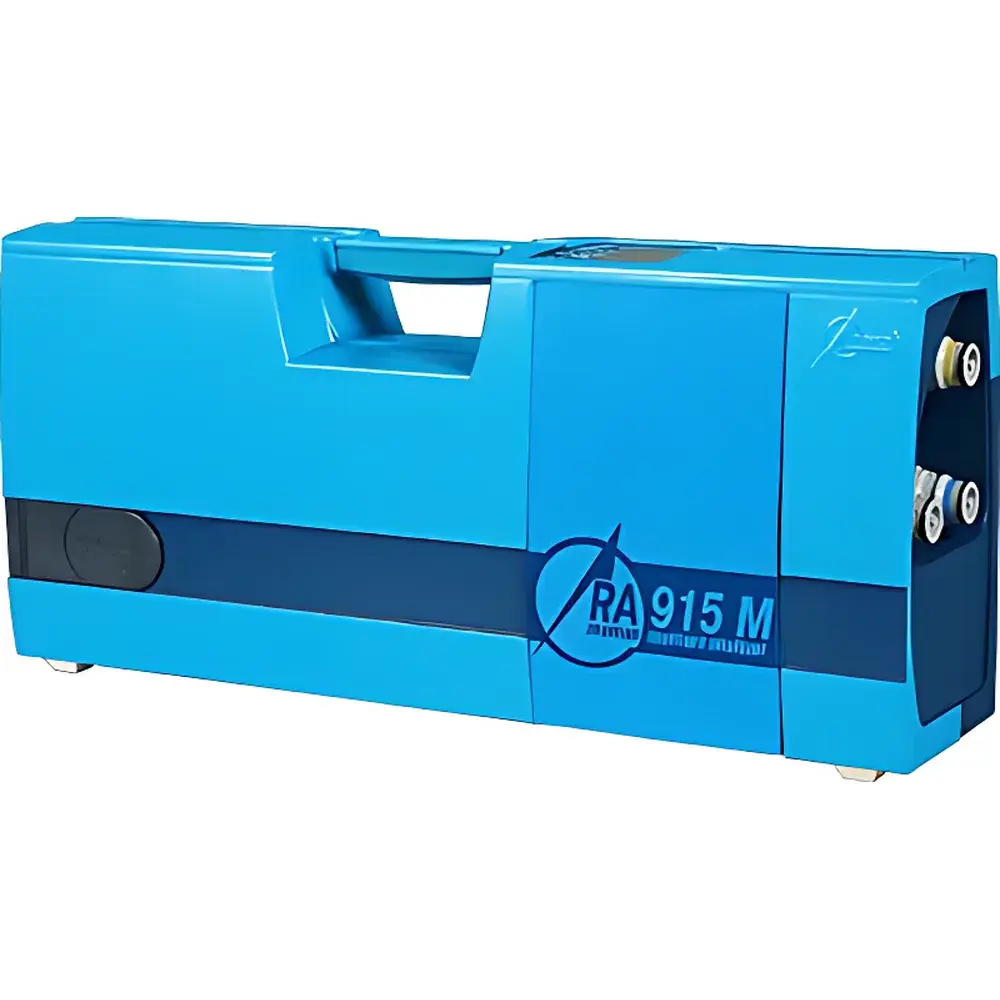
LUMEX RA-915M Portable Mercury Analyzer
| Brand | LUMEX |
|---|---|
| Origin | Canada |
| Model | RA-915M Series |
| Instrument Type | Portable |
| Principle | Zeeman Atomic Absorption Spectrometry with High-Frequency Modulation (ZAAS-HFM) |
| Detection Limit | 0.5 ng/m³ (10 s), 2 ng/m³ (1 s) |
| Repeatability | <2% RSD |
| Linearity Error | ±5% |
| Measurement Range | 0.5–200,000 ng/m³ |
| Zero Signal SD | <2 ng/m³ |
| 5-min Zero Drift | <2 ng/m³ |
| Warm-up Time | <20 min |
| Air Pump Flow Rate | >10 L/min |
| Power Supply | Internal 12 V DC battery (8 h continuous operation) or 110/220 V AC, 50/60 Hz |
| Dimensions | 460 × 110 × 220 mm |
| Weight | 7 kg |
| Power Consumption | 40 W |
| Compliance | EPA Method 1631, EPA SW-846 7473 & 30B, ASTM D7622-10, EN 1483 / 13806 / 15852, GB 7468-87 |
Overview
The LUMEX RA-915M Portable Mercury Analyzer is a field-deployable, direct-reading instrument engineered for real-time, quantitative mercury (Hg⁰) analysis in gaseous, liquid, and solid matrices. It employs Zeeman Atomic Absorption Spectrometry with High-Frequency Modulation (ZAAS-HFM), a physically robust variant of cold vapor atomic absorption spectroscopy (CVAAS). Unlike conventional CVAAS systems requiring gold amalgamation preconcentration, the RA-915M measures elemental mercury vapor directly via its resonant absorption at 254 nm, using polarization-modulated light and magnetic-field-induced spectral splitting to eliminate broadband and structured background interference. This enables trace-level detection without chemical reagents, carrier gases, or consumables—critical for rapid response in environmental emergencies, occupational hygiene assessments, and regulatory compliance monitoring.
Key Features
- Direct, reagent-free mercury quantification across gas, liquid, and solid phases—no sample digestion, derivatization, or gold trap regeneration required.
- Ultra-low detection limit of 0.5 ng/m³ (10-second integration), with sub-second response time (2 ng/m³ at 1 s) for dynamic plume tracking and leak localization.
- Modular accessory architecture: integrated thermal decomposition unit for solids (EPA Method 7473-compliant), hydride generation module for aqueous samples (EPA Method 1631), and high-flow gas sampling manifold for ambient air or stack emissions.
- Onboard data logging supporting up to 122 hours of timestamped concentration records with automatic zero calibration and drift compensation.
- Self-contained operation powered by internal 12 V DC battery (8 h runtime) or vehicle/AC mains; ruggedized chassis rated for field use (IP54 equivalent).
- Full compliance with international method standards including EPA SW-846, ASTM D7622-10, EN 1483, EN 13806, EU 15852, and GB 7468-87—enabling auditable, defensible data for regulatory reporting.
Sample Compatibility & Compliance
The RA-915M supports heterogeneous sample types without matrix-specific hardware modification. Gaseous mercury is measured in-line via calibrated flow-through cell; liquid samples (e.g., wastewater, biological fluids) undergo sodium borohydride reduction in the optional liquid module; solid and semi-solid matrices (soil, sediment, coal fly ash, pharmaceuticals, cosmetics) are thermally decomposed at 800–900 °C in the solid-phase module, releasing Hg⁰ for direct ZAAS detection. All operational protocols align with GLP/GMP documentation requirements, and raw data files include full audit trails (operator ID, calibration timestamps, system diagnostics). The instrument meets FDA 21 CFR Part 11 readiness when paired with validated LUMEX DataSuite software, enabling electronic signatures and secure data archiving.
Software & Data Management
The embedded firmware provides real-time concentration display, auto-ranging, and configurable alarm thresholds. Optional LUMEX DataSuite v4.x (Windows-based) enables advanced post-processing: spectral deconvolution, multi-point calibration curve fitting, EPA-compliant report generation (including Method 30B adsorption tube validation), and export to CSV, XML, or LIMS-compatible formats. All measurements retain full metadata—ambient temperature, pressure, flow rate, lamp intensity, and Zeeman modulation parameters—for traceability. Data encryption, user role management (admin/operator/auditor), and automated backup to external USB storage ensure integrity during extended field campaigns.
Applications
- Regulatory Emissions Monitoring: Continuous Hg monitoring in coal-fired power plant flue gas (EPA Method 30B), wastewater discharge points, and hazardous waste incinerators.
- Environmental Emergency Response: Rapid source identification during mercury spills, industrial accidents, or illegal mining activities—deployable within 90 seconds of power-on.
- Occupational & Indoor Air Quality: Real-time assessment of Hg vapor in dental clinics, chlor-alkali plants, and laboratory facilities per OSHA PEL and ACGIH TLV guidelines.
- Geochemical & Seismological Research: High-frequency soil gas and groundwater Hg flux measurements along fault lines for precursory anomaly detection.
- Product Safety Screening: Direct screening of consumer goods (cosmetics, batteries, seafood) and pharmaceutical intermediates without acid digestion.
FAQ
Does the RA-915M require carrier gas or gold traps for routine operation?
No. The ZAAS-HFM optical path eliminates dependence on inert carrier gases or amalgamation cartridges—reducing operational cost and complexity.
Can it quantify mercury in complex biological matrices like blood or urine?
Yes, when used with the thermal decomposition module and certified reference materials (CRMs), it achieves accuracy compliant with ISO 17025-accredited laboratories for clinical toxicology applications.
Is calibration traceable to NIST standards?
Yes. Factory calibration uses NIST-traceable Hg permeation sources; field verification employs certified gas standards (e.g., Scott-Marrin 100 ng/m³ Hg⁰ in N₂) per EPA QA/QC protocols.
How is data integrity ensured during unattended long-term deployments?
Internal clock-synchronized logging, cyclic zero checks every 15 minutes, and tamper-evident file hashing meet EPA PS-11 and EU IED Annex VIII requirements for continuous emission monitoring systems (CEMS).
What maintenance is required beyond routine optical cleaning?
Annual lamp intensity verification and pump filter replacement; no alignment or wavelength recalibration needed due to monolithic optical design and solid-state detector stabilization.






