
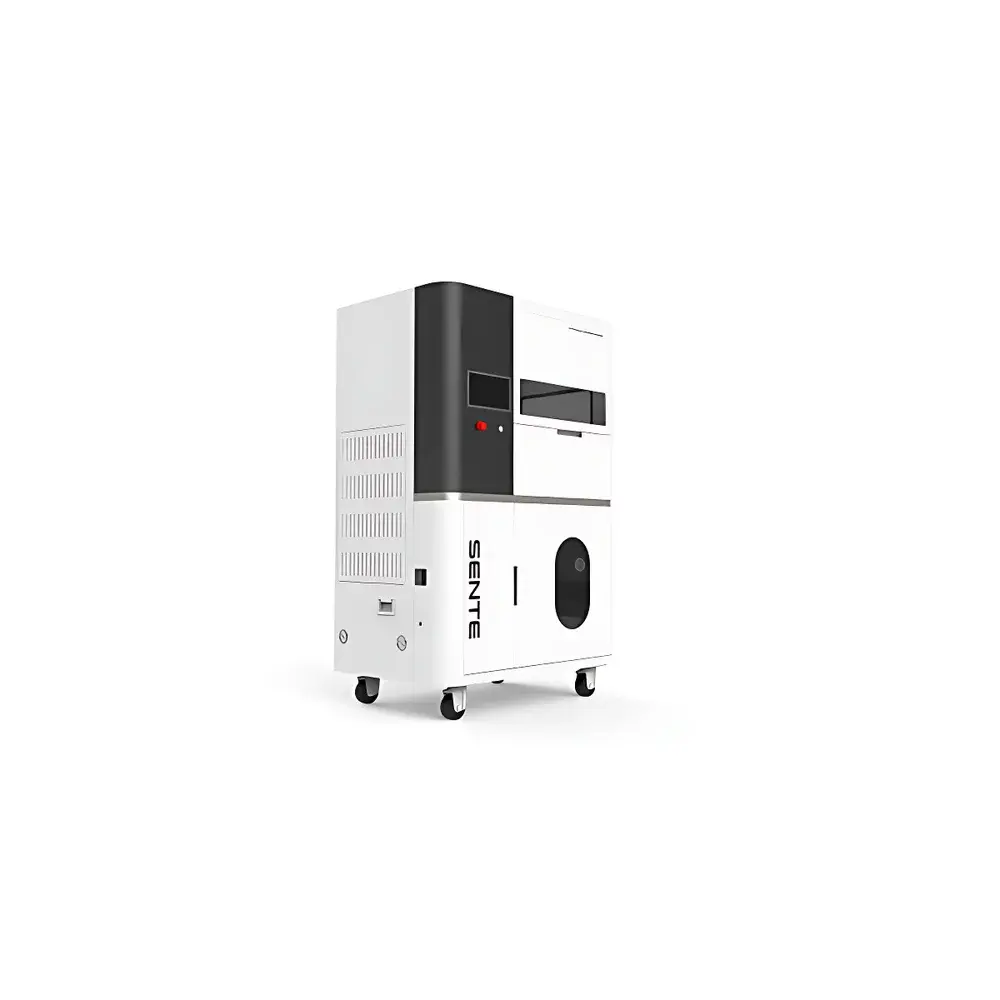
SENTE ST106K2 Integrated Cation Exchange Capacity (CEC) Analyzer for Soil
| Brand | SENTE |
|---|---|
| Model | ST106K2 |
| Origin | Shandong, China |
| Manufacturer Type | Direct Manufacturer |
| Instrument Type | Multi-Function Soil Analyzer |
| Compliance Standards | LY/T 1243–1999, NY/T 295–1995 |
| Sample Throughput | 36 samples (solid-liquid separation), 6 samples (steam distillation & titration) |
| Automation Features | Automated reagent dispensing, robotic cap handling, programmable centrifugation & oscillation, vision-based endpoint detection, magnetic stirring at receiver |
Overview
The SENTE ST106K2 Integrated Cation Exchange Capacity (CEC) Analyzer is an automated, dual-module laboratory system engineered for precise, standardized determination of cation exchange capacity in diverse soil matrices—including acidic, neutral, and calcareous soils. CEC quantifies the total quantity of exchangeable cations (e.g., Ca²⁺, Mg²⁺, K⁺, Na⁺, H⁺, Al³⁺) that soil colloids—primarily clay minerals and organic matter—can reversibly adsorb per unit mass (cmolc/kg). Accurate CEC measurement is foundational to soil fertility assessment, nutrient management planning, acid-base buffering evaluation, and environmental risk modeling of heavy metal mobility. The ST106K2 implements two internationally recognized wet-chemical protocols: the ammonium acetate exchange method (LY/T 1243–1999) for acidic and neutral soils, and the ammonium acetate–ammonium chloride method (NY/T 295–1995) for calcareous soils. Unlike manual workflows prone to inter-operator variability and contamination, this system executes extraction, solid–liquid separation, steam distillation, and endpoint-detecting titration as a synchronized, traceable sequence—minimizing analyst intervention while ensuring analytical reproducibility and compliance with GLP-aligned laboratory practices.
Key Features
- Dual-module architecture: ST106K2-1 Solid–Liquid Separation Module and ST106K2-2 Steam Distillation & Titration Module operate independently or in cascade mode.
- High-throughput sample processing: 36-position rotor-compatible centrifuge with adjustable speed (0–4000 rpm) and time (1–30 min); multi-axis orbital shaker with variable speed (0–300 rpm) and programmable oscillation intervals.
- Fully automated liquid handling: Robotic arm for vial capping/uncapping, precision reagent dispensing (±1% volumetric accuracy), and supernatant decanting under inert atmosphere control.
- Steam distillation subsystem: Integrated steam generator with PID-controlled temperature regulation (up to 100 °C), six parallel digestion zones with independent thermal insulation, and auto-termination triggered by pre-set distillation duration or condensate volume threshold.
- Optical endpoint detection: High-sensitivity CMOS-based vision sensor calibrated against standard colorimetric titration curves (e.g., mixed indicator methyl red–bromocresol green), eliminating subjective visual interpretation and reducing titration error to <±0.02 mL.
- Magnetic stirring at receiving flask: Ensures homogeneous mixing during titrant addition and improves reaction kinetics consistency across all six channels.
Sample Compatibility & Compliance
The ST106K2 accommodates air-dried, sieved (<2 mm) soil samples ranging from sandy loam to high-clay-content vertisols and organic-rich histosols. Its modular design supports both routine agricultural soil testing and regulatory environmental monitoring workflows. The system is validated against Chinese national forestry and agricultural standards LY/T 1243–1999 and NY/T 295–1995, which align methodologically with ISO 11260:1994 (Soil quality — Determination of cation exchange capacity) and ASTM D4373–21 (Standard Test Method for Cation Exchange Capacity (CEC) of Soils). All instrument actions—including reagent volumes, centrifugation parameters, distillation timing, and titration logs—are timestamped and stored with user ID attribution, supporting audit readiness for ISO/IEC 17025-accredited laboratories and internal QA/QC documentation requirements.
Software & Data Management
The ST106K2 operates via SENTE SoilLab Control Suite—a Windows-based application compliant with FDA 21 CFR Part 11 principles. It provides role-based access control (administrator, analyst, reviewer), electronic signature capture, and immutable audit trails covering method selection, parameter modification history, raw sensor outputs (e.g., optical intensity profiles), and final CEC calculation (reported in cmolc/kg dry weight). Data export options include CSV, PDF analytical reports, and direct integration with LIMS via HL7 or ODBC. Calibration records, maintenance logs, and instrument performance verification (IPV) results are archived with automatic retention policies configurable per institutional SOPs.
Applications
- Soil fertility mapping and lime requirement estimation in agronomic advisory services.
- Baseline characterization and long-term monitoring of CEC changes in reclaimed mine soils or contaminated sites.
- Validation of soil amendments (e.g., biochar, zeolites) for cation retention enhancement.
- Research on clay mineralogy–CEC relationships in pedogenic studies.
- Quality assurance for commercial soil testing laboratories serving certification programs (e.g., USDA Organic, EU Eco-Schemes).
FAQ
What extraction buffers does the ST106K2 support?
The system is pre-configured for ammonium acetate (pH 7.0) and ammonium acetate–ammonium chloride (pH 7.0) solutions; custom buffer protocols can be loaded via method templates.
Can the instrument quantify individual exchangeable cations (e.g., Ca²⁺, Mg²⁺)?
No—the ST106K2 determines total CEC via titrimetric quantification of displaced NH₄⁺. For elemental speciation, coupling with ICP-OES or AAS instrumentation is recommended.
Is method validation data available?
Yes—SENTE provides a comprehensive validation report including repeatability (RSD ≤ 3.2% across n=10 replicates), recovery (98.4–101.7% for spiked reference soils), and linearity (r² ≥ 0.999 over 5–50 cmolc/kg range).
Does the system require external cooling water or compressed air?
No—all modules are self-contained; only standard 230 V AC power and deionized water supply are required.
What maintenance intervals are recommended?
Centrifuge rotor balancing and optical sensor calibration every 6 months; steam generator descaling every 200 operational hours; full preventive maintenance annually by SENTE-certified engineers.







