
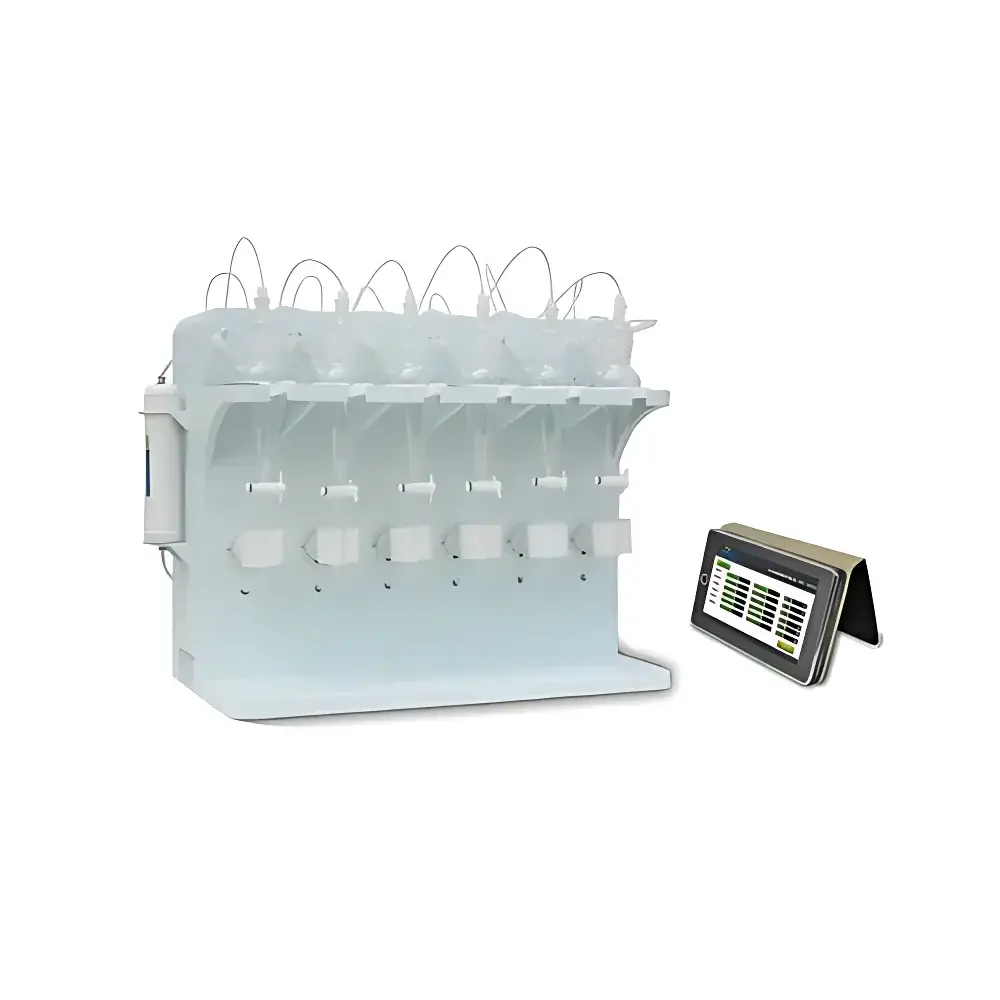
Sentte STC-302B Intelligent Liquid-Liquid Extraction System
| Brand | Sentte |
|---|---|
| Origin | Shandong, China |
| Manufacturer Type | Direct Manufacturer |
| Region Classification | Domestic (China) |
| Model | STC-302B |
| Price Range | USD 7,000 – 14,000 |
| Extraction Efficiency | 0–100% |
| Extraction Duration | 0–200 min |
| Agitation Method | Closed-loop Pneumatic Gas-Liquid Mixing |
| Simultaneous Samples | 6 |
Overview
The Sentte STC-302B Intelligent Liquid-Liquid Extraction System is an automated, closed-loop benchtop instrument engineered for reproducible and operator-safe liquid-liquid extraction (LLE) in environmental, pharmaceutical, food safety, and regulatory compliance laboratories. Unlike conventional mechanical shakers or rotary inverters, the STC-302B employs a proprietary closed-loop pneumatic agitation principle—generating controlled gas-driven turbulence within sealed extraction vessels to achieve homogeneous phase mixing without venting, pressure buildup, or manual intervention. This architecture eliminates exposure to volatile organic compounds (VOCs), halogenated solvents, or toxic analytes commonly associated with phenolic compounds, anionic surfactants, organochlorine pesticides, and priority pollutants in water matrices. Designed for routine EPA Method 1664, ISO 9562, and ASTM D3370-compliant sample preparation, the system delivers consistent mass transfer kinetics across all six positions, enabling high-throughput, GLP-aligned extraction workflows.
Key Features
- Closed-loop pneumatic agitation: Eliminates manual venting, ensures full containment of vapors and aerosols during extraction
- One-touch operation via industrial-grade tablet interface: Predefined and customizable method templates with parameter logging
- Automated post-extraction rinse cycle: Programmable intake of deionized water or tap water; adjustable volume and duration
- Integrated activated carbon filtration module: Captures residual solvent vapors and organic contaminants prior to waste discharge
- Auto-phase separation mode: Controlled agitation stop followed by programmable静置 (settling) time (0–999 s) for reliable interfacial demarcation
- Scalable capacity: Six 500 mL standardized glass separatory funnels mounted on precision-aligned carriers with leak-proof sealing
- Adjustable agitation intensity: Three-tier pneumatic pressure control (low/medium/high) to optimize emulsion formation and breakdown per analyte-solvent pair
Sample Compatibility & Compliance
The STC-302B accommodates aqueous samples containing target analytes such as phenolic compounds (e.g., bisphenol A, pentachlorophenol), anionic surfactants (LAS), polycyclic aromatic hydrocarbons (PAHs), and chlorinated benzenes—typically extracted using dichloromethane, ethyl acetate, or n-hexane. All wetted components are chemically resistant (borosilicate glass, PTFE-sealed joints, stainless-steel frame). The system supports audit-ready documentation: timestamped method files, operator ID tagging, and parameter change logs—fully compatible with laboratory quality systems requiring adherence to ISO/IEC 17025, USP , and FDA 21 CFR Part 11 when integrated with validated LIMS or ELN platforms. No external fume hood required due to integral vapor retention and carbon filtration.
Software & Data Management
The embedded Android-based HMI tablet provides intuitive graphical workflow navigation, real-time status monitoring (agitation phase, settling countdown, rinse progress), and secure local storage of method configurations and run histories (≥10,000 records). Export formats include CSV and PDF reports with metadata (date/time, operator ID, vessel IDs, parameters). Firmware supports over-the-air updates and optional RS-485 or Ethernet connectivity for centralized lab instrument management. Audit trail functionality records all user actions—including parameter modifications, start/stop events, and error alerts—with immutable timestamps, satisfying GLP/GMP traceability requirements.
Applications
- Environmental analysis: Extraction of volatile phenols (EPA 625.1), alkylphenols, and surfactants from surface water, wastewater, and drinking water per ISO 11348 and EN ISO 11348-2
- Food and beverage testing: Isolation of pesticide residues (e.g., organophosphates) from aqueous extracts prior to GC-MS or LC-MS/MS analysis
- Pharmaceutical QC: Recovery of active pharmaceutical ingredients (APIs) and impurities from aqueous process streams
- Regulatory compliance labs: High-volume batch processing aligned with CNAS-accredited methods and Chinese MEE Standard HJ 503-2009
FAQ
Is the STC-302B compatible with non-standard extraction vessel sizes?
Yes—while optimized for 500 mL glass separatory funnels, custom mounting adapters support 250 mL and 1000 mL vessels with recalibrated pneumatic pressure profiles.
Does the system meet international electrical safety standards?
It complies with IEC 61010-1:2010 for laboratory equipment, including overcurrent protection, grounding continuity, and dielectric strength testing per EN 61326-1.
Can extraction methods be exported and shared across multiple STC-302B units?
Yes—method files (.stcxml) are portable and interoperable across devices running firmware v2.1 or higher.
What maintenance is required for the activated carbon filtration module?
Carbon cartridges are rated for ≥300 extraction cycles under standard use; replacement is indicated by pressure differential >15 kPa or VOC sensor alarm.
Is remote monitoring supported via network protocols?
Standard Ethernet port enables Modbus TCP integration for SCADA or building management systems; optional OPC UA gateway available upon request.
Related Products



