
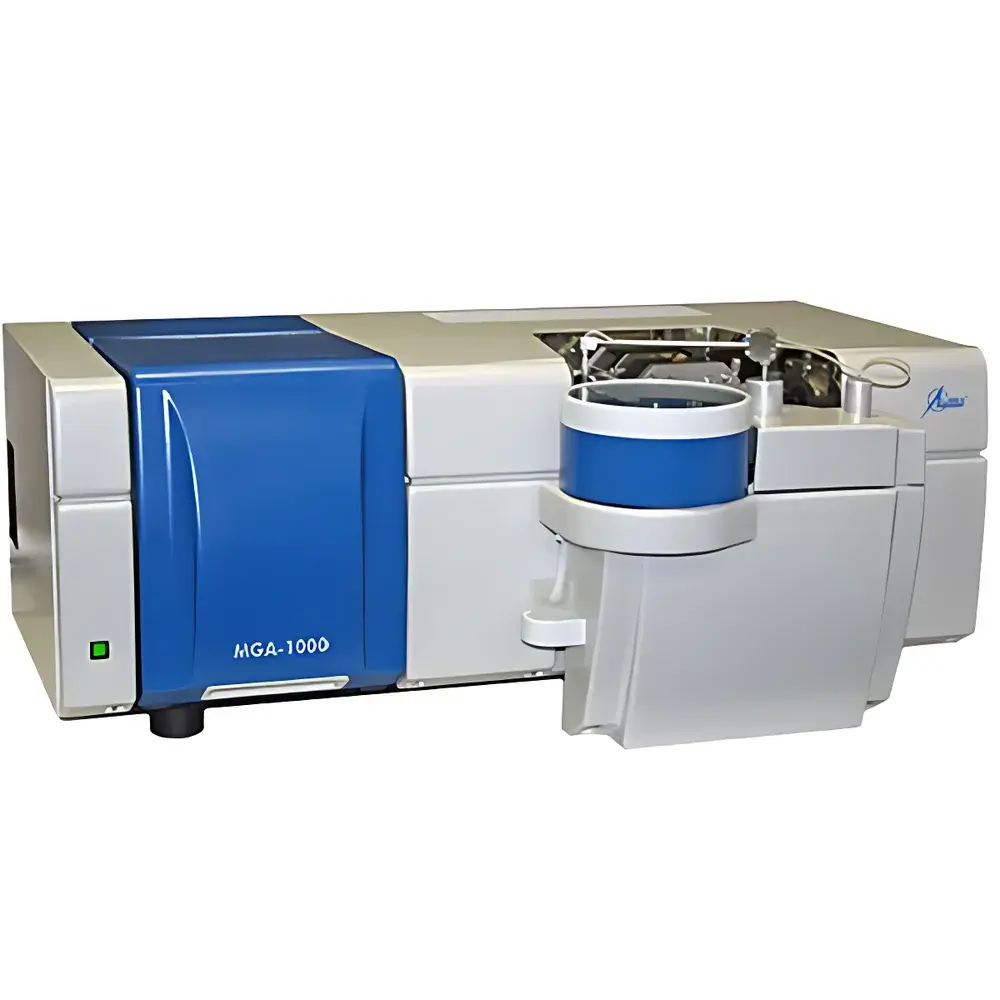
LUMEX MGA-1000 Graphite Furnace Atomic Absorption Spectrometer
| Brand | LUMEX |
|---|---|
| Origin | Russia |
| Model | MGA-1000 |
| Instrument Type | Graphite Furnace AAS |
| Monochromator | Concave Grating (1800 lines/mm) |
| Optical System | Quasi-Dual-Beam |
| Detector | Photomultiplier Tube (PMT) |
| Background Correction | Zeeman Effect (50 kHz) |
| Spectral Resolution | 0.3 nm |
| Sensitivity | 0.3 A |
| RSD (Repeatability) | ≤0.3% |
| Detection Limit (Cu) | <0.006 µg/L |
| Max Graphite Furnace Temperature | 3000 °C |
| Heating Rate | Up to 7000 °C/s |
| Argon Flow Rate | <1 L/min (high-purity) |
| Wavelength Range | 185–900 nm |
| Typical LODs | Pb ≤0.05 µg/L, Cr ≤0.01 µg/L |
| Dimensions | 800 × 475 × 310 mm |
| Weight | 50 kg |
| Power Supply | 380 VAC, 50 Hz (3-phase) |
| Cooling | Integrated Closed-Loop Recirculating Water System |
Overview
The LUMEX MGA-1000 is a high-performance graphite furnace atomic absorption spectrometer (GFAAS) engineered for trace and ultra-trace elemental analysis in complex matrices. Based on the well-established MGA platform refined over two decades, the MGA-1000 implements fundamental atomic absorption principles—ground-state atomization in an electrothermally heated graphite tube followed by quantification via Beer-Lambert absorbance measurement at characteristic resonance wavelengths. Its core innovation lies in the integration of high-frequency Zeeman background correction (50 kHz), enabling full-spectrum, real-time compensation for both structured and molecular absorption interferences without spectral slit narrowing or signal attenuation. This architecture delivers exceptional analytical robustness for regulatory-compliant heavy metal testing across environmental, food safety, clinical, and industrial quality control laboratories.
Key Features
- High-frequency Zeeman background correction (50 kHz) – provides continuous, wavelength-independent correction across the entire 185–900 nm range, eliminating matrix-induced spectral overlaps and ensuring accurate quantitation in high-salt or organic-rich samples.
- Ultra-rapid graphite furnace heating – achieves up to 7000 °C/s ramp rates, enabling precise thermal programming for optimized atomization efficiency, minimized analyte volatilization loss, and enhanced sensitivity for refractory elements.
- Integrated high-intensity electrodeless discharge lamps (EDLs) – deliver superior radiant intensity and spectral purity for As, Se, Cd, Pb, and other volatile elements, permitting direct determination without hydride generation or cold vapor systems.
- Rotating six-lamp turret – accommodates both hollow cathode lamps (HCLs) and EDLs simultaneously; no separate power supplies or lamp housings required, reducing configuration complexity and improving long-term photometric stability.
- Quasi-dual-beam optical path – actively compensates for source drift, detector aging, and electronic fluctuations through reference beam modulation, significantly improving baseline stability and measurement reproducibility over extended run times.
- STPF (Stabilized Temperature Platform Furnace) compatible design – supports both Massmann-type and Lvov-platform graphite tubes, enhancing temperature homogeneity, extending tube lifetime, and suppressing gas-phase interferences during pyrolysis and atomization stages.
- Onboard closed-loop recirculating water cooling system – eliminates external chiller dependency, reduces footprint, and ensures consistent thermal management of the furnace power supply and optical bench under continuous operation.
- Zero-warm-up operation – stable absorbance readings achievable immediately after instrument startup, with no mandatory pre-heating period for lamps or electronics—critical for high-throughput routine labs.
Sample Compatibility & Compliance
The MGA-1000 is validated for direct analysis of liquid, solid, and semi-solid samples following standardized digestion or slurry preparation protocols. It meets methodological requirements for regulatory applications including EPA Method 200.12 (trace metals in drinking water), ISO 11174:1996 (determination of lead, cadmium, nickel, chromium, and copper in soils), GB/T 17141–1997 (soil heavy metal analysis), HJ 748–2015 (arsenic and mercury in solid waste), and GB 5009 series (food safety standards for As, Cd, Cr, Pb, Hg, Sn). Its performance aligns with GLP and GMP documentation practices, and software audit trails comply with FDA 21 CFR Part 11 data integrity requirements when configured with appropriate user access controls and electronic signature modules.
Software & Data Management
The MGA-1000 operates under LUMEX’s proprietary multi-parameter acquisition and processing software, supporting fully automated sequence definition—including element selection, lamp assignment, furnace temperature programs, calibration curve types (linear, quadratic, weighted), and QC check standards. The system logs all instrumental parameters, raw absorbance signals, peak-area/height integrations, and background-corrected results with time-stamped metadata. Data export formats include CSV, TXT, and XML for seamless integration into LIMS environments. Software validation packages are available for laboratories requiring formal IQ/OQ/PQ documentation per ISO/IEC 17025 or CAP accreditation frameworks.
Applications
- Environmental monitoring: Quantification of Ag, Al, As, Ba, Be, Cd, Co, Cr, Cu, Fe, Li, Mn, Mo, Ni, Pb, Se, Sn, Sr, Ti, V, Zn in surface water, wastewater, soil, sediment, and sludge per EPA, ISO, and Chinese HJ standards.
- Food & beverage safety: Routine determination of As, Cd, Cr, Pb, Hg, and Sn in raw materials, finished products, and packaging extracts—fully compliant with GB 5009.12, GB 5009.15, and EU Commission Regulation (EC) No 1881/2006.
- Clinical & occupational health: Trace-level monitoring of toxic metals (e.g., Pb in blood, Cd in urine, As in hair) in accordance with CLIA, CAP, and WHO biological exposure indices.
- Industrial process control: In-line QA/QC for pharmaceutical excipients, catalyst residues in petrochemical streams, and elemental impurities in battery-grade raw materials (e.g., Li, Co, Ni).
FAQ
Does the MGA-1000 support hydride generation or cold vapor techniques?
No—the MGA-1000 is a dedicated graphite furnace AAS platform. Elements such as As and Se are measured directly using high-intensity EDLs and optimized thermal programs; no external hydride or vapor generation modules are integrated or required.
Is the instrument compatible with third-party graphite tubes?
Yes—it accepts standard 0.8 mm inner diameter graphite tubes conforming to ASTM D4691 specifications, including Massmann-style and platform-equipped variants from major suppliers (PerkinElmer, NIST-traceable, etc.).
What level of software validation support is provided?
LUMEX supplies documented IQ/OQ protocols, electronic signature configuration guides, and audit trail reports suitable for ISO/IEC 17025, FDA 21 CFR Part 11, and GLP compliance verification.
Can the MGA-1000 be networked within a laboratory intranet?
Yes—Ethernet connectivity enables remote instrument monitoring, method transfer, and centralized data archiving via standard TCP/IP protocols; optional LIMS middleware drivers are available upon request.
What maintenance intervals are recommended for routine operation?
Daily: Lamp alignment verification and graphite tube inspection. Quarterly: Optical alignment check, PMT voltage calibration, and furnace power calibration. Annually: Full system performance qualification (SPQ) including detection limit verification per ISO 11885.






