
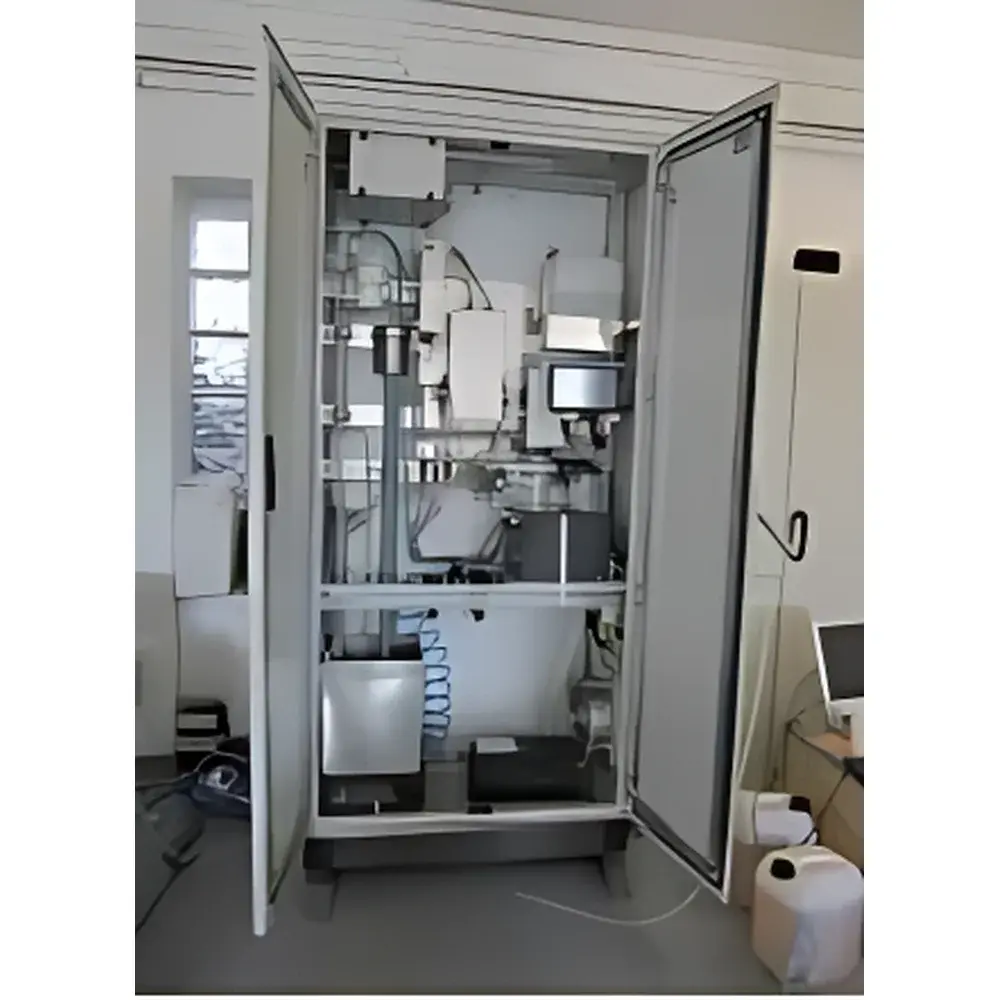
LUMEX RA-915WM Continuous Online Mercury Analyzer for Water
| Brand | LUMEX |
|---|---|
| Model | RA-915WM |
| Principle | High-Temperature Thermal Decomposition Coupled with Zeeman Atomic Absorption Detection |
| Detection Limit | 0.3 µg/L |
| Measurement Range | 0–200 µg/L |
| Analysis Frequency | Once every 0.5–3 hours |
| Calibration | Fully Automatic |
| Baseline Verification | Fully Automatic |
| Max. Dissolved Solids Tolerance | 1000 mg/L |
| Communication Interfaces | RS-232/485, LAN, Isolated 4–20 mA |
| Protocols | Modbus, GESYTEC |
| Output Relays | Open/Closed |
| Operating Temperature | 5–40 °C |
| Atmospheric Pressure Range | 84–106.7 kPa |
| Relative Humidity | <98% at +35 °C |
| Power Supply | 110/240 VAC, 50/60 Hz |
| Dimensions (L×W×H) | 1000 × 400 × 2000 mm |
Overview
The LUMEX RA-915WM Continuous Online Mercury Analyzer is a fully automated, high-precision instrument engineered for real-time, unattended monitoring of total mercury (Hg) in aqueous matrices—including surface water, drinking water, and industrial or municipal wastewater. It operates on the principle of high-temperature thermal decomposition (EPA Method 7473-compliant), followed by atomic absorption spectroscopy with Zeeman-effect background correction. Unlike conventional cold vapor atomic absorption (CVAAS) systems requiring chemical reduction and vapor generation, the RA-915WM thermally volatilizes mercury directly from liquid samples at up to 700 °C in an inert carrier gas stream, enabling complete atomization without reagents or catalysts. This direct thermal pathway eliminates memory effects, minimizes interferences from chloride, sulfide, or organic complexes, and ensures quantitative recovery across variable salinity and matrix composition—critical for long-term field deployment in heterogeneous environmental settings.
Key Features
- High-temperature dual-stage atomization: Integrated pyrolysis unit heats samples to >700 °C under controlled air flow, ensuring complete mercury release and vapor-phase transport to the detection cell.
- Zeeman-effect background correction: High-frequency modulation enables real-time spectral interference compensation, delivering sub-part-per-trillion sensitivity (0.3 µg/L LOD) and exceptional selectivity in complex matrices.
- Zero-reagent operation: No potassium permanganate, stannous chloride, or gold traps required—reducing consumables, maintenance intervals, and operational risk of clogging or carryover.
- Automatic calibration and drift correction: Onboard standard solution delivery system performs periodic zero-point and span verification; software-driven baseline stabilization compensates for instrumental drift over extended runs.
- Robust environmental resilience: Designed for continuous operation in ambient conditions ranging from 5 °C to 40 °C, with humidity tolerance up to 98% RH at 35 °C and pressure stability across 84–106.7 kPa.
- Integrated safety and diagnostics: Self-monitoring firmware detects abnormal temperature gradients, gas flow anomalies, or optical path degradation, triggering preemptive alerts and protective shutdown sequences.
Sample Compatibility & Compliance
The RA-915WM accepts raw, unfiltered water samples with total dissolved solids (TDS) up to 1000 mg/L—making it suitable for estuarine, brackish, and moderately saline effluents without pretreatment. Its thermal decomposition method aligns with U.S. EPA Method 7473 for total mercury determination in solids and liquids, and its performance characteristics support compliance with ISO 17294-2 (water quality — elemental specifications by ICP-MS/AAS) and EU Directive 2008/105/EC (Environmental Quality Standards for priority substances). The analyzer’s architecture supports audit-ready data integrity: all calibration events, system diagnostics, and measurement records are timestamped and stored locally with optional secure export to LIMS or SCADA platforms via encrypted LAN or serial protocols.
Software & Data Management
The embedded control unit runs a deterministic real-time OS with dedicated firmware for mercury-specific signal processing, including peak integration, spectral deconvolution, and statistical outlier rejection. Data output conforms to industry-standard formats (CSV, XML) and integrates natively with Modbus RTU/TCP and GESYTEC protocol stacks for seamless interoperability with central monitoring systems. All communications—whether analog (4–20 mA), digital (RS-485), or network-based (TCP/IP)—support bi-directional command exchange, enabling remote parameter adjustment, scheduled analysis initiation, and firmware updates. Audit trails include full metadata: sample ID, analysis time, calibration status, ambient sensor readings, and hardware health indicators—fully traceable for GLP/GMP or ISO/IEC 17025 laboratory accreditation requirements.
Applications
- Continuous compliance monitoring at drinking water intake points and distribution reservoirs.
- Real-time effluent tracking at coal-fired power plants, chlor-alkali facilities, and gold mining operations where mercury discharge is regulated.
- Early-warning surveillance in river basins impacted by legacy contamination or artisanal mining activities.
- Research-grade longitudinal studies requiring high-frequency temporal resolution (sub-hourly sampling) to capture diurnal or event-driven mercury flux dynamics.
- Integration into multi-parameter water quality networks alongside sensors for pH, conductivity, turbidity, and heavy metals (e.g., As, Cd, Pb).
FAQ
Does the RA-915WM require daily manual intervention?
No—once commissioned and calibrated, it operates autonomously for weeks. Only routine quarterly maintenance (e.g., quartz cell inspection, carrier gas filter replacement) is recommended.
Can it handle wastewater with suspended solids?
It accepts samples with up to 1000 mg/L TDS but requires pre-filtration if particulate load exceeds 5 µm to prevent inlet clogging; inline filtration modules are available as accessories.
How is data security ensured during remote transmission?
All network communications use TLS 1.2 encryption; local storage employs write-once filesystem partitioning to prevent tampering, satisfying FDA 21 CFR Part 11 electronic record requirements when configured with user authentication and audit logging.
Is method validation documentation provided?
Yes—each unit ships with a Factory Acceptance Test (FAT) report, including linearity, precision (RSD <3% at 10 µg/L), and spike recovery data across representative water matrices (deionized, tap, synthetic wastewater).
What service and support options are available globally?
LUMEX-certified field service engineers provide installation, preventive maintenance, and emergency response through authorized partners in North America, EMEA, and APAC regions; extended warranty and remote diagnostics contracts are available.







