
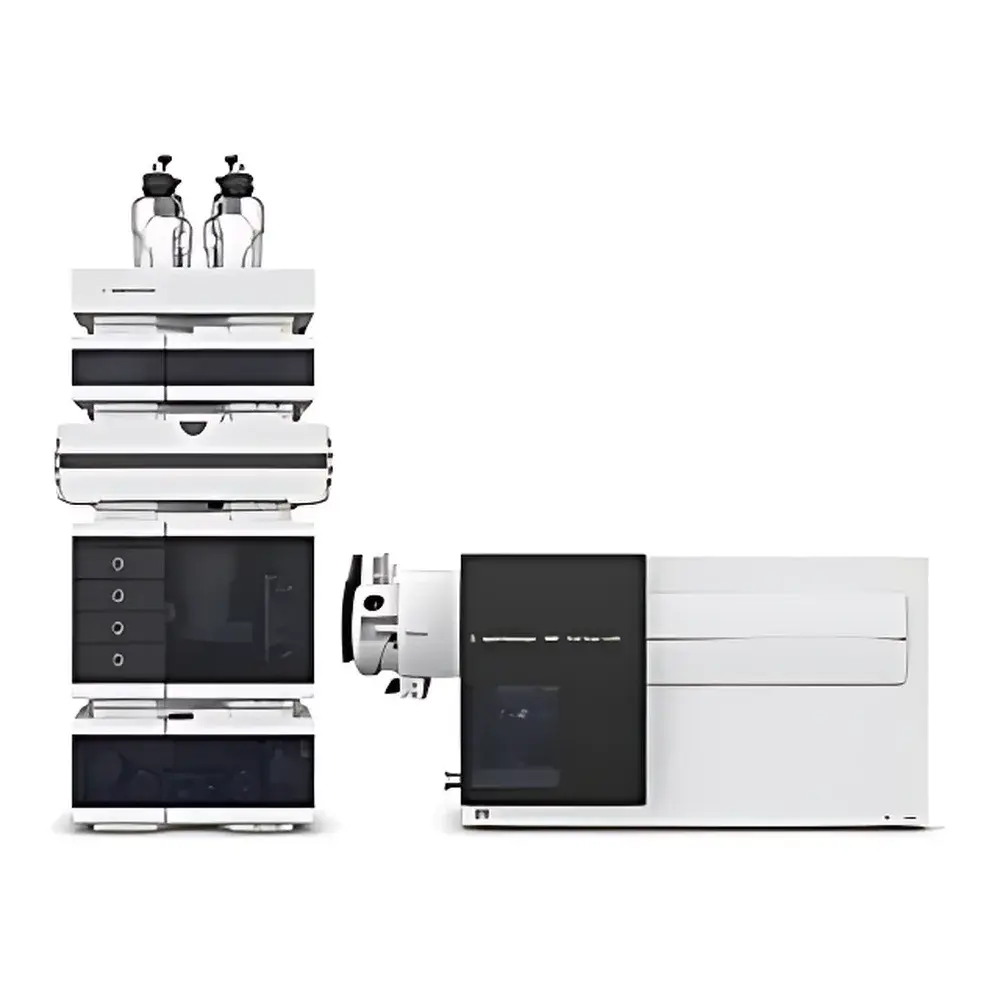
Agilent 6495B LC/MS/MS Triple Quadrupole Liquid Chromatography Mass Spectrometry System
| Brand | Agilent Technologies |
|---|---|
| Origin | Singapore |
| Manufacturer Type | Original Equipment Manufacturer (OEM) |
| Origin Category | Imported |
| Model | 6495B |
| Instrument Type | Tandem Quadrupole (QqQ) |
| Mass Range | m/z 3000 |
| Ion Source | Electrospray Ionization (ESI) / Atmospheric Pressure Chemical Ionization (APCI) |
| Key Technology | iFunnel Ion Optics |
| Maintenance Feature | Plug-and-Play Ion Source with Vacuum Isolation Valve |
Overview
The Agilent 6495B LC/MS/MS Triple Quadrupole Liquid Chromatography Mass Spectrometry System is engineered for high-sensitivity, high-throughput quantitative analysis in regulated and discovery-driven laboratories. Built upon Agilent’s proven iFunnel ion optics architecture, the 6495B operates on the fundamental principle of tandem mass spectrometry—employing three quadrupole mass filters (Q1 → collision cell → Q3) to isolate precursor ions, induce controlled fragmentation via collision-induced dissociation (CID), and selectively detect product ions. This QqQ configuration delivers exceptional specificity, dynamic range (>5 orders), and reproducibility essential for trace-level quantitation in complex biological, environmental, and food matrices. With an extended mass range up to m/z 3000, the system supports robust detection and characterization of large peptides, glycopeptides, and metabolites bearing post-translational modifications (PTMs), including glycosylation site mapping and stoichiometry assessment.
Key Features
- iFunnel ion optics: Enhances ion transmission efficiency across wide mass ranges while maintaining low background noise and high signal-to-noise ratios—enabling attomole-to-zeptomole detection limits in routine operation.
- Vacuum-isolated plug-and-play ion source: Allows rapid source exchange or cleaning without venting the mass spectrometer vacuum system, minimizing instrument downtime and preserving calibration stability.
- High-energy conversion dynode detector: Delivers consistent sensitivity and linearity over extended acquisition periods, critical for long-sequence LC gradients and unattended overnight runs.
- Triggered Multiple Reaction Monitoring (tMRM): Combines quantitative MRM transitions with real-time acquisition of diagnostic product ion spectra—supporting retrospective compound identification, spectral library matching (e.g., NIST, MassBank), and structural confirmation without re-injection.
- Integrated jet stream electrospray and APCI sources: Enable seamless method transfer between polar and non-polar analytes; compatible with UHPLC systems operating up to 1300 bar.
Sample Compatibility & Compliance
The 6495B accommodates diverse sample types—including plasma, serum, tissue homogenates, plant extracts, food digests, and environmental water extracts—without requiring extensive method redevelopment. Its robust ion source design tolerates moderate levels of salts, phospholipids, and matrix interferences common in bioanalytical workflows. The system complies with key regulatory requirements for data integrity and auditability: full support for 21 CFR Part 11-compliant electronic signatures, audit trails, and user access controls when deployed with Agilent OpenLab CDS or MassHunter Workstation software. It meets ISO/IEC 17025 method validation criteria and aligns with ICH M10 guidance for bioanalytical method validation in pharmaceutical development.
Software & Data Management
Controlled via Agilent MassHunter Acquisition and Quantitative Analysis software, the 6495B enables automated method setup, batch processing, and integrated calibration curve generation with weighted linear regression (1/x or 1/x²). Raw data files (.d format) are natively compatible with third-party platforms including Skyline, Compound Discoverer, and SimLipid for targeted quantitation, untargeted screening, and lipidomics workflows. All processing steps—including peak integration, interference correction, and isotopic pattern deconvolution—are fully traceable and exportable in CSV, PDF, or XML formats. Audit trail logs record operator actions, parameter changes, and instrument status events—ensuring full GLP/GMP compliance during regulatory submissions.
Applications
- Bioanalysis: Quantification of small-molecule drugs and metabolites in plasma with LLOQs ≤ 1 pg/mL; simultaneous multi-analyte assays for pharmacokinetic studies.
- Proteomics: Targeted quantification of signature peptides from therapeutic proteins and endogenous biomarkers; PTM characterization via high-m/z fragment ion monitoring.
- Food safety: Detection of mycotoxins (e.g., ochratoxin A, aflatoxin B1), nitrofuran metabolites, veterinary drug residues, and pesticide contaminants at sub-ng/g levels in complex food matrices.
- Environmental analysis: Screening and quantitation of emerging contaminants—including PFAS, pharmaceuticals, and microplastic additives—in wastewater, soil, and sediment extracts.
- Clinical research: Validation of biomarker panels in cerebrospinal fluid (CSF) and dried blood spots (DBS) under CLIA-equivalent laboratory protocols.
FAQ
What is the maximum mass range supported by the Agilent 6495B?
The system achieves reliable detection and quantitation up to m/z 3000, enabling analysis of intact peptides, glycopeptides, and medium-sized proteins.
Does the 6495B support both ESI and APCI ionization modes?
Yes—the instrument includes dual-source capability with swappable ESI and APCI probes, each optimized for polarity range, flow rate, and thermal stability.
Can tMRM data be used for retrospective identification after acquisition?
Absolutely: tMRM stores full product ion spectra alongside quantitative transitions, permitting post-acquisition library searching and structural verification without re-running samples.
Is the 6495B compatible with existing Agilent LC systems?
It integrates natively with all Agilent 1290 Infinity II and 1260 Infinity II LC modules, including VWD, DAD, and MWD detectors, via LAN-based communication and synchronized timing control.
How does the iFunnel technology improve sensitivity compared to conventional RF-only ion guides?
iFunnel combines stacked ring electrodes with variable RF and DC voltages to focus and accelerate ions across pressure gradients—resulting in >10× higher transmission efficiency and lower detection limits versus legacy hexapole or octopole designs.




