
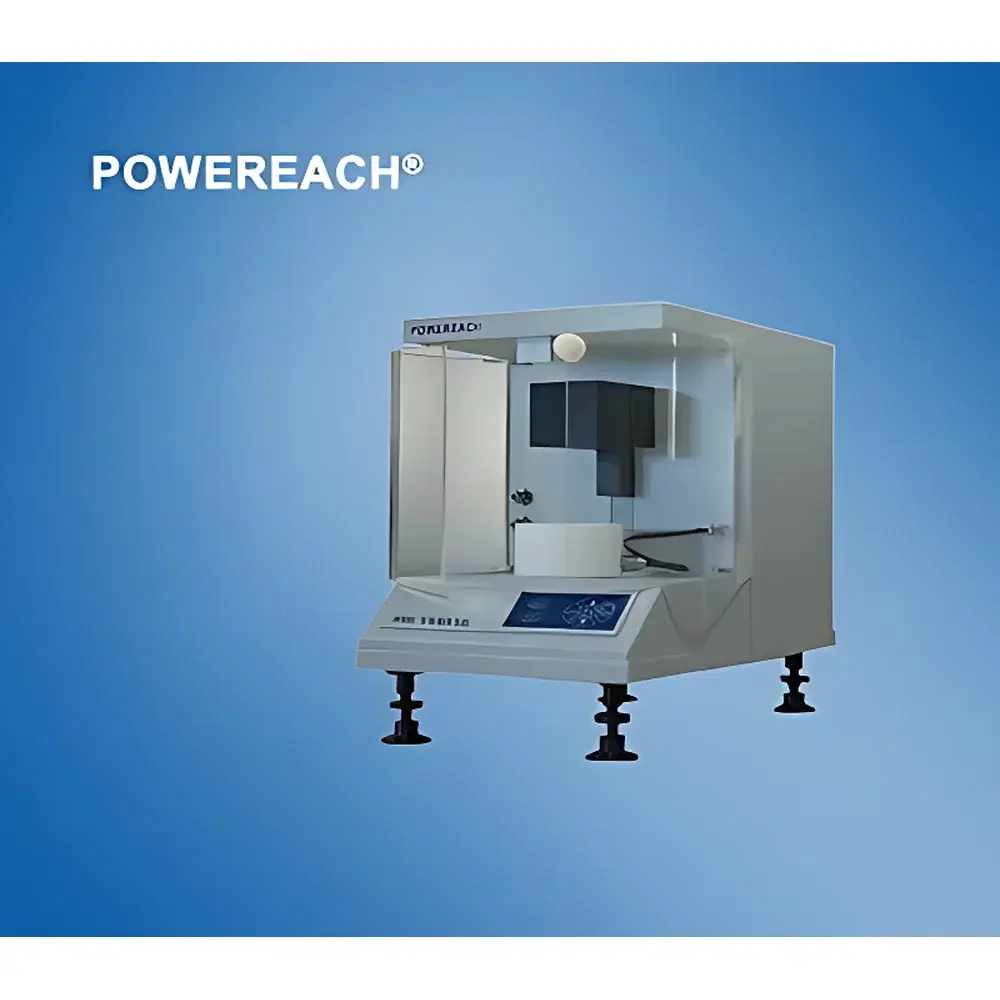
JK99D Fully Automated Surface & Interfacial Tensiometer
| Origin | Shanghai, China |
|---|---|
| Manufacturer Type | Authorized Distributor |
| Origin Category | Domestic (China) |
| Model | JK99D |
| Pricing | Upon Request |
| Measurement Range | 0–500 mN/m |
| Sensitivity | 0.05 mN/m |
| Accuracy | ±0.1 mN/m |
| Resolution | <0.05 mN/m |
| Methods | Du Noüy Ring & Wilhelmy Plate |
| Ring Method Cycle Time | 150–200 s |
| Plate Method Cycle Time | 1–5 s |
| Power Supply | AC 220 ±5 V, <150 W |
| Temperature Control Precision | ±0.1 °C (with optional thermostatic platform) |
| Humidity Range | 30–85% RH |
| Zeroing | Hardware & Software One-Touch Auto-Zero |
| Calibration | Integrated standard weight kit |
| Compliance | ASTM D971, ISO 6295, ISO 1409, USP <721>, GB/T 6541 |
Overview
The JK99D Fully Automated Surface & Interfacial Tensiometer is an advanced, dual-mode laboratory instrument engineered for high-precision measurement of surface tension (γLV) and liquid–liquid interfacial tension (γLL) across diverse industrial and research applications. Based on the fundamental principles of the Du Noüy ring and Wilhelmy plate methods—both standardized under ASTM D971, ISO 6295, and ISO 1409—the JK99D delivers traceable, reproducible results by quantifying the force exerted on a calibrated platinum probe during controlled immersion and withdrawal from the test liquid phase. Its modular architecture supports both standalone operation via integrated LCD display and thermal printer, and PC-connected real-time data acquisition with dynamic curve visualization. Designed for robustness in QC labs, R&D centers, and academic settings, the system accommodates temperature-sensitive measurements through optional thermostatic platforms (±0.1 °C precision) and integrates magnetic stirring to ensure homogeneous sample conditions during kinetic surfactant adsorption studies.
Key Features
- Dual-method compliance: Simultaneous support for ASTM-standardized Du Noüy ring and Wilhelmy plate techniques—enabling cross-validation and extended applicability to viscous media (e.g., coatings, inks, crude oils).
- High-fidelity sensing: Japanese-sourced load cell with <0.05 mN/m sensitivity, ±0.1 mN/m accuracy, and sub-0.05 mN/m resolution—validated using NIST-traceable calibration weights.
- Intelligent automation: One-touch auto-zero (hardware + software), programmable stepwise or fully autonomous measurement sequences, and forced stage lift/drop functionality for method optimization and troubleshooting.
- Thermal integration readiness: Built-in mounting interface for external thermostatic baths or optional Peltier-controlled heating/cooling platforms—critical for temperature-dependent CMC determination and polymer solution characterization.
- Standalone operability: Integrated 4.3″ TFT LCD, embedded microprocessor, and thermal line printer enable field-deployable, offline operation without PC dependency—ideal for teaching labs and production-floor QA checks.
- Expandable modularity: Optional add-ons include CMC analysis module, density measurement kit, powder wettability adapter, fiber contact angle stage, and dynamic contact angle extension—configured per ISO 19403 and ASTM D7334 protocols.
Sample Compatibility & Compliance
The JK99D accommodates aqueous and non-aqueous systems—including surfactant solutions, emulsions, polymer melts, paints, inks, pharmaceutical formulations, and petroleum derivatives—with validated performance up to 500 mN/m. Its platinum ring and plate probes meet ISO 1409 requirements for geometric tolerance and surface purity. All firmware and data handling routines are structured to support GLP/GMP-aligned workflows: audit trails, user access levels, electronic signatures, and raw-data export in CSV/PDF formats comply with FDA 21 CFR Part 11 readiness guidelines. Instrument validation documentation (IQ/OQ) is provided upon request, referencing ASTM D1331 (for foaming agents), USP (surface tension for parenterals), and GB/T 6541 (petroleum products).
Software & Data Management
The Windows-based control software provides real-time plotting of γ(t) and γ(c) curves, automatic baseline correction, and built-in calculation engines for CMC estimation (via breakpoint, curvature, or polynomial fitting), diffusion coefficient approximation, and Gibbs adsorption isotherm derivation. All measurement parameters—including dwell time, immersion depth, withdrawal speed, and temperature setpoint—are programmable and stored with timestamped metadata. Data files retain full traceability: operator ID, instrument serial number, calibration date, environmental RH/T logs, and method version. Export options include CSV (for LIMS integration), PNG/SVG vector graphics, and printable PDF reports with header/footer customization—supporting ISO/IEC 17025 documentation requirements.
Applications
- Surfactant development: CMC mapping, adsorption kinetics, and formulation stability screening in agrochemicals, detergents, and personal care products.
- Coatings & inks: Wetting behavior assessment on substrates, pigment dispersion efficiency, and rheo-surface coupling analysis.
- Pharmaceutical QA: Surface tension verification of injectables, ophthalmic solutions, and nanoemulsion carriers per USP .
- Petroleum & lubricants: Interfacial tension between crude oil/water phases for EOR (enhanced oil recovery) evaluation.
- Academic research: Teaching interfacial thermodynamics, capillary phenomena, and Langmuir monolayer modeling in physical chemistry laboratories.
- Quality control: Batch-to-batch consistency testing for raw materials (e.g., silicone oils, fluorosurfactants) and finished products.
FAQ
Does the JK99D comply with international standards for surface tension measurement?
Yes—it implements Du Noüy ring (ASTM D971, ISO 6295) and Wilhelmy plate (ISO 1409, USP ) methodologies with hardware and software alignment to these specifications.
Can it measure interfacial tension between two immiscible liquids?
Yes—both platinum ring and plate configurations are validated for liquid–liquid interfacial tension (γLL) determination, including oil–water and solvent–aqueous systems.
Is temperature control built-in or optional?
The base unit includes thermal sensor input and stage mounting provisions; precise temperature regulation (±0.1 °C) requires optional thermostatic platform or external bath integration.
What data security and audit capabilities does the software provide?
It supports multi-level user authentication, immutable measurement logs with timestamps, electronic signature capture, and export-ready files compliant with FDA 21 CFR Part 11 and ISO/IEC 17025 reporting frameworks.
How is calibration performed and how often is it required?
Calibration uses supplied stainless-steel reference weights traceable to national standards; frequency depends on usage intensity but is recommended before each critical test series or at least daily in regulated environments.
Related Products



