
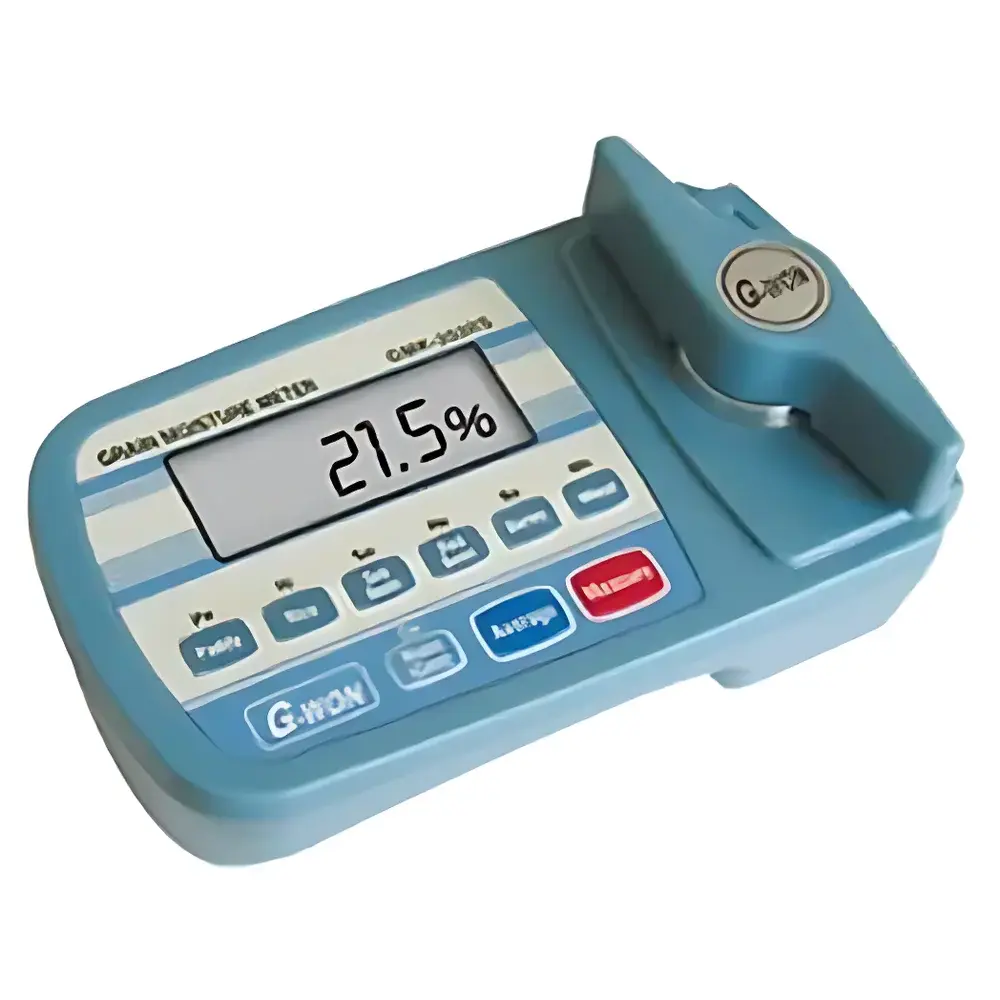
G-WON GMK-303RS Capacitance-Based Grain Moisture Analyzer
| Brand | G-WON |
|---|---|
| Origin | South Korea |
| Model | GMK-303RS |
| Measurement Principle | Capacitance Dielectric Method |
| Sample Types | Rice (8.3–26.0%), Paddy (8.5–40.0%), Soybean (8.5–21.5%), Red Bean (12.5–19.7%), Barley (8.3–35.0%), Wheat (8.5–35.0%), Corn/Maize (8.7–22.8%) |
| Accuracy | ±0.5% w.b. |
| Display | Digital LCD with Automatic Temperature Compensation |
| Power | 4 × 1.5 V AA batteries (low-battery indicator) |
| Dimensions | 164 × 94 × 40 mm |
| Weight | ~1.2 kg |
Overview
The G-WON GMK-303RS is a portable, capacitance-based grain moisture analyzer engineered for rapid, field-deployable quantification of moisture content in bulk cereal grains and legumes. Unlike loss-on-drying (LOD) or Karl Fischer titration methods, the GMK-303RS employs dielectric constant measurement — a non-destructive, real-time technique where the instrument applies a low-frequency AC electric field across a representative grain sample and correlates the resulting capacitance shift to water content. This principle leverages the high relative permittivity of water (εr ≈ 80) compared to dry grain matrices (εr ≈ 2–5), enabling robust correlation models calibrated per species. Designed for agricultural supply chain stakeholders — including farm cooperatives, grain elevators, commodity traders, and quality assurance personnel — the GMK-303RS delivers repeatable results within 3–5 seconds without sample grinding, drying ovens, or reagents. Its compact form factor and battery-powered operation support continuous use across harvest fields, receiving docks, storage silos, and procurement offices.
Key Features
- Capacitance dielectric sensing architecture optimized for heterogeneous grain kernels — no grinding or milling required prior to measurement
- Pre-loaded, species-specific calibration curves for seven major commodities: rice, paddy, soybean, red bean, barley, wheat, and corn/maize
- Automatic temperature compensation (ATC) algorithm integrated into firmware to correct for ambient thermal drift (operating range: 0–40 °C)
- Digital LCD display with backlight for readability under variable lighting conditions; intuitive single-button interface with tactile feedback
- Battery-powered design using four standard AA cells (1.5 V each), supporting >5,000 measurements per set; integrated low-battery warning indicator
- Rugged ABS housing rated for field use; ergonomic dimensions (164 × 94 × 40 mm) and lightweight construction (~1.2 kg) facilitate handheld operation during extended sampling campaigns
Sample Compatibility & Compliance
The GMK-303RS is validated for intact, unprocessed grain samples meeting ISO 712:2017 (Cereals and cereal products — Determination of moisture content — Reference method using oven drying) as a rapid screening tool. While not intended to replace official reference methods for regulatory reporting, its ±0.5% w.b. accuracy (at 20 °C, 45–75% RH) aligns with ASTM D4940–20 (Standard Guide for Conducting Moisture Testing of Agricultural Commodities) performance expectations for portable capacitance meters. The device complies with IEC 61000-6-3 (EMC emission limits) and IEC 61000-6-2 (immunity to electrostatic discharge and RF fields). Calibration verification is traceable to NIST-traceable moisture standards via G-WON’s certified service centers in Seoul and regional APAC distribution hubs.
Software & Data Management
The GMK-303RS operates as a standalone, embedded-system analyzer with no external software dependency. All calibration data, user settings, and measurement history are retained in non-volatile memory. While it does not feature Bluetooth, USB, or cloud connectivity, its deterministic measurement protocol supports GLP-compliant manual recordkeeping: each reading includes timestamp (via internal RTC), grain type selection code, and numeric moisture value. For laboratories requiring digital audit trails, G-WON provides optional CSV export via the GMK-Link companion adapter (sold separately), which interfaces with Windows-based desktop software supporting FDA 21 CFR Part 11–compliant electronic signatures and audit-log generation.
Applications
- On-farm decision support: Real-time assessment of harvest readiness, post-harvest drying thresholds, and optimal storage moisture targets to mitigate mold growth and aflatoxin risk
- Grain procurement QA/QC: Rapid verification of seller-submitted moisture declarations at intake points, reducing disputes and enabling tiered pricing based on contractual moisture bands
- Storage management: Periodic monitoring of silo or bagged inventory to detect localized condensation or moisture migration before spoilage occurs
- Research & extension services: Field validation of drought-tolerant cultivars, irrigation scheduling studies, and post-harvest technology trials under resource-constrained conditions
- Export documentation: Preliminary moisture screening prior to formal ISO/IEC 17025-accredited testing for phytosanitary certification and customs clearance
FAQ
Does the GMK-303RS require sample grinding or conditioning before measurement?
No. It is designed for direct measurement of whole, unground kernels. Grinding may alter dielectric homogeneity and invalidate factory calibrations.
How often should calibration be verified?
G-WON recommends quarterly verification using certified reference materials (CRM) or against a gravimetric LOD reference test, especially after exposure to extreme humidity or temperature cycling.
Can the device measure moisture in processed grains (e.g., milled flour or broken kernels)?
Not reliably. The calibration curves are validated exclusively for intact, commercially harvested kernels. Flour or cracked grain introduces air gaps and density variation that degrade capacitance correlation accuracy.
Is the battery compartment sealed against dust and moisture?
The unit meets IP54 ingress protection rating — sufficient for outdoor agricultural environments but not submersion or high-pressure washdown.
What documentation accompanies the instrument for regulatory audits?
Each unit ships with a Factory Calibration Certificate (traceable to Korean Research Institute of Standards and Science, KRISS), CE Declaration of Conformity, and multilingual operating manual compliant with ISO/IEC Guide 37 requirements.




