
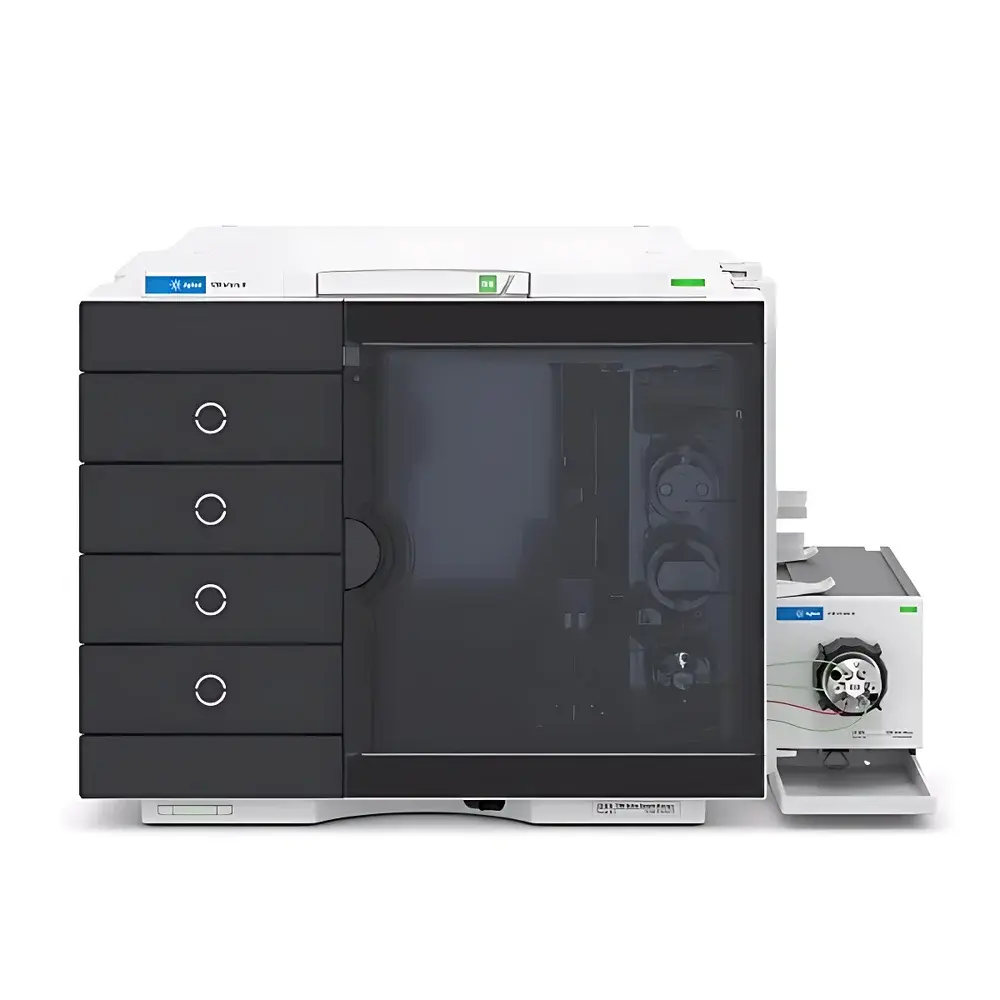
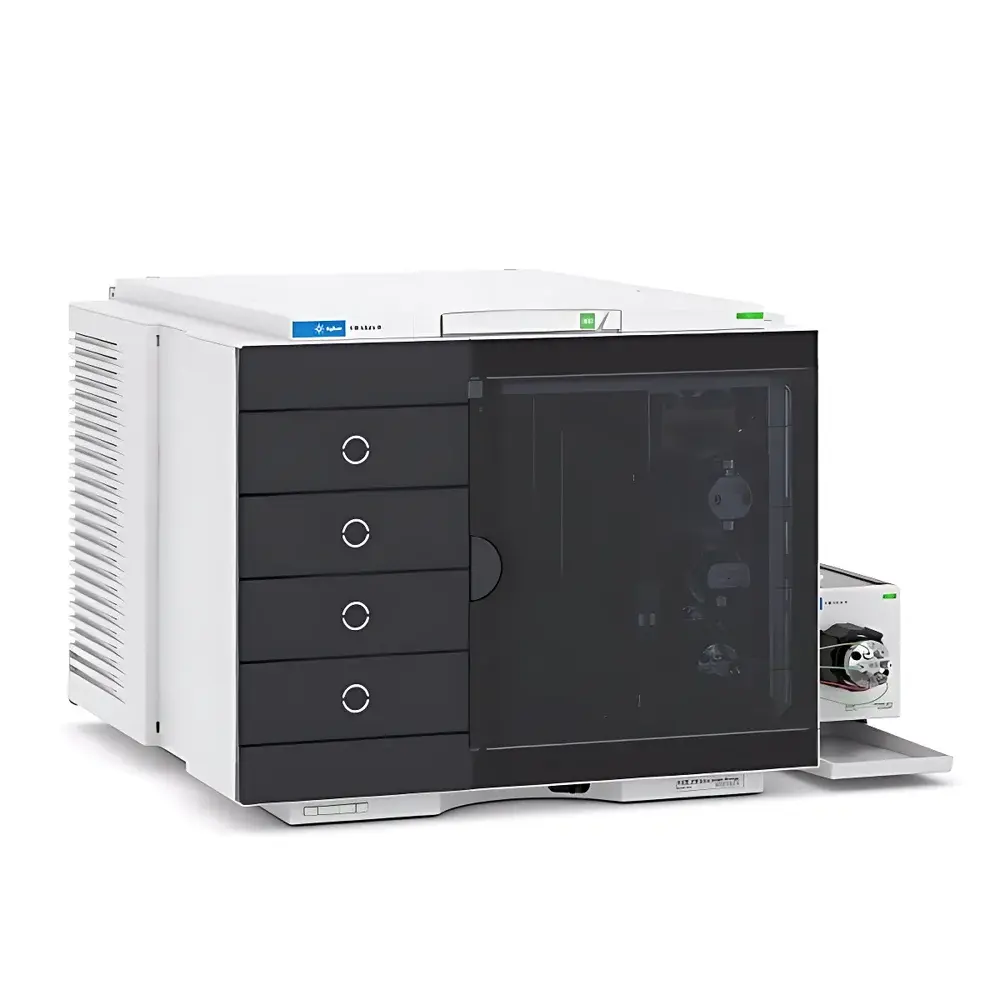
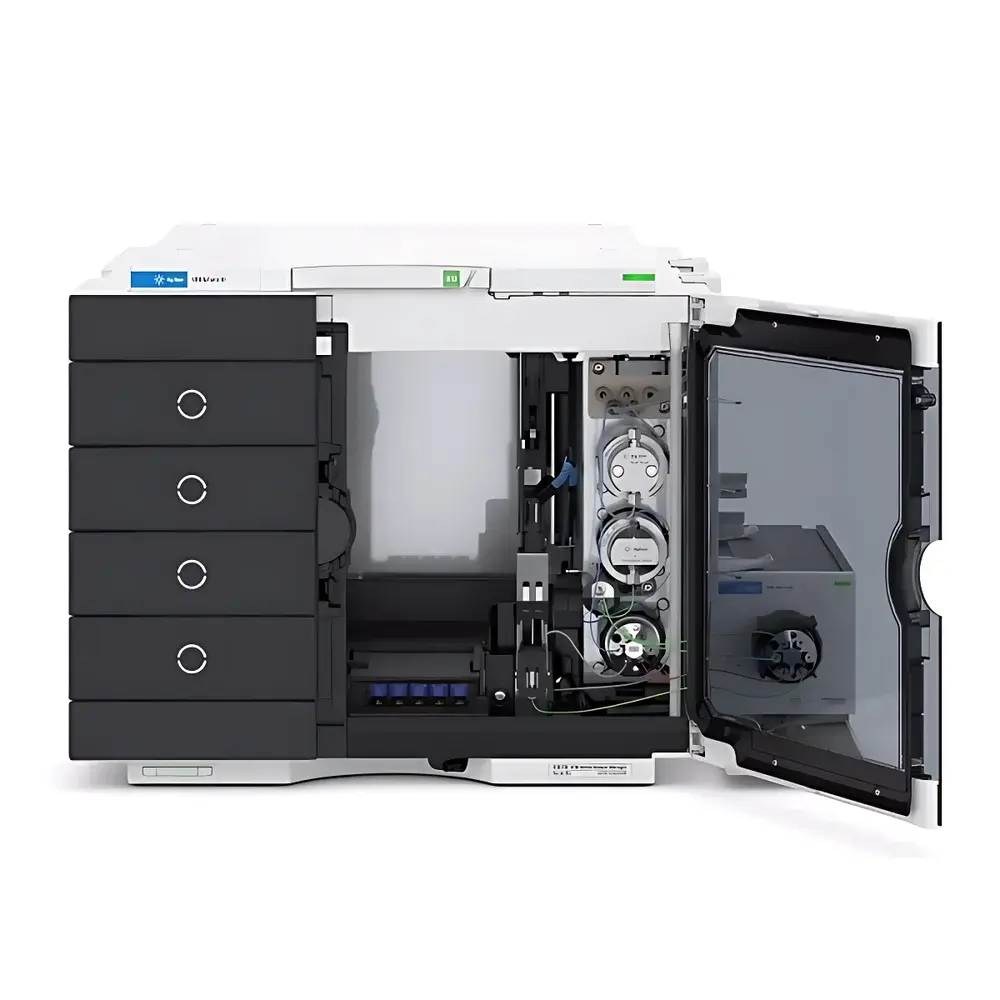
Agilent 1290 Infinity III Bio Online Sample Manager
| Brand | Agilent Technologies |
|---|---|
| Origin | Germany |
| Manufacturer Type | Original Equipment Manufacturer (OEM) |
| Product Origin | Imported |
| Model | 1290 Infinity III Bio Online Sample Manager |
| Instrument Type | HPLC Autosampler for Biopharmaceutical Applications |
| Maximum Sample Capacity | 432 vials (2 mL) |
| Minimum Injection Volume | 0.1 µL |
| Maximum System Pressure | 1300 bar |
| Temperature Control Range (Optional Integrated Thermostat) | 4–40 °C |
| Dilution Ratio | Up to 1:1000 |
| Sample Handling Modes | Flow-through injection, FEED (Fast Exchange and Dilution) injection, Retention mode with quenching and pre-processing capability |
Overview
The Agilent 1290 Infinity III Bio Online Sample Manager is a purpose-engineered autosampling platform designed specifically for Process Analytical Technology (PAT) implementation in biopharmaceutical manufacturing and development. It integrates the high-pressure performance of the 1290 Infinity III LC system with the robust, biocompatible fluidic architecture of the 1260 Infinity III Online Sample Manager and the multi-functional sampling capabilities of the 1290 Infinity III Bio Multisampler. Operating at pressures up to 1300 bar, the system supports ultra-high-performance liquid chromatography (UHPLC) and size-exclusion chromatography (SEC), critical for intact mAb analysis, aggregate quantification, and charge variant profiling. Its core function is to enable automated, real-time sampling from bioreactors, perfusion systems, or purification skids—without manual intervention—while preserving biomolecular integrity through inert, low-binding flow paths constructed from PEEK, titanium, and passivated stainless steel.
Key Features
- Biocompatible fluidic path engineered to minimize surface adsorption, aggregation, and degradation of sensitive biomolecules—including monoclonal antibodies, ADCs, viral vectors, and fusion proteins.
- Support for dual injection modes: flow-through injection for direct, zero-dilution analysis of process streams; and FEED (Fast Exchange and Dilution) injection for on-the-fly dilution up to 1:1000, mitigating solvent mismatch and column overloading.
- Integrated sample retention functionality enabling post-injection quenching, buffer exchange, enzymatic digestion, or derivatization—all under programmable, unattended operation.
- High-capacity tray configuration accommodating up to 432 × 2 mL vials, supporting both offline batch analysis and online sample archiving with timestamped traceability.
- Optional integrated thermostat maintaining sample temperature between 4 °C and 40 °C—critical for thermolabile analytes such as cytokines, enzymes, or mRNA-lipid nanoparticles.
- Seamless method transfer compatibility across Agilent’s Infinity III LC portfolio, ensuring reproducible retention times and peak shapes when moving methods from R&D to GMP QC environments.
Sample Compatibility & Compliance
The Bio Online Sample Manager is validated for use with aqueous- and organic-based mobile phases commonly employed in reversed-phase, ion-exchange, hydrophobic interaction, and SEC separations. Its wetted materials comply with USP Class VI and ISO 10993-5 biocompatibility standards. The system supports 21 CFR Part 11–compliant audit trails, electronic signatures, and role-based access control when operated within Agilent OpenLab CDS or MassHunter software environments. It meets ICH Q5E requirements for comparability studies and aligns with FDA PAT guidance for continuous monitoring of Critical Process Parameters (CPPs) and Critical Quality Attributes (CQAs). All firmware and control logic are designed to support GLP/GMP audit readiness, including full data integrity (ALCOA+ principles) and instrument qualification documentation packages (IQ/OQ/PQ).
Software & Data Management
Control and method sequencing are managed via Agilent OpenLab CDS ChemStation or OpenLab ECM, enabling centralized scheduling of online sampling events synchronized with bioreactor DCS/SCADA signals. The system logs all injection metadata—including vial position, injection volume, dilution factor, thermostat setpoint, pressure trace, and valve actuation timestamps—in a structured, searchable database. Raw data files (.D files) are automatically archived with embedded calibration and maintenance history. For advanced analytics, exported chromatograms integrate natively with Agilent MassHunter Quantitative Analysis or BioConfirm software for higher-order structure assessment and glycan mapping workflows.
Applications
- Real-time monitoring of cell culture titer, viability, and metabolite profiles (e.g., glucose, lactate, ammonium) during fed-batch and perfusion processes.
- Automated SEC-UHPLC analysis of aggregate formation kinetics during purification hold steps or storage stability studies.
- In-line cation-exchange chromatography for charge variant tracking across purification cycles.
- Online peptide mapping of degraded mAbs following forced degradation studies.
- Direct injection of clarified harvest or column eluates into intact mass analysis workflows without offline dilution or filtration.
- Support for Quality-by-Design (QbD) initiatives by generating multivariate process data sets for multivariate statistical process control (MSPC).
FAQ
Can the Bio Online Sample Manager interface directly with third-party bioreactor control systems?
Yes—it supports analog/digital I/O, Modbus TCP, and OPC UA protocols for bidirectional communication with major bioreactor platforms (e.g., Sartorius BIOSTAT®, Thermo Fisher HyClone™, and Applikon DASware®).
Is method validation support available for GMP environments?
Agilent provides comprehensive IQ/OQ documentation templates, installation checklists, and performance qualification test protocols aligned with ASTM E2500 and EU Annex 15.
What is the maximum allowable particulate load in process samples?
Samples must be filtered inline using ≤0.22 µm membrane filters prior to introduction; the system includes a 0.2 µm in-line filter cartridge as standard.
Does the FEED injection mode require additional hardware modules?
No—the FEED functionality is fully integrated into the valve manifold and syringe drive; no external dilutors or mixing chambers are needed.
How is carryover controlled during high-concentration biotherapeutic injections?
The system employs sequential wash protocols with configurable solvent strength, dwell time, and rinse volume—validated to achieve ≤0.005% carryover for IgG at 10 mg/mL concentrations.






