
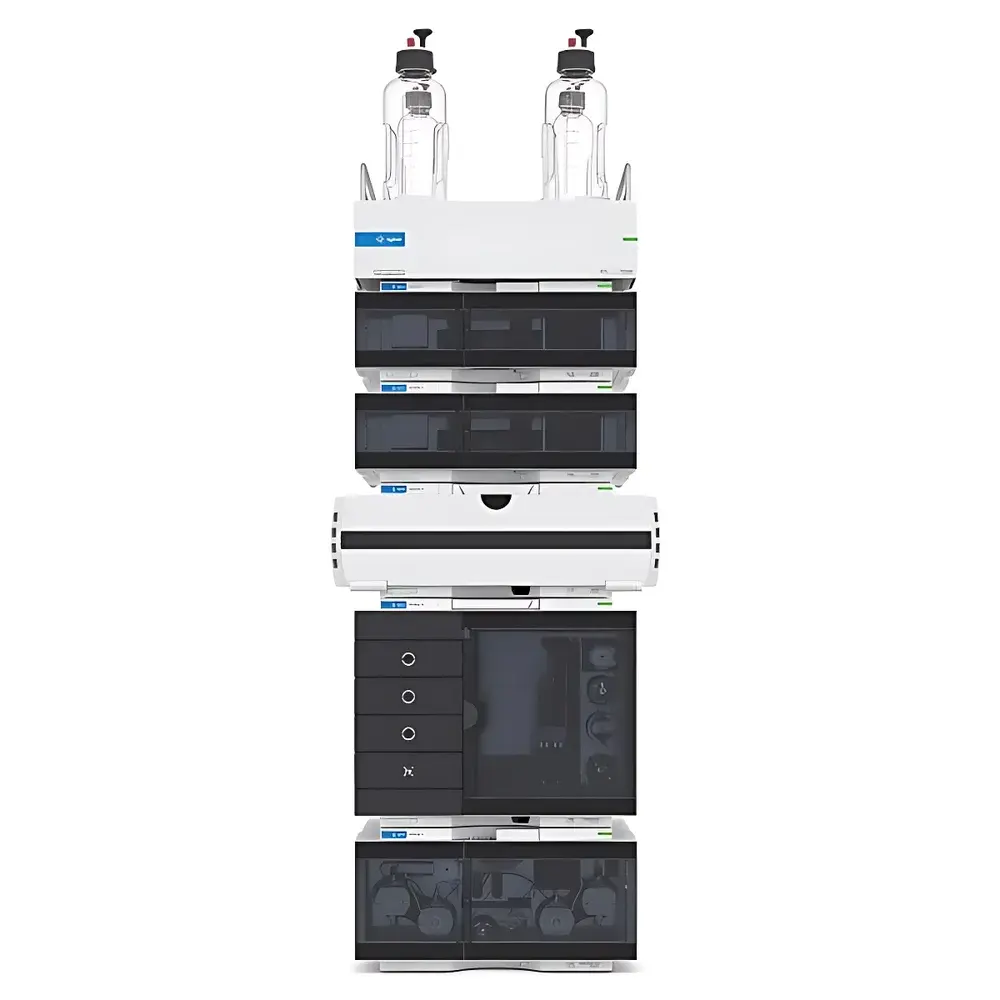
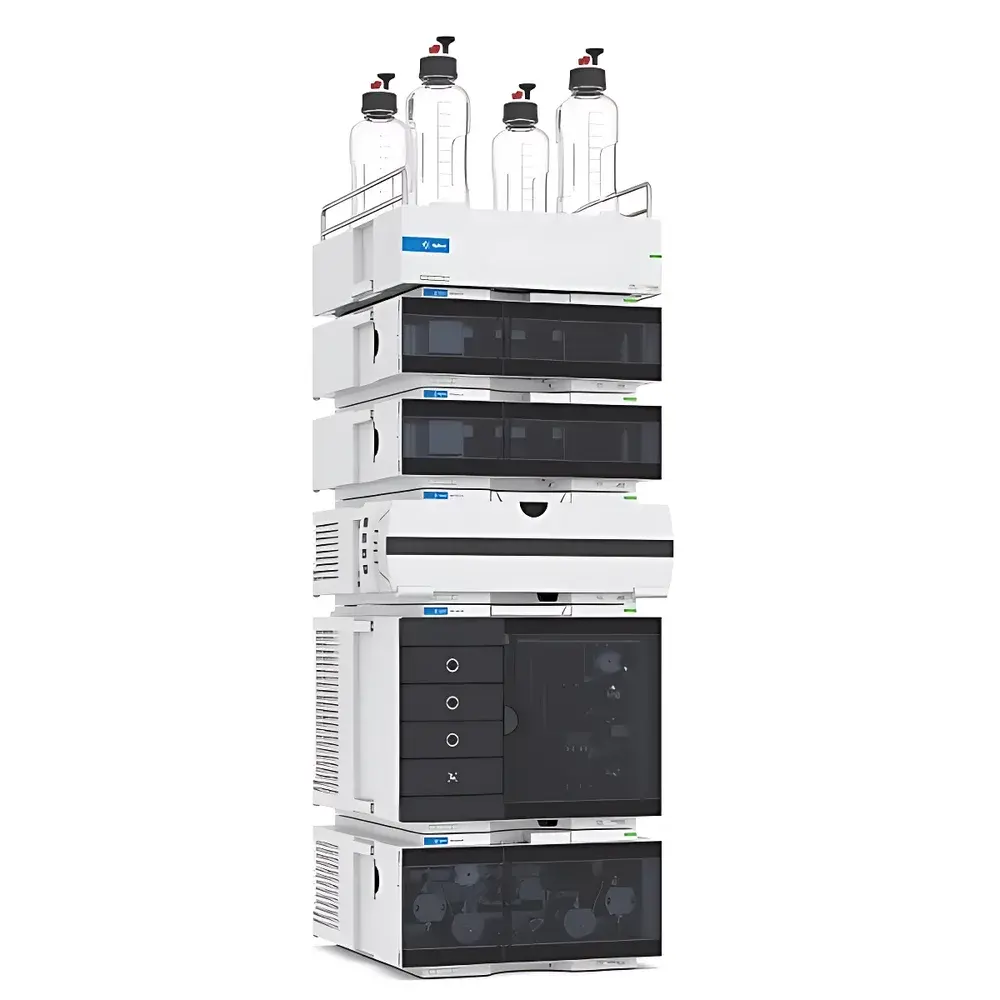
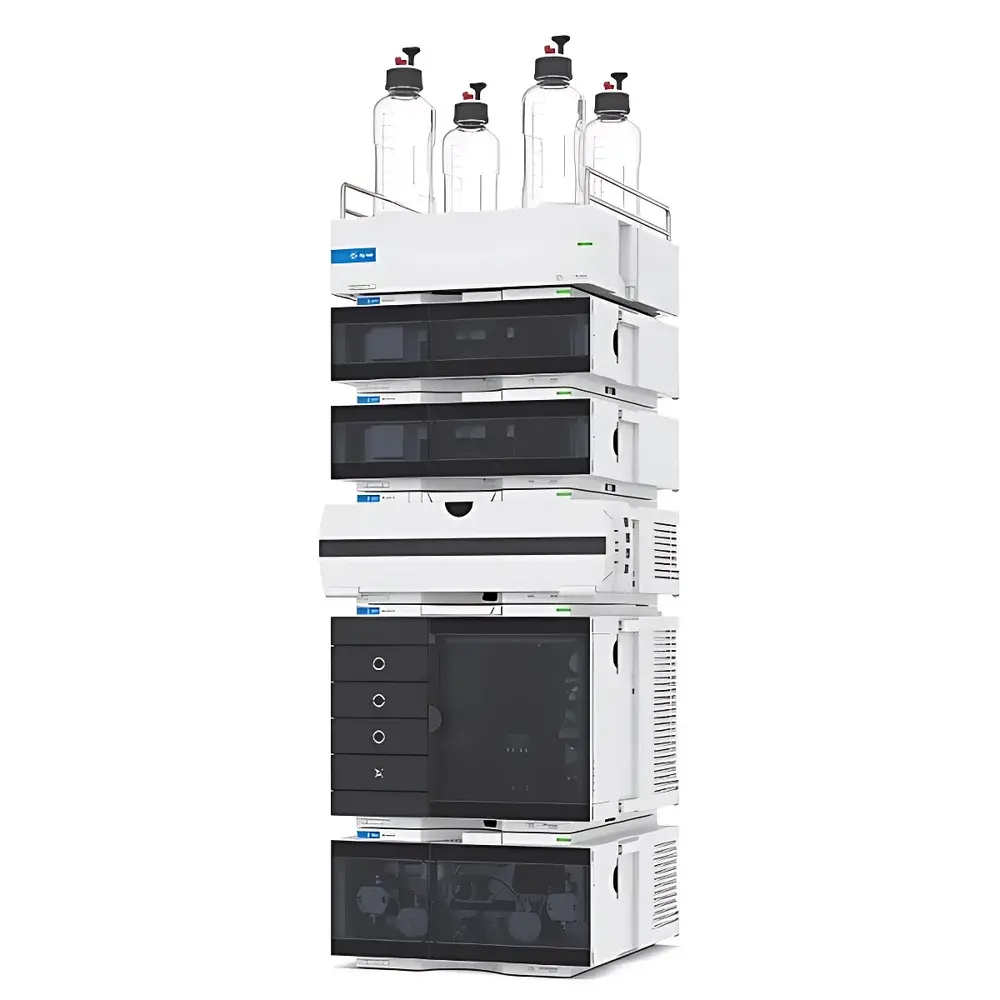
Agilent 1290 Infinity III HDR-DAD Impurity Analysis System
| Brand | Agilent Technologies |
|---|---|
| Origin | Germany |
| Manufacturer Type | Original Equipment Manufacturer (OEM) |
| Product Origin | Imported |
| Model | 1290 Infinity III HDR-DAD |
| Instrument Type | Conventional Ultra-High Performance Liquid Chromatograph (UHPLC) |
| Application Scope | General-purpose impurity profiling and trace-level quantitation |
| Flow Rate Range | Up to 5 mL/min (G7120A pump module) |
| Maximum Operating Pressure | 1300 bar |
| Injection Volume Range | 0.1–100 µL (standard) |
Overview
The Agilent 1290 Infinity III HDR-DAD Impurity Analysis System is a purpose-engineered UHPLC platform integrating high-resolution liquid chromatography with a wide dynamic range diode array detector (HDR-DAD). It operates on the principle of reversed-phase or hydrophilic interaction liquid chromatography (HILIC), coupled with real-time, full-spectrum UV-Vis detection (190–800 nm) at acquisition rates up to 80 Hz. Designed specifically for pharmaceutical quality control, stability-indicating assays, and regulatory-compliant impurity profiling, the system delivers simultaneous separation and quantitation of major active pharmaceutical ingredients (APIs) and structurally related low-abundance impurities—without signal saturation or detector nonlinearity. Its 1300 bar pressure capability enables use of sub-2 µm particle columns for enhanced peak capacity and resolution, while the HDR-DAD’s extended linear dynamic range—30× greater than conventional DADs—ensures accurate photometric response across concentration spans from 0.01% to >100% relative to main peak area, eliminating the need for sample dilution or re-injection.
Key Features
- Ultra-high-pressure UHPLC architecture supporting up to 1300 bar, enabling optimal utilization of narrow-bore and core-shell columns for improved efficiency and reproducibility
- High-definition HDR-DAD with 30× expanded linear dynamic range (0.0005–4.0 AU), delivering robust quantitation of trace impurities alongside dominant components in a single chromatographic run
- G7120A binary pump delivering precise flow control from 0.001 to 5.000 mL/min with <0.07% RSD flow precision and <0.15% RSD retention time repeatability
- Autosampler with 0.1–100 µL standard injection volume range; expandable to 1500 µL via Multi-Draw Kit for high-volume or low-concentration applications
- Dual-zone column compartment (G7116A/B) maintaining temperature stability ±0.1 °C across 5–85 °C, critical for method transfer and retention time consistency
- Integrated column ID reader (optional) for automated method validation and audit trail compliance in regulated environments
- ACT-certified sustainability profile: independently verified by My Green Lab for reduced environmental impact across manufacturing, energy use, and end-of-life recyclability
Sample Compatibility & Compliance
The system supports aqueous, organic, and mixed mobile phases across four solvent channels (expandable to 15 with Solvent Selection Valve), accommodating ICH Q2(R2)-recommended gradient methods for forced degradation studies. It complies with global regulatory requirements including USP , EP 2.2.46, and JP 6.03 for HPLC method validation. Data integrity is ensured through native support for Agilent OpenLab CDS 2.x and alignment with FDA 21 CFR Part 11, Annex 11, and ALCOA+ principles—featuring electronic signatures, role-based access control, and immutable audit trails for all instrument method changes, sequence modifications, and raw data processing events.
Software & Data Management
Controlled via Agilent OpenLab CDS (ChemStation Edition or EZChrom Edition), the system provides validated workflows for peak integration, purity assessment (peak homogeneity via spectral overlay), and threshold-based impurity reporting per ICH Q3B(R3). The HDR-DAD’s high-speed spectral acquisition enables post-run deconvolution of co-eluting peaks using library-matched spectra. All raw data—including chromatograms, spectra, and method parameters—are stored in vendor-neutral .d format compliant with ISO/IEC 17025 and GLP/GMP documentation standards. Optional integration with Agilent MassHunter or OpenLab ECM supports hybrid workflows involving LC-MS confirmation of unknown impurities.
Applications
- ICH Q3B(R3)-compliant identification and quantitation of process-related and degradation impurities in drug substances and products
- Stability-indicating assay development for accelerated and long-term storage studies
- Forced degradation product characterization under acidic, basic, oxidative, thermal, and photolytic stress conditions
- Excipient compatibility screening and leachables profiling in primary packaging systems
- Reference standard purity assessment and certificate of analysis (CoA) generation
- Method transfer between QC labs and contract manufacturing organizations (CMOs) with documented equivalence protocols
FAQ
What distinguishes the HDR-DAD from conventional DAD detectors in impurity analysis?
The HDR-DAD eliminates detector saturation during high-concentration API injections while preserving linearity for sub-0.1% impurity peaks—enabling true single-run quantitation without manual range switching or sample dilution.
Can this system be used for method validation under ICH Q2(R2)?
Yes—the platform meets all system suitability, specificity, accuracy, precision, linearity, range, and robustness requirements when operated with validated OpenLab CDS methods and documented instrument qualification (IQ/OQ/PQ).
Is the 1300 bar pressure rating compatible with legacy 1200-series columns?
While backward-compatible with most 1200-series hardware interfaces, column hardware must be rated for ≥1300 bar; older stainless-steel frits or fittings may require replacement to ensure mechanical integrity.
How does the ACT certification impact laboratory sustainability reporting?
The My Green Lab ACT label provides third-party-verified metrics on energy consumption, hazardous material content, and recyclability—supporting ESG reporting and green lab certification initiatives.
What data security features are embedded for regulated environments?
Full 21 CFR Part 11 compliance includes digital signature capture, user authentication, automatic audit trail logging, and encrypted data storage—configurable to meet internal SOPs and external inspection readiness requirements.






