
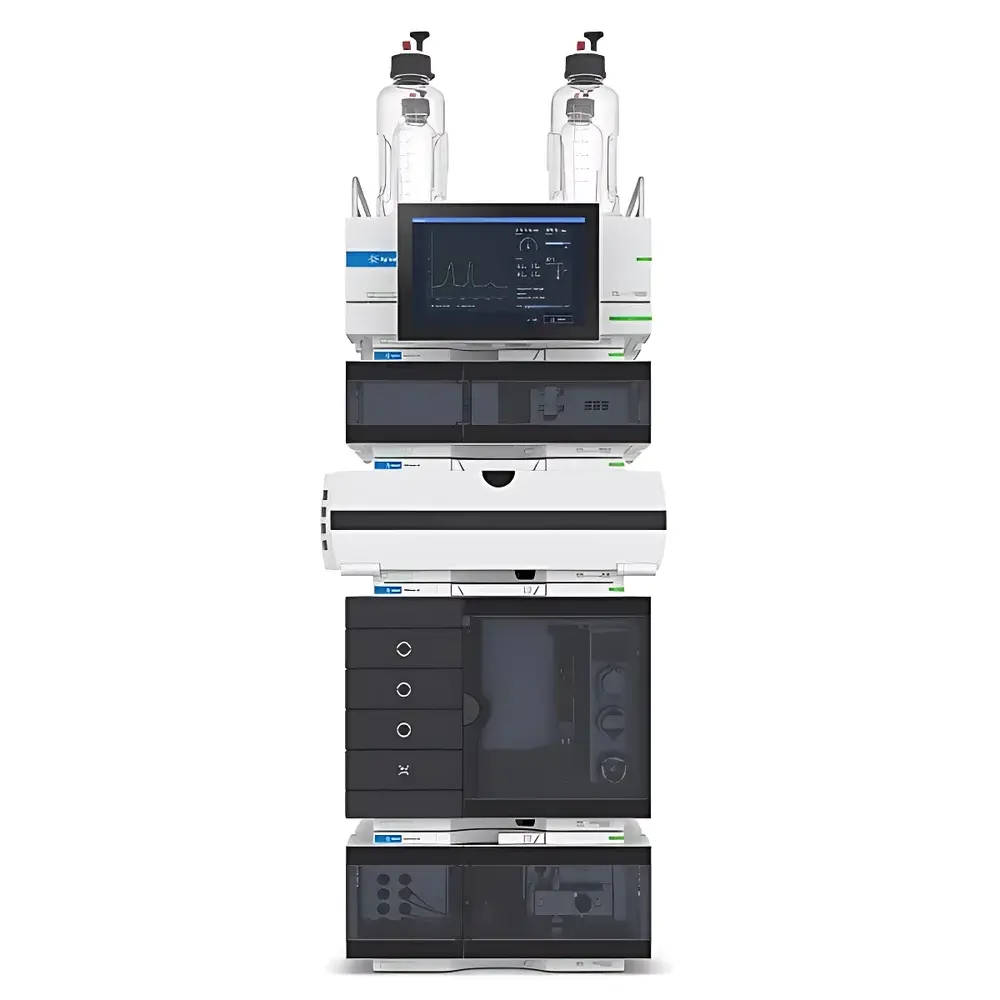
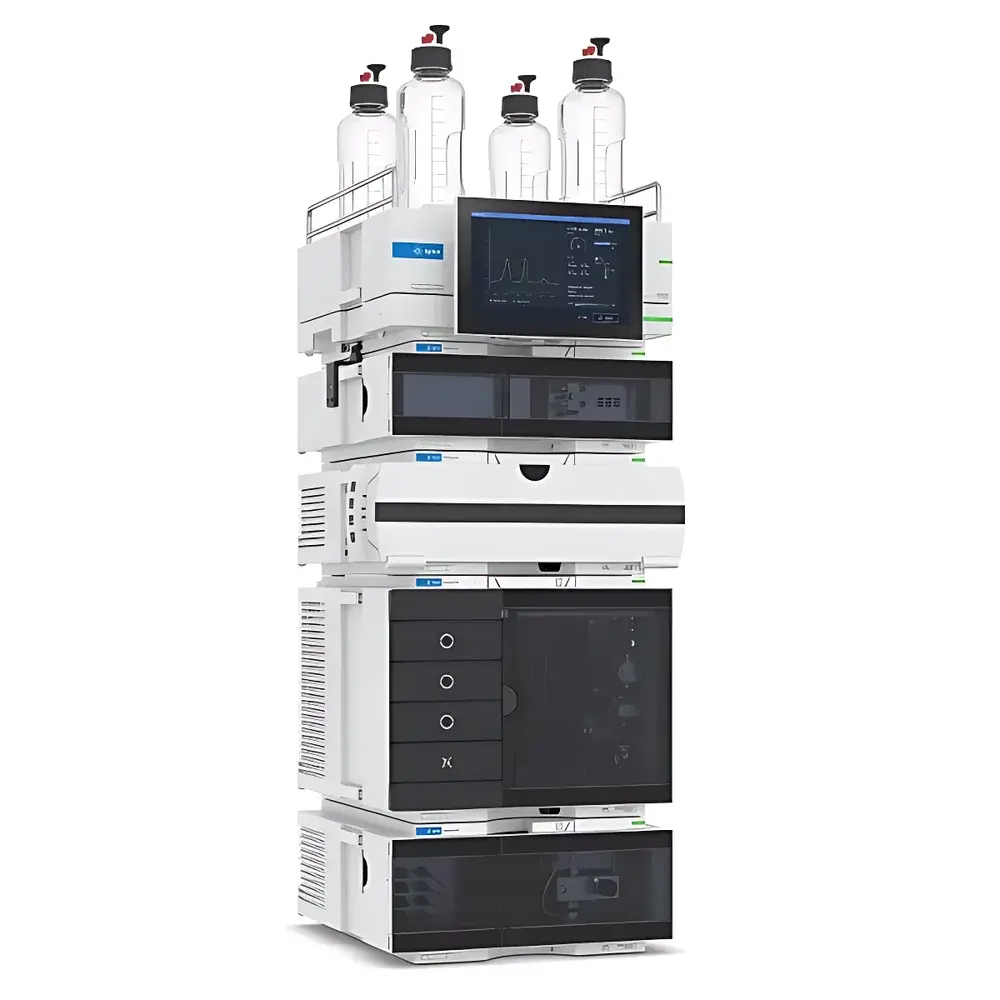
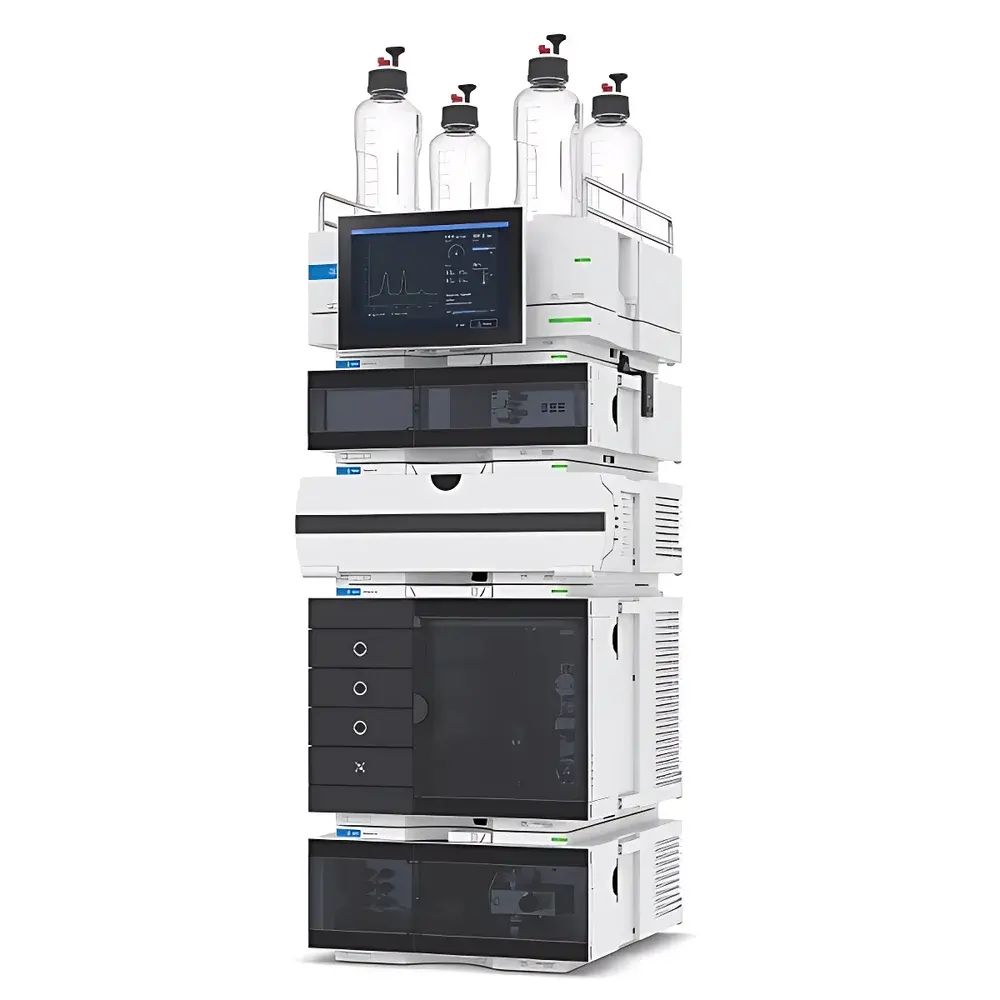
Agilent 1260 Infinity III Bio-Inert Liquid Chromatography System
| Brand | Agilent Technologies |
|---|---|
| Origin | Germany |
| Manufacturer | Agilent Technologies |
| Origin Category | Imported |
| Model | 1260 Infinity III Bio-Inert LC System |
| Instrument Type | Ultra-High Performance Liquid Chromatograph (UHPLC) |
| Application | Universal for Biomolecular Analysis |
| Flow Rate Range | 0.2–10 mL/min |
| Maximum Operating Pressure | up to 600 bar |
| Injection Volume Range | 0.1–100 µL (0.1–1000 µL with Multi-Draw Kit, max 400 bar) |
| Solvent Channels | 4 (expandable to 15 with Solvent Selection Valve) |
| Column Temperature Zones | 2 (with G7116A) |
| Column ID Reader | Optional |
| Column Capacity | 4 |
| pH Range | 1–13 (short-term exposure to pH 14) |
| Salt Tolerance | up to 2 mol/L NaCl |
| Residual Carryover | <9 ppm |
| Power Supply | 100–240 VAC |
| Dimensions (W × D) | 435 × 468 mm |
| ACT Certification | Yes (My Green Lab ACT Label) |
Overview
The Agilent 1260 Infinity III Bio-Inert Liquid Chromatography System is an engineered UHPLC platform designed specifically for the robust, reproducible, and contamination-free analysis of sensitive biomolecules—including monoclonal antibodies (mAbs), recombinant proteins, peptides, and other labile biopharmaceuticals. Its core architecture implements a fully bio-inert fluidic path, eliminating all metallic surfaces (e.g., stainless steel, iron) in contact with samples or mobile phases. Instead, wetted components—including pump heads, injection valve rotors/stators, capillaries, and flow cells—are constructed from chemically resistant materials such as PEEK, titanium, sapphire, and ceramic-coated alloys. This design mitigates metal-catalyzed degradation, adsorption, oxidation, and aggregation—critical failure modes in protein chromatography. The system supports high-pressure operation up to 600 bar, enabling use of sub-2 µm particle-packed columns for enhanced resolution and speed without compromising biomolecular integrity. It complies with ICH Q5E guidelines on comparability of biologics and supports GLP/GMP-aligned workflows through hardware-level traceability and software audit trail capabilities.
Key Features
- Fully bio-inert flow path: No stainless steel, iron, or nickel in sample-contacting components—validated for compatibility with acidic, basic, and high-salt mobile phases (pH 1–13; short-term pH 14; ≤2 mol/L NaCl)
- High-pressure UHPLC capability: Dual-piston quaternary pump delivering precise flow control from 0.2 to 10 mL/min at pressures up to 600 bar
- Low carryover autosampler: 1260 Infinity III Bio-Inert Multisampler with active seal wash and dual-stage needle wash reduces residual carryover to <9 ppm
- Modular detection: Compatible with inert UV/Vis flow cells and fluorescence detectors optimized for low-volume, high-sensitivity biomolecule detection
- Column selection flexibility: Integrated column selector valve supports up to four columns; optional column ID reader enables automatic method-to-column mapping and tracking
- Advanced connectivity: InfinityLab Quick Connect fittings and Quick Turn column connectors minimize installation time and leak risk while maintaining pressure integrity
- Sustainability certified: Independently audited and awarded the My Green Lab ACT Label for environmental accountability across its full lifecycle
Sample Compatibility & Compliance
The system is validated for direct analysis of intact mAbs, antibody-drug conjugates (ADCs), fusion proteins, and host cell proteins (HCPs) under native and denaturing conditions. Its bio-inert construction ensures compliance with USP , ISO 17025, and ASTM E2689 for analytical method robustness in biopharmaceutical QC environments. When configured with SEC or IEX columns, it meets FDA 21 CFR Part 11 requirements for electronic records and signatures when paired with OpenLab CDS 2.x or later. All hardware components are qualified per Agilent’s Biocompatibility Assurance Program (BAP), including extractables/leachables testing per USP and ISO 10993-1. The system supports IQ/OQ/PQ documentation packages aligned with GxP and EU Annex 11 expectations.
Software & Data Management
Agilent OpenLab CDS provides integrated method development, acquisition, and reporting for multi-attribute monitoring (MAM) and quality-by-design (QbD) workflows. The included Buffer Advisor software accelerates ion-exchange method development by automating buffer pKa calculations, salt concentration optimization, and gradient slope prediction—reducing empirical screening time by up to 60%. All chromatographic data are stored with full audit trail, electronic signature support, and version-controlled method parameters. Raw data files comply with ASTM E2812-22 for chromatographic data interchange and are compatible with third-party platforms including Waters Empower and Thermo Chromeleon via .CDF export.
Applications
- Size-exclusion chromatography (SEC) for aggregate/fragment quantification and molecular weight distribution profiling of therapeutic proteins
- Ion-exchange chromatography (IEX) for charge variant analysis of mAbs and Fc-fusion proteins
- Reversed-phase LC (RPLC) for peptide mapping, deamidation, oxidation, and glycosylation site characterization
- Hydrophobic interaction chromatography (HIC) for higher-order structure assessment
- Multi-dimensional LC workflows integrating online desalting and fraction collection for proteomics and impurity identification
- Process development support for purification step validation and column lifetime studies
FAQ
Is the 1260 Infinity III Bio-Inert system compatible with SEC columns packed with sub-2 µm particles?
Yes—its 600-bar pressure rating and low-dispersion fluidic path enable optimal performance with AdvanceBio SEC columns (e.g., 1.9 µm, 300 Å pore size) for high-resolution separation of IgG aggregates.
Can the system be upgraded to support mass spectrometry coupling?
Yes—the system features standard LC/MS interface ports and low-flow-capable capillary routing; it is routinely deployed with Agilent 6470/6495 triple quadrupole and 6550 Q-TOF systems for intact mass analysis and peptide sequencing.
Does the bio-inert configuration affect baseline noise or detection sensitivity?
No—engineered inert flow cells (e.g., 60-mm pathlength UV cell with sapphire windows) maintain optical clarity and thermal stability, delivering signal-to-noise ratios comparable to conventional HPLC systems while eliminating metal-induced background drift.
How is column lifetime extended in bio-inert mode?
By eliminating metal-mediated surface adsorption and irreversible binding, column fouling is reduced—typical column lifetimes increase by 2–3× compared to stainless-steel-based systems under identical mAb loading conditions.
Is remote monitoring and preventive maintenance scheduling supported?
Yes—Agilent Remote Manager enables real-time status tracking, predictive diagnostics, and automated service alerts via secure HTTPS connection; all logs are timestamped and exportable for regulatory review.





