
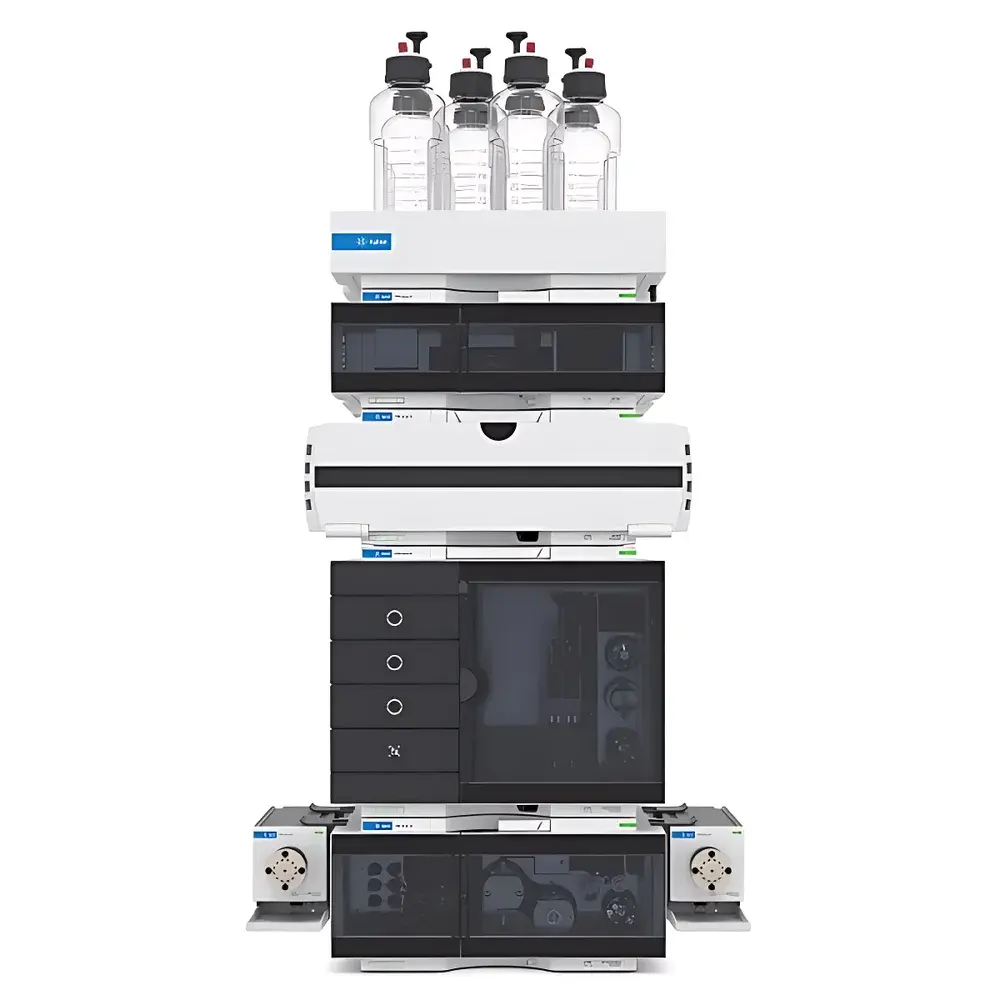
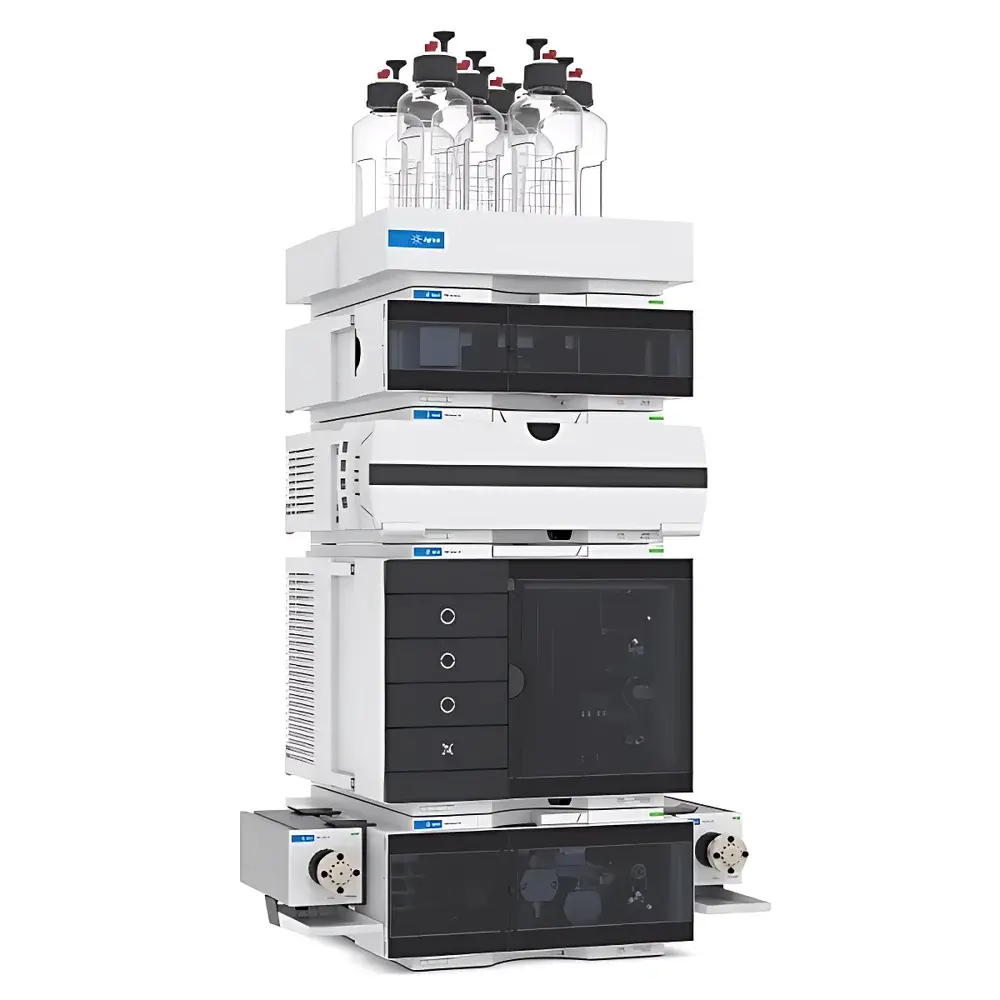
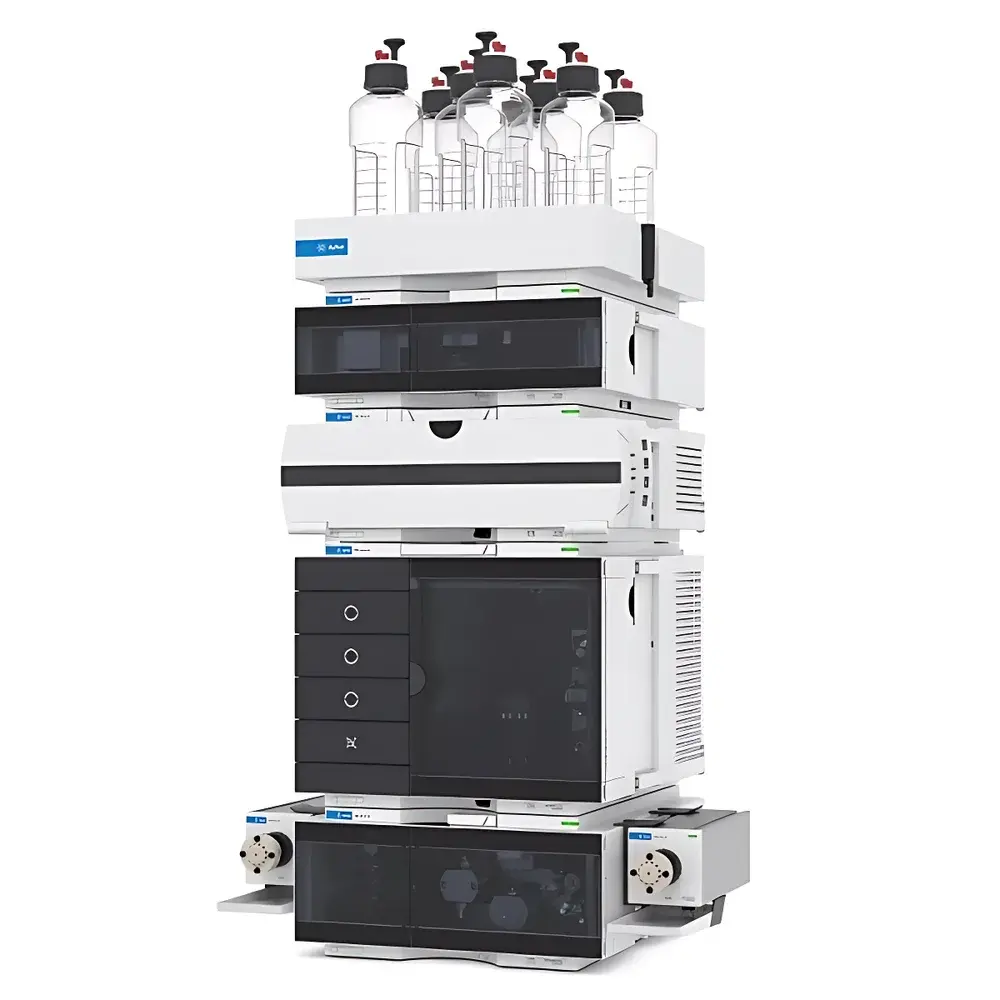
Agilent 1290 Infinity III Multimethod System
| Brand | Agilent Technologies |
|---|---|
| Origin | Germany |
| Manufacturer Type | Original Equipment Manufacturer (OEM) |
| Product Origin | Imported |
| Model | 1290 Infinity III Multimethod |
| Instrument Type | Ultra-High Performance Liquid Chromatograph (UHPLC) |
| Application Scope | General-purpose analytical laboratory |
| Flow Rate Range | up to 5 mL/min (with G7120A binary pump and G7104A quaternary pump) |
| Maximum Operating Pressure | 1300 bar |
| Injection Volume Range | 0.1–100 µL (standard) |
| Solvent Capacity | up to 26 solvents (with two external solvent selection valves) |
| Column Capacity | 8 columns (expandable to 32 via Multi-Column Thermostat clustering) |
| Temperature Zones | 2 standard (up to 8 with clustered MCT configuration) |
| Column ID Reader | Optional |
| BlendAssist Functionality | Enabled with G7104A pump |
| Power Supply | 100–240 VAC |
| Environmental Certification | My Green Lab ACT Label (Audited for Accountability, Consistency, Transparency across lifecycle) |
Overview
The Agilent 1290 Infinity III Multimethod System is an ultra-high performance liquid chromatography (UHPLC) platform engineered for maximum instrument utilization in shared-laboratory environments. Built upon Agilent’s proven 1300-bar fluidic architecture, it supports simultaneous method execution across multiple users without manual reconfiguration—enabling true multimethod operation within a single, integrated LC system. Its core design leverages advanced pressure-stable pumping, low-dispersion flow paths, and intelligent solvent blending via BlendAssist technology to deliver high-resolution separations under demanding gradient conditions. The system operates fully compliant with Good Laboratory Practice (GLP) and Good Manufacturing Practice (GMP) requirements, supporting audit-ready data integrity through secure user authentication, electronic signatures, and full 21 CFR Part 11–compliant software logging.
Key Features
- Automated Method Switching: Seamless transition between chromatographic methods—including column chemistries, mobile phase compositions, and temperature profiles—without manual intervention or system downtime.
- Dual-Needle Multisampler (G7129A): Independent injection channels enable parallel sample handling; one needle dedicated to routine analysis, the other to sample cleanup or challenging matrices (e.g., plasma, tissue extracts), minimizing carryover and cross-contamination.
- High-Pressure Flexibility: Sustained operation at up to 1300 bar allows use of sub-2-µm particles and narrow-bore columns for enhanced resolution, peak capacity, and speed—critical for complex biopharmaceutical, environmental, and food safety applications.
- Expandable Column Management: Standard 8-position column thermostat (MCT) supports diverse column types (reversed-phase, HILIC, SEC, chiral); scalable to 32 columns via clustered MCT configurations for high-throughput method development and screening workflows.
- BlendAssist Solvent Delivery: Dynamic on-line mixing of stock solutions enables precise, real-time buffer and pH gradient formation—eliminating need for pre-mixed mobile phases and reducing solvent waste by up to 40% versus conventional quaternary systems.
- Sustainability-Certified Design: Independently verified by My Green Lab’s ACT label for environmental accountability across manufacturing, energy use, packaging, and end-of-life recyclability—supporting institutional ESG reporting and green lab certification programs.
Sample Compatibility & Compliance
The 1290 Infinity III Multimethod System accommodates a broad range of sample types—from small-molecule pharmaceuticals and metabolites to intact monoclonal antibodies and oligonucleotides—when paired with appropriate column chemistries and detection modules (e.g., DAD, MWD, or MS-coupled interfaces). It complies with key international standards including ISO/IEC 17025:2017 (for testing laboratories), ASTM D7097 (for hydrocarbon analysis), USP (chromatography), and ICH Q2(R2) guidelines for method validation. All firmware and software components meet FDA 21 CFR Part 11 requirements for electronic records and signatures, featuring role-based access control, immutable audit trails, and automated backup protocols aligned with GLP/GMP data governance frameworks.
Software & Data Management
Controlled via OpenLab CDS 2.x or MassHunter Workstation (for LC/MS configurations), the system supports centralized method deployment, remote monitoring, and automated report generation. The software architecture includes built-in sequence scheduling, real-time pressure/flow diagnostics, and predictive maintenance alerts based on pump seal wear metrics and column backpressure trends. Data files adhere to AIA/ANDI standards for cross-platform compatibility, while raw data storage follows ALCOA+ principles (Attributable, Legible, Contemporaneous, Original, Accurate, Complete, Consistent, Enduring, Available). Integration with LIMS and ELN platforms is achieved through standardized RESTful APIs and vendor-neutral middleware (e.g., Thermo Fisher SampleManager, LabVantage).
Applications
- Pharmaceutical QC/QA: Release testing of APIs and finished dosage forms per compendial monographs (USP, EP, JP)
- Biopharmaceutical Characterization: mAb charge variant profiling, glycan mapping, and peptide mapping workflows
- Environmental Monitoring: Multi-residue pesticide analysis in soil/water matrices per EPA Method 1694
- Clinical Research: Quantitative bioanalysis of therapeutic drugs and biomarkers in plasma/serum using validated LC-MS/MS methods
- Food & Beverage Safety: Mycotoxin screening, allergen peptide detection, and nutritional compound quantification
- Academic & Contract Research: High-throughput method scouting, stability-indicating assay development, and forced degradation studies
FAQ
Can the 1290 Infinity III Multimethod System run multiple methods concurrently?
Yes—via time-scheduled method switching and independent autosampler channels, enabling unattended execution of distinct analytical protocols across different users or projects.
Is column identification (ID) reading supported natively?
Column ID reading is available as an optional hardware module (G7167B), compatible with Agilent-certified Smart Columns and enabling automatic method-parameter recall based on physical column attributes.
What solvent management options exist for large-scale method libraries?
With two external solvent selection valves, the system supports up to 26 discrete solvents—ideal for labs maintaining extensive gradient libraries across reversed-phase, HILIC, and ion-pairing methods.
How does BlendAssist improve method robustness?
By dynamically blending stock solutions during gradient formation, BlendAssist eliminates errors from manual solvent preparation, reduces baseline drift, and improves retention time reproducibility across long sequences.
Is the system suitable for regulated environments requiring 21 CFR Part 11 compliance?
Yes—OpenLab CDS 2.x provides full electronic signature support, audit trail archiving, and role-based permissions validated per Agilent’s IQ/OQ/PQ documentation packages.
Related Products




