
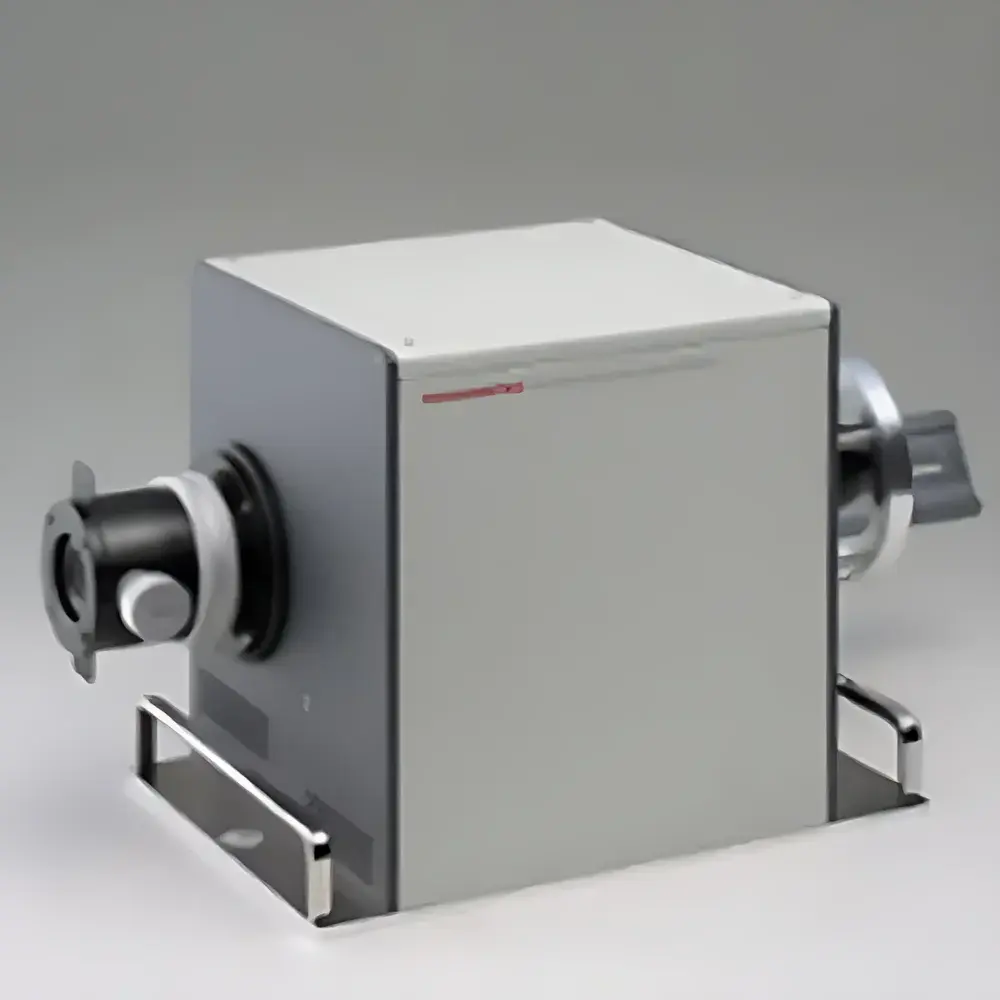
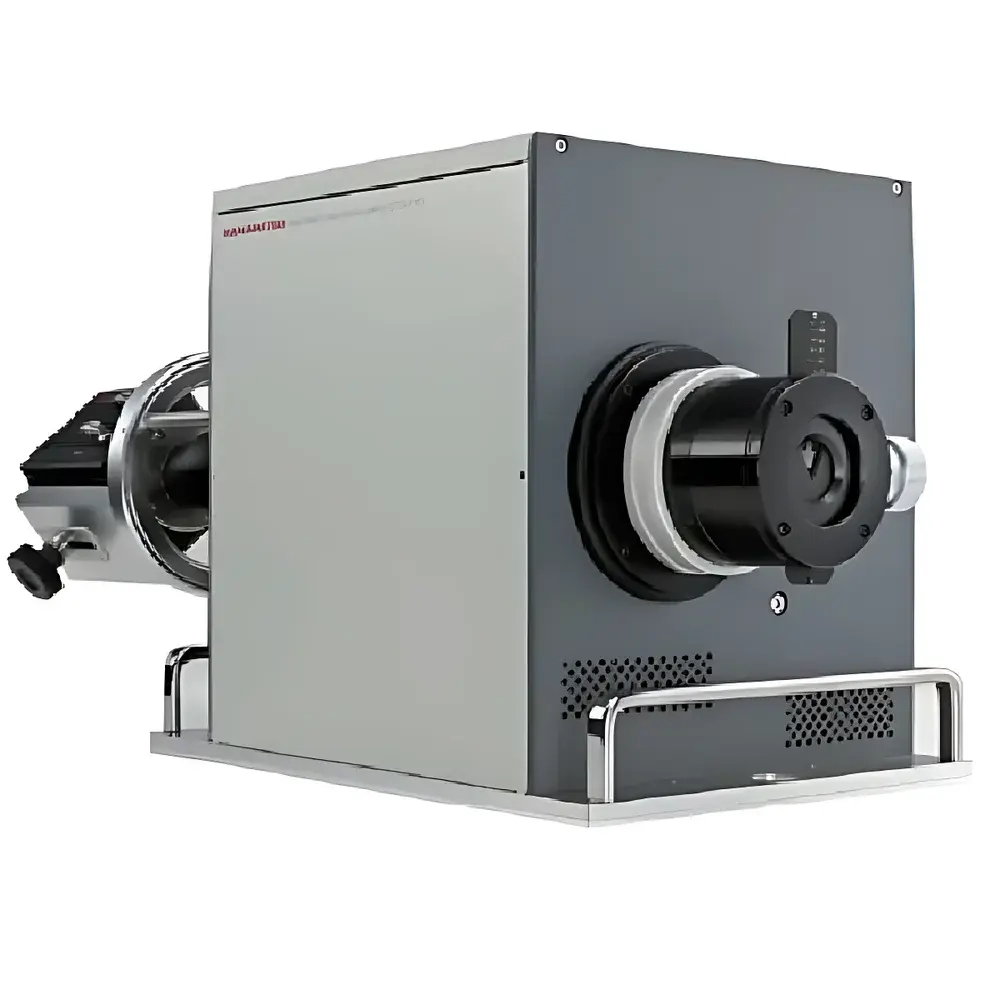
Hamamatsu C13410 High-Dynamic-Range Streak Camera
| Brand | Hamamatsu |
|---|---|
| Origin | Japan |
| Manufacturer Status | Authorized Distributor |
| Product Category | Imported |
| Model | C13410 |
| Price Range | USD 420,000 – 700,000 |
| Instrument Type | Synchronized Scanning Streak Camera |
| Photocathode Material | S-20 / S-1 |
| Photocathode Dimensions | 7.0 mm × 17.48 mm |
| Spectral Response Range | 200–850 nm (S-20) / 300–1060 nm (S-1) |
| Spatial Resolution | ≥18 lp/mm (at photocathode center, λ = 530 nm) |
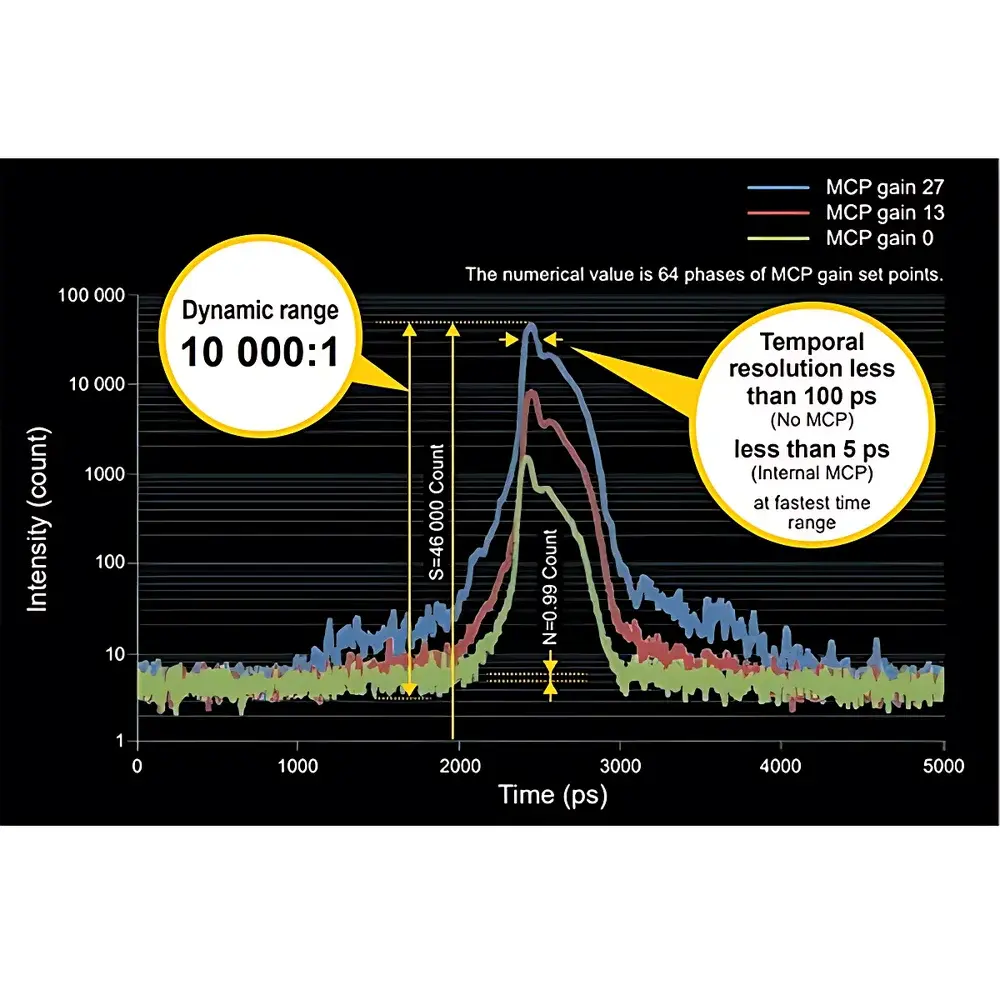
| Temporal Resolution | <5 ps (at fastest sweep range) |
Overview
The Hamamatsu C13410 is a high-dynamic-range synchronized scanning streak camera engineered for quantitative, single-shot ultrafast optical diagnostics. It operates on the principle of time-resolved photoelectron deflection: incident photons strike a photocathode, generating photoelectrons that are accelerated and electrostatically swept across a phosphor screen at precisely controlled linear velocities. The resulting spatial displacement along the horizontal axis encodes temporal information, while the vertical axis preserves spatial or spectral dimensionality—enabling simultaneous measurement of intensity versus time and position (or wavelength, when coupled with a spectrometer). With a maximum effective photocathode length of 17.48 mm and dual photocathode options (S-20 for UV–visible, S-1 for extended NIR), the C13410 supports broad-band ultrafast spectroscopy from 200 nm to 1060 nm. Its sub-5-ps temporal resolution—achieved via low-jitter (<±20 ps) triggering, sub-nanosecond sweep linearity, and optimized electron optics—makes it suitable for applications demanding both picosecond timing fidelity and high signal-to-noise ratio across orders-of-magnitude intensity variation.
Key Features
- High dynamic range up to 10,000:1 (measured at 100 ps sweep speed); maintains 1,000:1 at 5 ps sweep speed
- Temporal resolution better than 5 ps at the fastest sweep setting (0.5 ns full-scale range)
- Large-format photocathode (7.0 mm × 17.48 mm) enabling high collection efficiency and compatibility with imaging optics and spectrograph slit coupling
- Dual photocathode variants: C13410-01x (S-20, 200–850 nm) and C13410-02x (S-1, 300–1060 nm)
- P-43 phosphor screen (25 mm diameter) with fiber-optic output for low-distortion, high-quantum-efficiency readout
- Adjustable sweep ranges from 0.5 ns to 10 ms, selectable via software; sweep linearity >99.5% over full range
- USB 2.0 interface for real-time data acquisition, configuration, and synchronization with external laser triggers or delay generators
- Integrated image intensifier (I.I./I.B.) option for single-photoelectron detection capability
Sample Compatibility & Compliance
The C13410 is designed for integration into vacuum-compatible, laser-based experimental environments—including high-power femtosecond/picosecond laser systems, plasma diagnostics chambers, and synchrotron beamlines. Its photocathode quantum efficiency (QE) profile complies with ISO 11146-3 for ultrafast beam characterization, and its timing jitter specification meets the requirements for time-of-flight measurements referenced in ASTM E2857 (Standard Practice for Time-of-Flight Mass Spectrometry). When operated with calibrated reference sources and traceable NIST-traceable photodiodes, the system supports GLP-compliant transient absorption and fluorescence lifetime quantification. No internal radioactive components; RoHS-compliant construction. CE-marked for EMC and safety (EN 61326-1, EN 61000-6-3).
Software & Data Management
Hamamatsu provides the proprietary StreakViewer software suite (Windows 10/11, 64-bit), supporting full instrument control, real-time preview, multi-frame averaging, and pixel-wise intensity calibration. Raw streak images are saved in 16-bit TIFF or HDF5 format with embedded metadata (timestamp, sweep speed, trigger delay, photocathode type, gain settings). The SDK includes C/C++ and Python APIs for custom automation, synchronization with pulse pickers or delay stages, and integration into LabVIEW or MATLAB-based analysis pipelines. Audit trails, user access logs, and electronic signatures are configurable to meet FDA 21 CFR Part 11 requirements for regulated R&D environments. Export modules support direct import into Origin, Igor Pro, and Python-based tools (NumPy, SciPy, scikit-image) for spectral-temporal decomposition and principal component analysis.
Applications
- Laser-driven inertial confinement fusion diagnostics: Thomson scattering, self-emission mapping, and shock front propagation
- Ultrafast spectroscopy: Picosecond transient absorption, time-resolved fluorescence anisotropy, and coherent anti-Stokes Raman scattering (CARS)
- Plasma physics: Line emission dynamics, electron temperature evolution, and recombination kinetics in Z-pinch and laser-ablated plasmas
- Time-of-flight LiDAR and atmospheric sensing: Single-photon ranging with sub-10-ps precision
- Ultrafast imaging modalities: Compressed Ultrafast Photography (CUP) and Hyperspectral CUP—validated in Nature and Physical Review Letters using earlier-generation Hamamatsu streak cameras (C7700), now superseded by the C13410’s enhanced dynamic range and photocathode area
- Combustion and detonation science: Chemiluminescence lifetime mapping during flame propagation and ignition events
FAQ
What is the difference between the C13410-01x and C13410-02x models?
The C13410-01x uses an S-20 photocathode with peak quantum efficiency in the visible range (200–850 nm), while the C13410-02x employs an S-1 photocathode optimized for near-infrared sensitivity (300–1060 nm), offering higher QE beyond 900 nm.
Can the C13410 be used for single-photon detection?
Yes—when equipped with the optional image intensifier (I.I./I.B.) module, the system achieves single-photoelectron sensitivity with photon-counting capability under gated operation.
Is vacuum required for operation?
The streak tube itself is hermetically sealed under high vacuum; no external vacuum pumping is needed. However, the input optical path must be maintained under vacuum or purged with dry nitrogen when measuring VUV or EUV radiation to prevent absorption.
How is timing synchronization achieved with external lasers?
Via SMA-trigger input with <±20 ps jitter; configurable trigger delay (adjustable from 0 to 10 µs in 1-ps steps) and programmable pre-/post-trigger acquisition windows.
Does the system support real-time data streaming?
StreakViewer enables real-time preview at up to 100 Hz (depending on ROI size and USB bandwidth); full-frame 16-bit streaming requires external frame grabber integration via SDK.



