
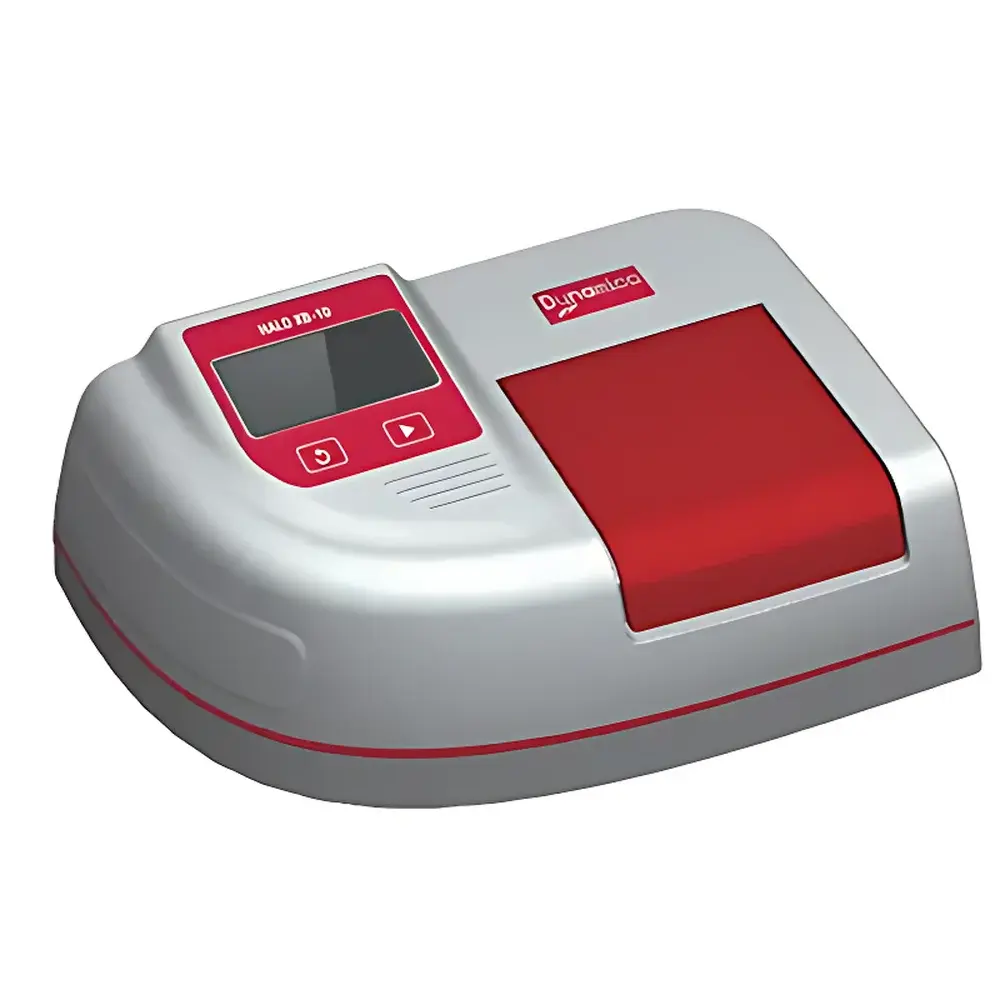
Dynamica XB-10 VIS-20 Touchscreen UV-Vis Spectrophotometer
| Brand | Dynamica |
|---|---|
| Origin | Australia |
| Model | XB-10 VIS-20 |
| Wavelength Range | 190–1000 nm (XB-10), 330–1000 nm (VIS-20) |
| Spectral Bandwidth | 5 nm (XB-10), 8 nm (VIS-20) |
| Wavelength Resolution | 1 nm |
| Wavelength Accuracy | ±2 nm |
| Wavelength Repeatability | 1 nm |
| Photometric Accuracy | ±1% T |
| Photometric Repeatability | 0.50% T |
| Stray Light | <0.5% at 220 nm, 340 nm, and 360 nm |
| Noise | 0.004 A at 250 nm, 0 A |
| Absorbance Range | –0.3 to 1.999 A |
| Transmittance Range | 0–199.9% T |
| Concentration Range | –300 to 1999 (user-selectable resolution: 1, 0.1, 0.01, or 0.001) |
| Data Storage | SD card |
| Measurement Modes | Absorbance, Transmittance, Concentration, Multi-wavelength, Kinetic (Time Scan), Spectrum Scan |
| Peak Detection | Automatic peak/valley identification in spectral scans |
Overview
The Dynamica XB-10 VIS-20 Touchscreen UV-Vis Spectrophotometer is a dual-platform benchtop instrument engineered for routine quantitative and qualitative analysis in academic teaching labs, quality control environments, and small-scale R&D settings. The XB-10 variant employs a pulsed xenon lamp to deliver full-spectrum coverage from 190 nm to 1000 nm—enabling reliable measurement across the deep ultraviolet, visible, and near-infrared regions. The VIS-20 variant utilizes a tungsten-halogen lamp optimized for stability and longevity in the 330–1000 nm range, making it ideal for applications where UV-critical measurements are not required. Both models implement single-beam optical architecture with fixed slit geometry and grating monochromator, ensuring consistent photometric performance without the complexity of dual-beam referencing. The instrument operates on Beer–Lambert law principles, converting detected photon flux into absorbance or transmittance values with traceable calibration pathways aligned to NIST-traceable standards.
Key Features
- 10.1-inch full-color capacitive touchscreen interface—responsive to stylus input and gloved operation, supporting pinch-to-zoom for spectral overlays and curve inspection
- Dual-lamp platform: Xenon source (XB-10) for extended UV coverage and rapid spectral acquisition; tungsten-halogen (VIS-20) for high-stability visible-range measurements
- Integrated self-diagnostic suite—including optical alignment verification, lamp intensity validation, and wavelength calibration check—executed at power-on and on-demand
- Real-time clock and calendar support time-stamped data logging and audit-ready metadata generation
- Onboard calculation engine for first-derivative spectra, peak/valley detection, and baseline correction during spectrum scan mode
- Modular design accommodating optional accessories including temperature-controlled cuvette holders, fiber-optic probes, and 8-position autosamplers (sold separately)
Sample Compatibility & Compliance
The XB-10 VIS-20 accepts standard 10 mm pathlength quartz or glass cuvettes (including matched pairs for reference compensation), as well as micro-volume adapters for sample volumes down to 50 µL. It complies with ISO 9001 manufacturing protocols and meets IEC 61010-1 safety requirements for laboratory electrical equipment. While not pre-certified for regulated GMP/GLP environments, its data integrity features—including immutable SD-card storage with timestamped .CSV export, user-accessible audit log, and configurable password protection—support alignment with FDA 21 CFR Part 11 expectations when deployed with documented SOPs. All photometric accuracy and stray light specifications conform to ASTM E275 and ISO 6059 test methodologies.
Software & Data Management
Data capture and export are handled natively via removable SD card (supplied), generating human-readable CSV files compatible with Excel, Origin, and MATLAB. For advanced analysis workflows, the optional UV-Detective software (Windows-based) provides extended functionality: multi-curve overlay with statistical comparison, kinetic trend modeling with rate constant derivation, custom calibration curve fitting (linear, quadratic, cubic, and 4-parameter logistic), and report generation compliant with internal QA templates. All software modules retain full traceability—each exported graph or table includes embedded metadata (operator ID, instrument serial number, date/time, measurement parameters). No cloud connectivity or remote telemetry is implemented, preserving data sovereignty in offline lab networks.
Applications
- Quantitative determination of nucleic acid concentration (A260) and purity (A260/A280, A260/A230) in molecular biology workflows
- Enzyme kinetics monitoring via time-scan mode (e.g., NADH oxidation at 340 nm)
- Colorimetric assay validation (e.g., Bradford, Lowry, BCA) across defined wavelength sets
- Quality assurance of dyes, pigments, and pharmaceutical excipients using spectral fingerprinting
- Teaching laboratory experiments covering Beer’s law verification, λmax determination, and mixture analysis via multi-wavelength regression
FAQ
Is the XB-10 capable of measuring below 200 nm in air?
Yes—the xenon lamp and fused silica optical path enable stable operation down to 190 nm without purging; however, atmospheric oxygen absorption becomes significant below 195 nm, so measurements at 190–195 nm are best interpreted with appropriate baseline correction.
Can the VIS-20 be upgraded to XB-10 functionality?
No—the lamp source, detector sensitivity profile, and grating calibration are hardware-differentiated; upgrade requires replacement of the optical module and firmware revalidation.
Does the instrument support GLP-compliant electronic signatures?
Not natively—the touchscreen supports operator login, but full 21 CFR Part 11 electronic signature capability requires integration with UV-Detective software and local domain authentication infrastructure.
What is the maximum scan speed in spectrum mode?
The XB-10 achieves 12,000 nm/min scanning speed with 1 nm step resolution; VIS-20 operates at 8,000 nm/min under identical conditions.
Are cuvette recognition sensors included?
No—cuvette positioning is manual; however, the optical beam height is fixed at 15 mm from the base to ensure compatibility with standard 10 mm cells and minimize meniscus-related variability.
Related Products




