
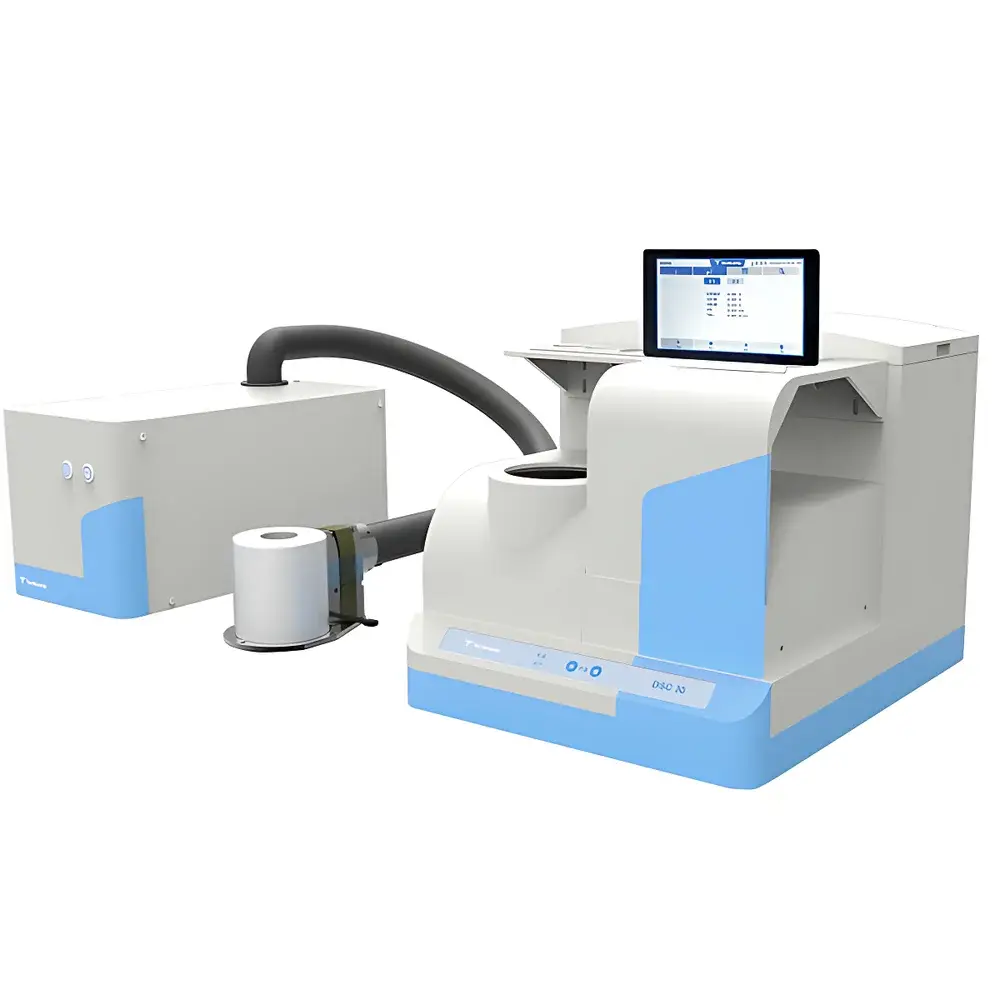
Techcomp DSC30 Intelligent Heat-Flow Differential Scanning Calorimeter
| Brand | Techcomp |
|---|---|
| Origin | Shanghai, China |
| Manufacturer Type | Original Equipment Manufacturer (OEM) |
| Model | DSC30 |
| Temperature Range | Ambient to 750 °C |
| Temperature Accuracy | ±0.1 °C |
| Heating/Cooling Rate | 0.1–100 °C/min |
| Baseline Stability | < ±0.1 µW over 30 min |
| Atmosphere Control | Dual-channel, 0–200 mL/min (0.1 mL/min resolution) |
| Cooling Speed | 550 °C → −40 °C in ≤35 min |
| Temperature Control Precision | < ±0.03 °C (isothermal), Linearity Error < 0.1 °C @ 10 °C/min |
| Sensor | Integrated NiCr/NiSi thermopile with symmetrical sample-stage electrodes |
Overview
The Techcomp DSC30 is a high-performance heat-flow differential scanning calorimeter engineered for precision thermal characterization of solids and liquids across academic, industrial R&D, and quality control laboratories. Operating on the fundamental principle of heat-flow DSC, the instrument continuously measures the differential heat flux between a sample and an inert reference as both are subjected to identical, programmable temperature profiles—enabling quantitative determination of endothermic and exothermic transitions including melting, crystallization, glass transition (Tg), solid-solid phase changes, oxidative induction time (OIT), specific heat capacity (Cp), and reaction enthalpies. Its design adheres to ISO 11357, ASTM E794, and ASTM E1356 standards for DSC methodology, ensuring data traceability and inter-laboratory comparability. The system is optimized for reproducible thermal analysis under controlled atmospheres—including inert (N2, Ar), oxidizing (air, O2), or reactive gas environments—supporting applications from polymer stability assessment to pharmaceutical polymorph screening.
Key Features
- Monolithic furnace architecture: Integrates a high-conductivity pure-silver heating block with embedded dual-gas channels, minimizing thermal lag and ensuring uniform temperature distribution (<±0.2 °C across 5 mm sample zone) and stable purge gas flow dynamics.
- High-fidelity heat-flow sensor: Custom-welded NiCr/NiSi thermopile with symmetrical sample-stage electrodes functions as both thermal mass and thermoelectric junction—delivering sub-microwatt sensitivity and rapid thermal response (τ < 0.8 s).
- Adaptive temperature control system: Combines high-frequency PWM power modulation (1/40,000 resolution) with BP neural network–assisted dynamic PID tuning, enabling robust thermal regulation across full operating range—from ambient to 750 °C—with isothermal stability < ±0.03 °C and linear ramp fidelity < 0.1 °C deviation at 10 °C/min.
- Intelligent dual-atmosphere management: Independent mass flow controllers (MFCs) support simultaneous or sequential switching between two gases (e.g., N2/O2) at 0.1 mL/min resolution and up to 200 mL/min total flow—critical for OIT testing per ASTM D3895 and oxidation kinetics studies.
- Rapid active cooling module: Achieves 550 °C → −40 °C in ≤35 minutes without liquid nitrogen, enabling precise isothermal crystallization studies and extended low-temperature characterization down to −40 °C.
Sample Compatibility & Compliance
The DSC30 accommodates standard hermetic and vented aluminum crucibles (20–50 µL), platinum, and gold pans—suitable for volatile organics, thermosets, metals, pharmaceuticals, and battery electrolytes. Sample mass range: 0.5–25 mg (optimal 3–10 mg). All hardware and firmware comply with IEC 61000-6-3 (EMC) and IEC 61010-1 (safety). Software supports 21 CFR Part 11–compliant audit trails, electronic signatures, and role-based access control when deployed in regulated GMP/GLP environments. Calibration protocols align with NIST-traceable standards (indium, zinc, tin, sapphire) and include multi-point non-linear baseline and enthalpy correction routines.
Software & Data Management
Techcomp Thermal Analysis Suite (v4.x) is a Windows-based platform supporting real-time signal visualization, automated data logging (≥100 Hz sampling), and post-run processing with zero manual interpolation. Key capabilities include: (1) Multi-point polynomial baseline fitting (up to 5th order) for accurate Tg, Tm, and ΔH quantification; (2) Cold-junction compensation integrated into thermocouple signal chain; (3) Automated peak detection with customizable onset/offset algorithms (tangent, intersection, derivative); (4) OIT calculation per ASTM D3895 using isothermal oxidation curves; (5) Cp determination via sapphire calibration method (ISO 11357-4); (6) Export of raw ASCII data (.txt), processed results (.csv), and publication-ready vector graphics (.svg, .emf). All calibration constants, method parameters, and raw datasets are stored in encrypted project files with SHA-256 integrity verification.
Applications
- Thermal stability and decomposition kinetics of polymers, composites, and adhesives
- Polymorph identification and relative stability ranking in API development
- Crystallinity quantification in semi-crystalline thermoplastics (e.g., PP, PET, PEEK)
- Oxidative induction time (OIT) and onset temperature (OOT) for antioxidant efficacy evaluation
- Glass transition mapping in amorphous small molecules and biologics formulations
- Reaction enthalpy and curing kinetics of epoxy resins and UV-curable systems
- Specific heat capacity profiling for thermal modeling of battery materials and ceramics
FAQ
What calibration standards are included with the DSC30?
A complete NIST-traceable calibration kit is supplied: high-purity indium (Tm = 156.598 °C, ΔHfus = 28.45 J/g), tin (Tm = 231.928 °C), zinc (Tm = 419.527 °C), and sapphire (for Cp calibration). Certificate of analysis and uncertainty budgets are provided.
Does the software support GLP-compliant data archiving?
Yes—the Thermal Analysis Suite implements full 21 CFR Part 11 compliance: electronic signatures, immutable audit trails, user authentication, and secure database encryption (AES-256). Audit logs record all method edits, calibration events, and result exports with timestamps and operator IDs.
Can the DSC30 perform modulated DSC (MDSC®)?
No—the DSC30 is a conventional heat-flow DSC platform. It does not implement temperature modulation; however, its high-resolution temperature control and low-noise sensor enable robust quasi-isothermal and step-scan protocols for advanced kinetic analysis.
What maintenance is required for long-term accuracy?
Annual verification using certified standards is recommended. Routine maintenance includes crucible cleaning, furnace purge line inspection, and MFC calibration check every 6 months. No consumable parts (e.g., heaters, sensors) require replacement under normal operation for ≥5 years.
Is remote monitoring supported?
The system supports TCP/IP-based remote operation via LAN/WAN using VNC-compatible protocols. Real-time data streaming and alarm notifications (email/SMS via optional gateway) are configurable within the software’s event manager.



