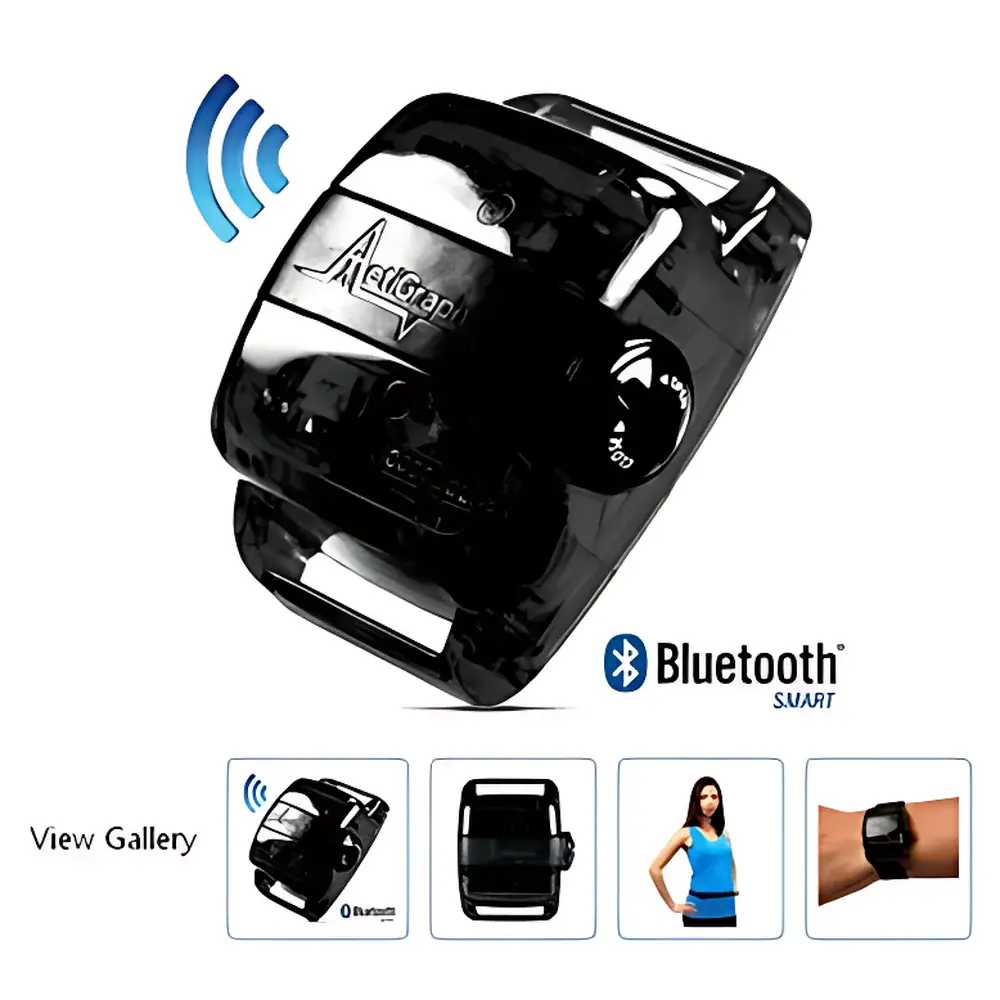
ActiGraph wGT3X-BT Wireless Tri-Axial Activity Monitor
| Brand | ActiGraph |
|---|---|
| Origin | USA |
| Model | wGT3X-BT |
| Sensor Type | Tri-axial accelerometer (±6 g range) |
| Sampling Rate | 10–100 Hz configurable |
| Memory Capacity | 28 days @ 30-s epochs, 14 days @ 15-s epochs, 7 days @ 5-s epochs |
| Battery Life | Up to 30 days (typical use) |
| Connectivity | Bluetooth® Smart (BLE 4.0) |
| Water Resistance | IP67 rated |
| Dimensions | 4.3 × 3.3 × 1.3 cm |
| Weight | 14 g |
| Compatible Software | ActiLife v6.8.1+ |
| Data Output Formats | CSV, TXT, AGD |
| Compliance | FDA-listed device (Class II), ISO 13485-manufactured, GLP-supportive audit trail in ActiLife |
Overview
The ActiGraph wGT3X-BT is a CE-marked, FDA-listed Class II medical device engineered for objective, long-term assessment of human physical activity and sleep-wake patterns in free-living environments. It employs a high-fidelity tri-axial MEMS accelerometer operating at user-configurable sampling rates (10–100 Hz), capturing raw acceleration signals along the x-, y-, and z-axes. These signals are processed onboard using validated digital filtering algorithms to derive time-stamped metrics including vector magnitude (VM), activity counts per epoch, steps, METs, energy expenditure (kcal), and intensity-based classifications (sedentary, light, moderate, vigorous). Its ultra-low-power architecture and IP67-rated enclosure enable continuous 24/7 wear across diverse real-world settings—homes, schools, workplaces, clinical trials, and field studies—without imposing behavioral constraints on participants. Unlike laboratory-bound motion capture systems, the wGT3X-BT delivers ecological validity by preserving natural movement ecology while maintaining metrological traceability to standardized activity measurement protocols.
Key Features
- Wireless Bluetooth® Smart (BLE 4.0) interface for remote device initialization, real-time status monitoring, and rapid data download—eliminating dependency on USB cables and enabling scalable deployment in multi-subject studies.
- Integrated wear-detection sensor: Capacitive contact detection at the device base automatically logs “on-body” vs. “off-body” status, reducing misclassification of non-wear time and supporting robust non-wear algorithm implementation (e.g., Choi, Troiano).
- Multi-modal sensing capability: In addition to acceleration, the wGT3X-BT records ambient light (lux), skin temperature (°C), and—when paired with compatible chest-worn heart rate monitors—RR-interval data, enabling synchronized analysis of autonomic correlates of activity and rest.
- Configurable epoch lengths (from 1 second to 60 minutes) and dynamic range (±2 g to ±6 g) allow optimization for specific research objectives—from fine-grained gait analysis to population-level surveillance of daily movement behavior.
- On-device memory (16 MB flash) supports lossless storage of raw acceleration data for up to 28 days at 30-second epochs, ensuring data integrity even under intermittent connectivity conditions.
Sample Compatibility & Compliance
The wGT3X-BT is validated for use across heterogeneous populations, including children (≥3 years), adolescents, adults, older adults, and clinical cohorts (e.g., type 2 diabetes, COPD, Parkinson’s disease, insomnia, obesity). Mounting flexibility—wrist, hip, ankle, or thigh—permits anatomical alignment with study-specific biomechanical models (e.g., wrist-worn for sleep staging; hip-worn for energy expenditure estimation per Freedson et al. 1998). The device complies with ISO 13485:2016 quality management standards for medical device manufacturing and is listed with the U.S. FDA (K152598). ActiLife software supports 21 CFR Part 11-compliant electronic signatures, audit trails, and role-based access control—enabling adherence to GLP and GCP requirements in regulated clinical research.
Software & Data Management
ActiLife v6.8.1 and later provides end-to-end workflow integration: device configuration, batch firmware updates, encrypted data download, epoch-level metric derivation, non-wear detection, sleep scoring (Sadeh, Cole-Kripke algorithms), and advanced filtering (e.g., low-pass, band-pass). All processed outputs—including raw .agd files, summary CSVs, and annotated TXT exports—are structured for direct ingestion into statistical platforms (SAS, SPSS, R, Python pandas). Built-in reporting modules generate standardized outputs aligned with NHANES, UK Biobank, and WHO STEPwise protocols. Cloud-enabled collaboration tools permit secure, permissioned sharing of de-identified datasets across geographically distributed research teams.
Applications
- Epidemiological surveillance of physical activity and sedentary behavior across national health surveys (e.g., NHANES, HSE).
- Clinical trial endpoints: Objective quantification of activity change in interventions targeting metabolic syndrome, rehabilitation outcomes post-stroke, or circadian disruption in shift workers.
- Sleep architecture validation: Derivation of total sleep time, sleep efficiency, wake after sleep onset (WASO), and sleep latency against polysomnography (PSG) benchmarks.
- Behavioral phenotyping in neurodegenerative disease: Longitudinal tracking of gait variability, bradykinesia, and nocturnal rest-activity rhythm fragmentation.
- Environmental exposure studies: Correlating GPS-derived location metadata (via paired smartphone) with activity intensity maps to assess neighborhood walkability or green space utilization.
FAQ
What is the difference between the wGT3X-BT and the GT9X Link?
The wGT3X-BT is optimized for high-volume, long-duration epidemiological and clinical monitoring with emphasis on battery longevity, wear compliance, and raw acceleration fidelity. The GT9X Link adds inertial measurement unit (IMU) capabilities—gyroscope and magnetometer—for orientation-aware motion analysis (e.g., posture classification, rotational dynamics), but at reduced battery life and higher computational overhead.
Can the wGT3X-BT measure heart rate directly?
No. It does not include a photoplethysmography (PPG) sensor. Heart rate must be acquired via external, Bluetooth-enabled chest straps (e.g., Polar H10) and synchronized in ActiLife using timestamp-matched pairing.
Is raw acceleration data exportable for custom algorithm development?
Yes. The device stores unprocessed 3-axis acceleration values at full sampling resolution. ActiLife enables export of calibrated, time-aligned .csv files containing milli-g units at user-defined frequencies—fully compatible with MATLAB, Python, and R-based signal processing pipelines.
How is non-wear time determined?
ActiLife implements multiple validated non-wear algorithms (Choi, Troiano, Hecht) based on within-epoch standard deviation and consecutive zero-count thresholds. Wear-detection sensor input further refines classification by flagging periods of confirmed off-body placement.
Does the device require IRB/ethics approval for use in human subjects research?
Yes. While the wGT3X-BT is FDA-listed as a general wellness device, its use in research involving human participants requires institutional review board (IRB) or ethics committee approval, particularly when collecting identifiable data or deploying in vulnerable populations.