
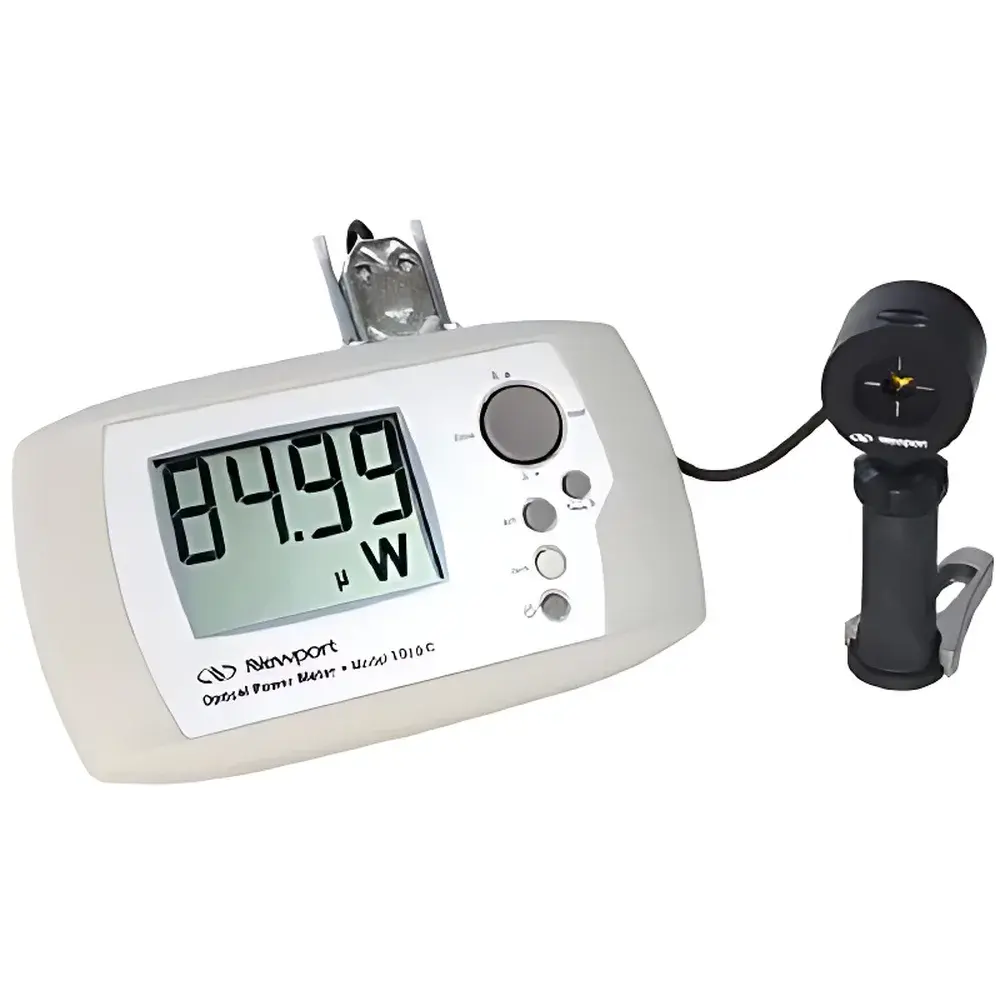
Newport PMKIT Series Optical Power Meter Kit
| Brand | Newport |
|---|---|
| Origin | USA |
| Manufacturer Type | Authorized Distributor |
| Product Origin | Imported |
| Model | PMKIT |
| Core Components | Optical Power Meter, Detectors, Mounting Hardware |
| Compatible Detectors | 818-UV/DB, 818-SL/DB, 818-IR/DB, 818P-010-12 |
| Power Meter | 1916-R Handheld Optical Power Meter |
| Detector Options | Silicon (Si), Germanium (Ge), UV-enhanced Si, Thermopile |
| Wavelength Ranges | 200–1100 nm (UV), 400–1100 nm (Si), 780–1800 nm (Ge), 190–10600 nm (Thermopile) |
| Power Range | 100 pW – 10 W |
| Resolution | 0.01% of Full Scale |
| Accuracy | ±1% (typical, wavelength-dependent) |
| Max. Avg. Power Density | 2 W/cm² |
| Uncertainty (w/ Attenuator) | ≤8% (UV), ≤5% (IR), ≤2.5% (Thermopile) |
| Optional Accessories | Fiber Adapters (sold separately), OD3 Removable Attenuator (integrated with 818-series detectors) |
Overview
The Newport PMKIT Series Optical Power Meter Kit is a modular, application-optimized measurement solution engineered for precision optical power quantification across ultraviolet (UV), visible (VIS), near-infrared (NIR), and mid-infrared (MIR) spectral regions. Built around the 1916-R handheld optical power meter—a compact, battery-operated instrument featuring analog and digital interfaces—the kit integrates calibrated photodiode and thermopile detectors with traceable NIST-traceable calibration certificates. Measurement principle relies on either photovoltaic (for low-power, high-sensitivity applications) or thermoelectric (for broadband, high-power, wavelength-independent response) transduction. Each detector type is selected to match spectral responsivity, damage threshold, and linearity requirements—ensuring metrological integrity from single-photon-level signals (100 pW) up to 10 W continuous-wave irradiance. The system operates under steady-state CW laser conditions and supports both free-space and fiber-coupled beam configurations (with optional fiber adapters).
Key Features
- Modular architecture: Interchangeable 818-series photodiode detectors (UV-enhanced Si, standard Si, Ge) and 818P thermopile detectors—all fully compatible with the 1916-R meter head without recalibration.
- Integrated OD3 removable attenuator on all 818-series detectors: Optimized for signal-to-noise ratio preservation at low irradiance (<1 mW/cm²); attenuation removed to maximize sensitivity in low-power regimes.
- High-resolution readout: 0.01% full-scale resolution enables stable digitization of sub-microwatt fluctuations in laser output stability monitoring.
- Wavelength-specific uncertainty profiles: Certified calibration data provided per detector model—including segmented uncertainty bands (e.g., ±4% at 200–219 nm for UV detectors; ±2.5% for thermopile across 190–10600 nm).
- Rugged mechanical design: Aluminum housing, anodized finish, and shock-absorbing mounting hardware ensure long-term repeatability in shared lab environments and production floor deployment.
- Compliance-ready firmware: Supports basic data logging via RS-232; compatible with Newport’s optional LabVIEW drivers and third-party SCPI-compliant automation frameworks for GLP/GMP-aligned workflows.
Sample Compatibility & Compliance
The PMKIT series accommodates collimated free-space beams and fiber-coupled sources (FC/PC, SMA, or ST connectors with optional adapters). Detector active areas range from 5.8 mm² (818-UV/DB) to 12.6 mm² (818P-010-12), supporting beam diameters up to 9 mm without vignetting. All detectors meet IEC 61326-1:2013 (EMC for laboratory equipment) and are CE-marked. Calibration certificates conform to ISO/IEC 17025:2017 requirements when issued by Newport’s A2LA-accredited calibration laboratory. Traceability extends to NIST Standard Reference Materials (SRMs) for spectral responsivity and power scale. For regulated environments, the 1916-R supports manual audit trails; full 21 CFR Part 11 compliance requires integration with Newport’s 1918-R desktop platform and associated software suite.
Software & Data Management
While the 1916-R operates as a standalone meter with LCD display and analog output (0–1 V), it is fully programmable via RS-232 using SCPI command sets. Newport provides free Windows-based configuration utilities for zero-setting, unit selection (W, mW, µW, dBm), and auto-ranging control. Raw measurement data can be streamed to CSV files for post-processing in MATLAB, Python (via PySerial), or Excel. For advanced analysis—including time-series trending, pass/fail thresholds, and statistical process control (SPC)—the kit interoperates with Newport’s Ophir StarLite or StarBright software platforms (requires adapter cable). All detector calibration files (.cal) are embedded in firmware and auto-loaded upon connection, eliminating manual coefficient entry.
Applications
- Laser diode and DPSS laser output verification during R&D prototyping and manufacturing QC.
- Optical amplifier gain/loss characterization in telecom and photonics labs.
- UV curing lamp intensity mapping and dose validation in semiconductor and medical device fabrication.
- Thermal lensing and mode instability studies requiring multi-wavelength, high-dynamic-range power monitoring.
- Educational optics laboratories: Teaching fundamental concepts of radiant flux, detector responsivity, and spectral mismatch error.
- Calibration transfer between primary standards and field-deployable instruments in metrology service organizations.
FAQ
Can the 1916-R meter be used with non-Newport detectors?
No—only Newport-certified detectors with matching impedance and analog output scaling (e.g., 1 V per decade) are guaranteed for accuracy and linearity. Third-party detectors may cause calibration drift or overload protection activation.
Is the OD3 attenuator mandatory for all measurements?
No—it is factory-installed but mechanically detachable. Removal is recommended when measuring irradiance below 1 mW/cm² to avoid unnecessary signal attenuation and preserve SNR.
What is the maximum pulse energy the 818-series detectors can handle?
The 818 photodiode detectors are rated for CW operation only. For pulsed lasers, peak power density must remain below 10 kW/cm² (10 ns pulses) and average power density below 2 W/cm². Consult Newport Application Note AN-102 for pulse-compatible alternatives.
Does the PMKIT include NIST-traceable calibration documentation?
Yes—each detector ships with a certificate listing wavelength points, uncertainty values, and calibration date. Certificates are valid for 12 months from issuance under normal use conditions.
How often should recalibration be performed?
Annual recalibration is recommended for ISO/IEC 17025-compliant labs. More frequent intervals (e.g., quarterly) are advised for high-use environments or after mechanical shock or thermal cycling events.





