
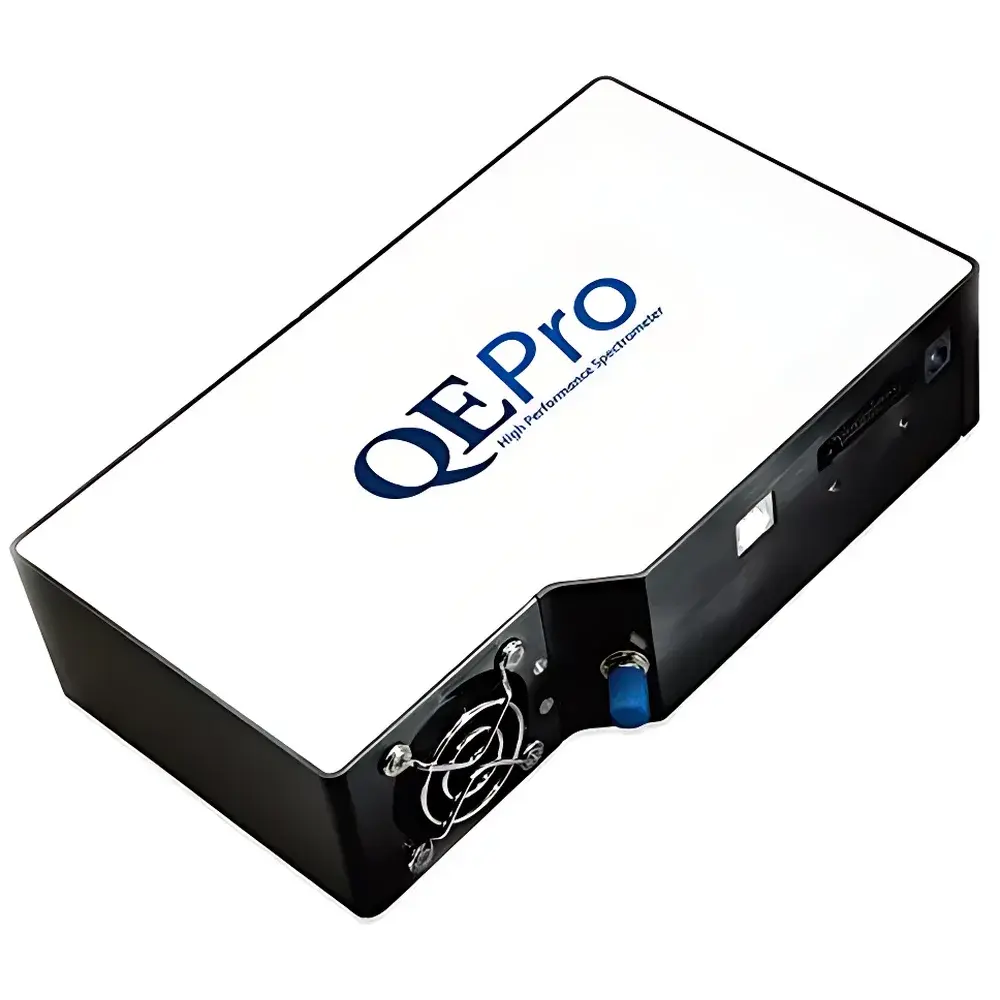
Ocean Optics QE Pro High-Performance Spectrometer
| Brand | Ocean Optics |
|---|---|
| Origin | USA |
| Model | QE Pro High-Performance Spectrometer |
| Detector Type | Back-Thinned CCD |
| Optical Resolution (FWHM) | Configurable from 0.14 nm to 10 nm (dependent on grating and slit) |
| Wavelength Range | 200–1100 nm (model-dependent configurations) |
| Signal-to-Noise Ratio | Up to 80,000:1 (at full signal, 10 s integration) |
| Dynamic Range | >85,000:1 (with 15,000-spectrum onboard memory buffer) |
| Integration Time | 8 ms – 60 s |
| Thermoelectric Cooling | Down to –15 °C below ambient |
| Interface | USB 3.0 |
| Compliance | CE, RoHS, FDA 21 CFR Part 11 ready (via OceanView software configuration) |
Overview
The Ocean Optics QE Pro High-Performance Spectrometer is a research-grade, back-thinned charge-coupled device (CCD) spectrometer engineered for demanding quantitative optical measurements across UV-VIS-NIR spectral regions (200–1100 nm). Its core architecture leverages deep-depletion, thermoelectrically cooled CCD detection—enabling high quantum efficiency (>90% peak in visible range), low dark current, and exceptional signal fidelity. Unlike standard CMOS-based miniature spectrometers, the QE Pro employs a fixed-grating, crossed Czerny-Turner optical bench with optimized stray-light suppression and calibrated wavelength accuracy (±0.2 nm typical). This design supports precise absorbance, reflectance, fluorescence, and Raman intensity quantification—particularly where low-light sensitivity, wide linear dynamic range, and thermal stability are critical. The instrument is not a general-purpose sensor but a metrology-grade tool intended for applications requiring traceable spectral data under variable environmental conditions or extended acquisition durations.
Key Features
- Back-thinned, 1024 × 58-pixel CCD detector with peak quantum efficiency >90% at 600 nm and enhanced UV response down to 200 nm
- Thermoelectric cooling to –15 °C below ambient temperature, reducing dark current by up to 10× versus uncooled systems and enabling stable baselines over multi-minute integrations
- Onboard 15,000-spectrum memory buffer—critical for high-speed transient capture (e.g., laser-induced breakdown, rapid chemical kinetics) without host PC bottlenecking
- Configurable spectral resolution (0.14–10 nm FWHM) via interchangeable slits (5–200 µm) and gratings (150–2400 grooves/mm), supporting application-specific optimization
- USB 3.0 interface with <100 µs trigger latency and hardware-level synchronization support for multi-channel or pump-probe experiments
- Factory-calibrated radiometric and photometric response; NIST-traceable calibration options available upon request
Sample Compatibility & Compliance
The QE Pro interfaces seamlessly with standard fiber-optic sampling accessories—including cuvette holders, integrating spheres (e.g., ISP-REF, IS-2000), collimating lenses, reflection probes, and Raman sampling modules. It supports both free-space and fiber-coupled illumination geometries compliant with ASTM E308 (computing tristimulus values), ISO 13655 (spectral measurement of graphic arts), and USP (UV-Vis spectrophotometric assay validation). When deployed with OceanView software configured for audit trail, electronic signatures, and user access control, the system meets GLP and GMP requirements per FDA 21 CFR Part 11 for regulated laboratories. All firmware and calibration files are digitally signed and version-controlled to ensure data integrity throughout the instrument lifecycle.
Software & Data Management
OceanView v2.x is the native cross-platform application (Windows/macOS/Linux) providing real-time spectral visualization, batch processing, multivariate analysis (PCA, PLS), and automated method execution. It supports direct export to CSV, HDF5, and JCAMP-DX formats for third-party chemometric tools (e.g., MATLAB, Python SciPy, Unscrambler). Raw spectra include embedded metadata (integration time, lamp reference ID, temperature, calibration timestamp), enabling FAIR (Findable, Accessible, Interoperable, Reusable) data practices. For enterprise integration, the QE Pro exposes a documented COM/ActiveX API and RESTful HTTP endpoints—allowing orchestration within LabVantage, Thermo Fisher SampleManager, or custom LIMS environments. Firmware updates preserve calibration coefficients and maintain backward compatibility with legacy .OOI file archives.
Applications
- Quantitative UV-Vis absorbance assays in pharmaceutical QC (e.g., dissolution testing, concentration verification per USP )
- Time-resolved fluorescence decay profiling in life sciences, leveraging high SNR for accurate lifetime fitting (τ₁, τ₂)
- In-line process monitoring of chemical reactions via NIR transmission (900–1100 nm) with drift-compensated referencing
- Plasmonic nanoparticle characterization through localized surface plasmon resonance (LSPR) peak tracking (±0.05 nm repeatability)
- Environmental water quality analysis—measuring nitrate, nitrite, and organic carbon indices using multiband regression models
- Calibration transfer between instruments using spectral matching algorithms validated against NIST SRM 2035
FAQ
What spectral calibration standards are included with the QE Pro?
Each unit ships with factory-applied wavelength and intensity calibration using Hg-Ne and tungsten-halogen sources. NIST-traceable recalibration services (including irradiance and radiance modes) are available through Ocean Insight’s certified metrology lab.
Can the QE Pro operate in continuous acquisition mode for >1 hour without thermal drift?
Yes—when actively cooled and operated within ambient temperature limits (15–30 °C), baseline shift remains <0.5% over 90-minute acquisitions at –10 °C setpoint, verified per ISO 17025 internal validation protocols.
Is the 15,000-spectrum buffer accessible via scripting interfaces?
Yes—the Ocean SDK provides direct memory-mapped read access to the ring buffer, enabling real-time frame selection, burst-mode triggering, and lossless streaming to RAM-disk or SSD storage.
Does the QE Pro support external triggering with TTL or LVDS signals?
It supports TTL-compatible rising-edge triggering (5 V logic) with jitter <1 µs, as well as programmable delay (0–1000 ms) and gate width control for gated detection applications.
How is stray light performance characterized, and what is the typical value?
Stray light is measured per ISO 17025-compliant procedures using a 546.1 nm mercury line with 1% neutral density filters; typical QE Pro units achieve <0.05% stray light at 600 nm ±50 nm.




