
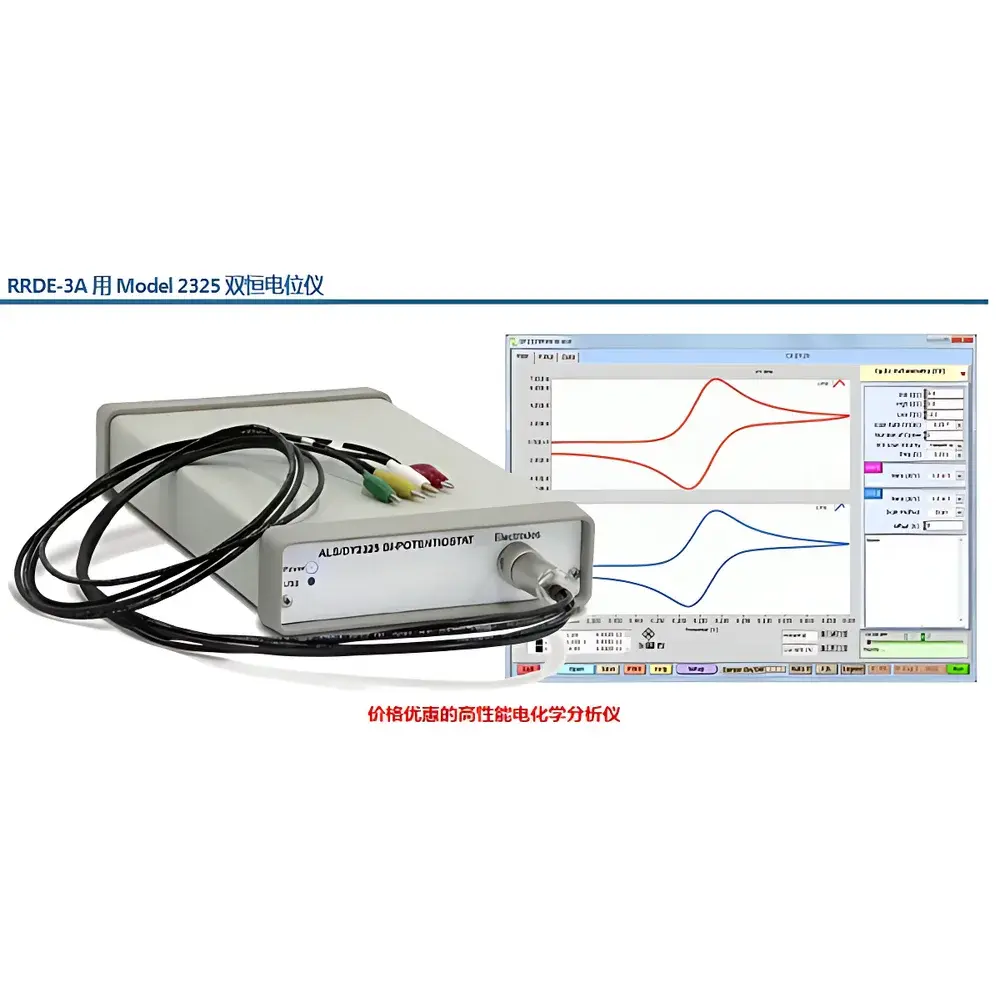
ALS Model 2325 Dual-Potentiostat
| Brand | ALS |
|---|---|
| Origin | Japan |
| Manufacturer Type | Authorized Distributor |
| Product Category | Imported Instrument |
| Model | Model 2325 |
| Instrument Type | Portable Electrochemical Workstation |
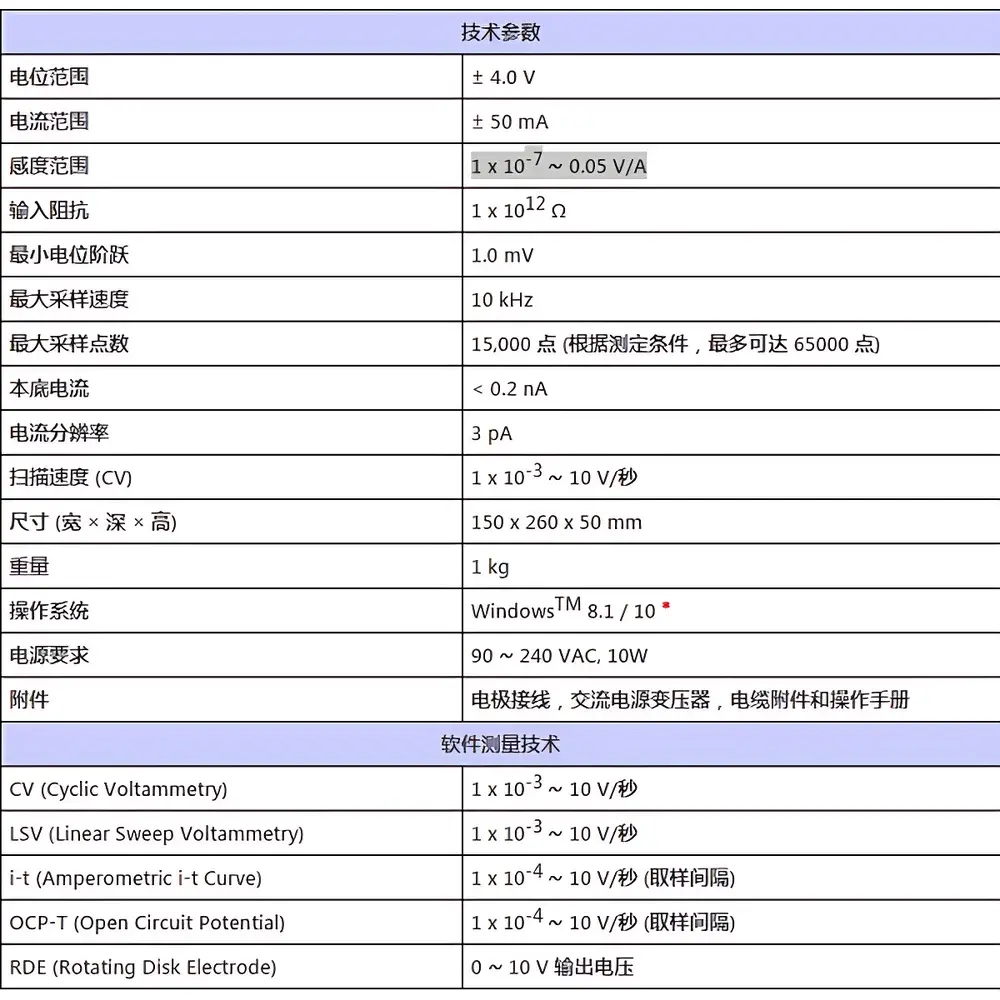
| Current Range | ±50 mA |
| Current Resolution | 1 × 10⁻⁷ A (100 fA) |
| Potential Accuracy | ±4.0 mV |
| Potentiostatic Range | ±4.0 V |
| Dual-Channel Capability | Yes |
| Impedance Spectroscopy Support | Not Integrated |
| Dimensions | 220 × 150 × 55 mm |
| Weight | 1.2 kg |
| Interface | USB 2.0 |
| Operating System Compatibility | Windows 7/10/11 (32 & 64-bit) |
Overview
The ALS Model 2325 Dual-Potentiostat is a compact, benchtop-grade electrochemical workstation engineered for precision dual-channel potentiostatic and galvanostatic control in research, education, and industrial quality assurance environments. Based on low-noise analog front-end circuitry and high-stability voltage reference architecture, the Model 2325 implements classical three-electrode electrochemical cell control with independent potential and current monitoring per channel. Its core design prioritizes signal integrity—achieving a current resolution of 100 fA and baseline noise <1 pA RMS (typ.) at 1 Hz bandwidth—enabling reliable detection of faradaic processes in low-current regimes typical of microelectrode studies, thin-film redox reactions, and corrosion monitoring. Unlike modular or PC-hosted systems requiring external analog-to-digital conversion, the Model 2325 embeds synchronized 16-bit DACs and 18-bit ADCs within its isolated signal path, minimizing timing jitter and ground-loop interference. The instrument operates exclusively in potentiostatic/galvanostatic mode; it does not incorporate built-in frequency response analysis (FRA) hardware or EIS firmware, making it purpose-built for steady-state and transient DC techniques—including cyclic voltammetry (CV), chronoamperometry (CA), chronopotentiometry (CP), and rotating ring-disk electrode (RRDE) experiments.
Key Features
- Dual independent potentiostat channels with full galvanostatic capability on both channels
- Current range: ±50 mA full scale, with 100 fA minimum detectable current (16-bit DAC + low-noise transimpedance amplifier)
- Potential accuracy: ±4.0 mV (DC), calibrated against internal 4.096 V reference; potential range: ±4.0 V vs. reference electrode
- Compact footprint (220 × 150 × 55 mm) and lightweight (1.2 kg) design optimized for teaching labs, field-deployable QA/QC, and space-constrained glovebox integration
- USB 2.0 interface with driver-free plug-and-play operation under Windows OS; no external power supply required (bus-powered)
- Real-time data streaming at up to 10 kS/s per channel with onboard FIFO buffer to prevent data loss during high-speed scans
- Hardware-level compliance with IEC 61010-1 safety standards for laboratory electrical equipment
Sample Compatibility & Compliance
The Model 2325 supports standard three-electrode configurations (working, counter, reference) and is compatible with aqueous and non-aqueous electrolytes, solid-state ion conductors, and gas diffusion electrodes when used with appropriate cell assemblies. It interfaces seamlessly with ALS-branded RRDE rotators (e.g., AFMSRX series) and spectroelectrochemical cuvettes (e.g., Q-SPEC cells) via TTL synchronization triggers. While not certified for Class I Division 1 hazardous locations, its isolation rating (≥500 VRMS channel-to-ground) permits safe use in controlled chemical laboratories adhering to ISO/IEC 17025-accredited testing protocols. The instrument meets electromagnetic compatibility requirements per EN 61326-1:2013 and is designed for long-term stability under GLP-compliant record-keeping workflows—though native audit trail functionality requires third-party software integration.
Software & Data Management
The included ALS GPES (General Purpose Electrochemical Software) v5.x provides intuitive experiment setup, real-time plotting, and post-acquisition analysis tools including background subtraction, peak integration, and Tafel slope calculation. All raw data are saved in ASCII-delimited (.txt) and binary (.bin) formats, ensuring interoperability with MATLAB, Python (via NumPy/Pandas), and OriginLab. GPES supports user-defined script sequences for automated multi-step experiments (e.g., CV → CA → CP), with timestamped metadata embedded in each file header (including instrument ID, calibration date, and operator tag). For regulated environments, GPES can be configured to generate PDF reports compliant with ALCOA+ principles when paired with validated PDF export modules; however, full 21 CFR Part 11 compliance—including electronic signatures and immutable audit trails—requires deployment on a validated IT infrastructure with supplementary validation documentation.
Applications
- Rotating ring-disk electrode (RRDE) studies for reaction mechanism elucidation in fuel cell catalysts and oxygen reduction kinetics
- Development and characterization of amperometric biosensors and enzyme-modified electrodes
- Teaching electrochemistry fundamentals in undergraduate and graduate laboratory courses
- In-process monitoring of electrodeposition bath composition and additive performance
- Corrosion rate assessment via linear polarization resistance (LPR) and electrochemical noise measurement (ENM)
- Spectroelectrochemical coupling with UV-Vis, FTIR, or Raman spectrometers using external trigger synchronization
FAQ
Does the Model 2325 support electrochemical impedance spectroscopy (EIS)?
No. The Model 2325 lacks integrated frequency response analysis hardware and does not include EIS firmware. Users requiring impedance measurements must employ an external FRA module or upgrade to the ALS Model 2360 series.
Can both channels operate simultaneously in different modes (e.g., one potentiostatic, one galvanostatic)?
Yes. Each channel is fully autonomous and may be configured independently for potentiostatic, galvanostatic, or zero-resistance ammeter (ZRA) operation.
Is calibration traceable to national standards?
Yes. Factory calibration is performed using NIST-traceable voltage and current references, with calibration certificates available upon request (ISO/IEC 17025 accredited lab).
What is the maximum scan rate achievable in cyclic voltammetry?
Up to 10 V/s with ≤1% linearity error, limited by capacitive current compensation and solution resistance effects—not instrument bandwidth.
Does the instrument support remote operation over LAN or Ethernet?
No. Communication is USB-only; networked operation requires a USB-over-IP bridge device managed externally.
Related Products




