
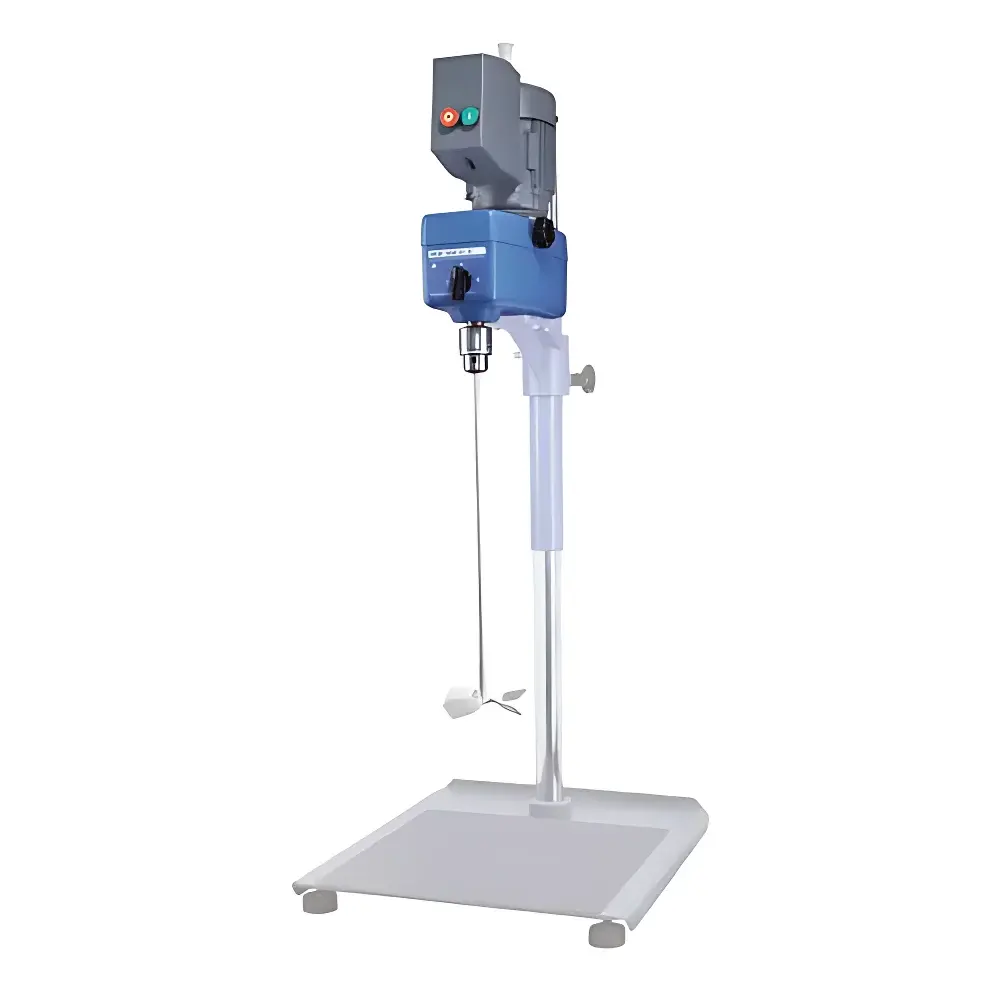
IKA RW47 Digital Display High-Torque Laboratory Stirrer
| Brand | IKA |
|---|---|
| Origin | Germany |
| Model | RW47 Digital Display |
| Input Power | 513 W |
| Output Power | 370 W |
| Stirring Shaft Output Power | 300 W |
| Speed Range | 57–1300 rpm (continuously adjustable, two speed ranges: I = 57–275 rpm, II = 275–1300 rpm) |
| Max. Viscosity | 100,000 mPa·s |
| Max. Torque | 3000 N·cm (at 100 rpm), 4642 N·cm (overload at 60 rpm), 285 N·cm (at 1000 rpm) |
| Max. Stirring Volume (H₂O) | 200 L |
| Chuck Capacity | 3–16 mm |
| Hollow Shaft ID | 13 mm |
| Duty Cycle | 100 % continuous operation |
| Protection Rating | IP54 (DIN EN 60529) |
| Dimensions (W × H × D) | 145 × 445 × 340 mm |
| Weight | 15 kg |
| Ambient Operating Conditions | 5–40 °C, ≤80 % RH |
| Voltage | 3 × 400 V / 3 × 230 V, 50 Hz |
| Clamp Mounting | Flange |
| Speed Indication | Digital display |
| Torque Display | Not available |
| RS232 Interface | Not available |
| Analog Output | Not available |
Overview
The IKA RW47 Digital Display is a high-torque, three-phase laboratory stirrer engineered for demanding mixing and dispersion tasks in research laboratories and pilot-scale production environments. Based on robust electromagnetic drive architecture and precision-machined mechanical transmission, the RW47 operates via Couette flow principles—generating controlled shear stress through rotational motion of impellers within viscous or heterogeneous media. Its dual-range, continuously variable speed control enables optimal adaptation to both low-shear homogenization and high-shear dispersion protocols. Designed for uninterrupted 100% duty cycle operation, the unit delivers stable torque output across its full speed range, making it suitable for applications involving non-Newtonian fluids, suspensions, pastes, and highly viscous polymer systems up to 100,000 mPa·s.
Key Features
- High-output three-phase motor with 370 W mechanical output power and 300 W shaft power—optimized for sustained load under elevated viscosity conditions
- Dual-speed-range design (Range I: 57–275 rpm; Range II: 275–1300 rpm) with infinitely variable electronic speed control via integrated digital display
- Maximum torque of 3000 N·cm at 100 rpm, with overload capability up to 4642 N·cm at 60 rpm—ensuring reliable start-up and acceleration of high-inertia loads
- Stainless-steel chuck with 3–16 mm clamping range and 13 mm internal hollow shaft diameter—compatible with standard IKA and third-party stirring elements including anchor, paddle, turbine, and helical impellers
- IP54-rated enclosure (per DIN EN 60529) for protection against dust ingress and water splashes—supporting safe operation in shared lab or pilot-plant settings
- Flange-mounted base configuration enabling rigid integration into reactor stands, jacketed vessels, or custom support frames
- Full 5–40 °C ambient operating range and ≤80 % relative humidity tolerance—validated for compliance with ISO/IEC 17025 environmental requirements for testing laboratories
Sample Compatibility & Compliance
The RW47 accommodates a broad spectrum of sample types—from aqueous solutions and organic solvents to thixotropic gels, ceramic slurries, and thermoplastic melts—provided vessel geometry and impeller selection align with fluid rheology and heat transfer constraints. It supports batch volumes up to 200 L of water-equivalent media, though actual capacity depends on viscosity, density, and required mixing intensity. The device conforms to EU Machinery Directive 2006/42/EC and Low Voltage Directive 2014/35/EU. Electrical safety certification includes CE marking, and mechanical construction complies with DIN 28131 for laboratory stirrer mounting interfaces. While not intrinsically rated for hazardous areas, optional ATEX-compatible accessories may be sourced separately per application-specific risk assessment.
Software & Data Management
The RW47 Digital Display operates as a stand-alone analog-controlled instrument without embedded microprocessor-based data logging or digital communication ports (RS232, USB, or Ethernet). Speed is monitored and displayed numerically on an integrated LED screen; no torque, temperature, or power consumption values are recorded or output. For traceable process documentation, users must integrate external data acquisition systems—e.g., calibrated tachometers, torque sensors, or PLC-linked analog signal conditioners—configured in accordance with GLP or GMP audit requirements. When deployed in regulated environments (e.g., pharmaceutical development per USP or ISO 13485), validation protocols should include operational qualification (OQ) of speed accuracy (±2% full scale), torque repeatability (≤3% RSD over 3 cycles), and thermal stability during 8-hour continuous operation.
Applications
- High-viscosity emulsification and suspension stabilization in formulation development (e.g., adhesives, coatings, topical pharmaceuticals)
- Batch-wise dispersion of nanoparticles, pigments, or fillers into polymer matrices under controlled shear history
- Mechanical activation of catalyst slurries prior to fixed-bed reactor loading
- Homogenization of biopolymer hydrogels and food-grade starch pastes in pilot-scale trials
- Preparation of standardized reference materials for rheological calibration (e.g., NIST-traceable silicone oils)
- Supporting ASTM D2196 (viscosity of paints) and ISO 2557-2 (plasticized PVC compound mixing) test procedures
FAQ
Is the RW47 compatible with single-phase power supplies?
No—the RW47 requires a three-phase supply (3 × 230 V or 3 × 400 V, 50 Hz) and cannot operate on standard single-phase laboratory circuits.
Can the hollow shaft accommodate temperature probes or pH electrodes during operation?
No—the hollow shaft is not designed for in-process probe insertion; it remains mechanically sealed in the stopped position and lacks dynamic feedthrough capability.
Does the unit include a stirrer paddle or coupling?
No—impellers, shaft extensions, and clamp couplings must be ordered separately according to vessel geometry and process requirements.
What maintenance intervals are recommended for continuous operation?
IKA recommends biannual inspection of gear train lubrication, chuck jaw wear, and electrical connection integrity—documented per ISO 55001 asset management guidelines.
Is speed calibration traceable to national standards?
Yes—calibration certificates issued by accredited third-party labs (e.g., DAkkS or UKAS) can be obtained for the digital speed display, referencing DIN 51306 or ISO/IEC 17025.



