
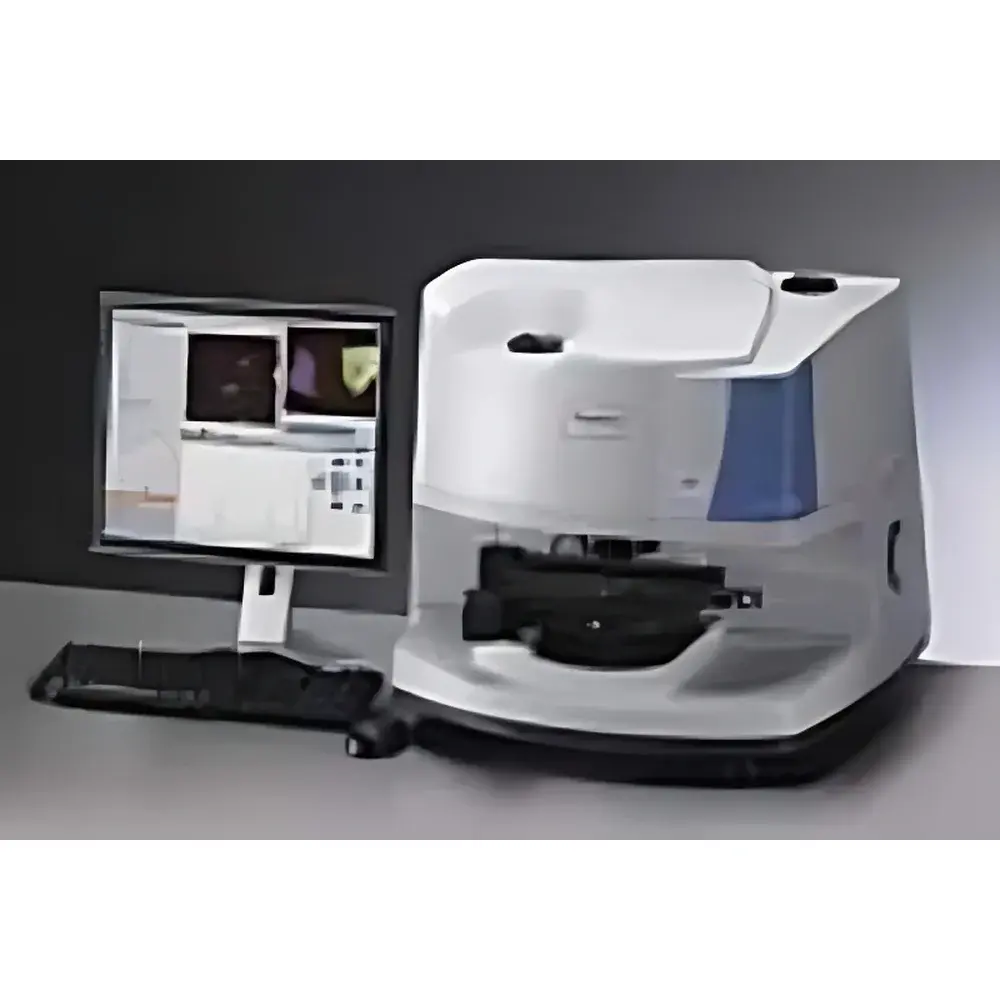
Thermo Scientific Nicolet iN10 FT-IR Microscope
| Brand | Thermo Fisher |
|---|---|
| Origin | USA |
| Manufacturer Type | Original Equipment Manufacturer (OEM) |
| Origin Category | Imported |
| Model | Nicolet iN10 |
| Pricing | Upon Request |
Overview
The Thermo Scientific Nicolet iN10 FT-IR Microscope is a fully integrated Fourier Transform Infrared (FT-IR) microspectroscopy system engineered for routine laboratory use in materials identification, micro-domain chemical mapping, and failure analysis. Unlike traditional modular configurations—where a standalone microscope is coupled to an external FT-IR spectrometer—the iN10 embeds a complete, high-efficiency interferometer, source, and detector directly within the optical bench of the microscope. This monolithic architecture eliminates alignment drift, minimizes optical path losses, and delivers superior signal-to-noise ratio (SNR) across the mid-IR range (4000–600 cm⁻¹). Its design adheres to fundamental principles of infrared microspectroscopy: spatially resolved absorption spectroscopy based on interferometric modulation of broadband IR radiation, followed by Fourier transformation to yield chemically specific spectra from micron-scale sample regions. The system operates without cryogenic cooling, utilizing a thermoelectrically cooled deuterated triglycine sulfate (DTGS) detector—enabling stable, maintenance-free daily operation in QC, R&D, and forensic laboratories.
Key Features
- Fully integrated FT-IR spectrometer and optical microscope in a single, compact benchtop platform—no external optics or alignment required
- Automated optical functions: motorized XYZ stage with software-controlled navigation, auto-focus, variable aperture control, and real-time video overlay with spectral correlation
- Micro-ATR objective enabling diffraction-limited spatial resolution down to 3 µm—ideal for surface-sensitive analysis of films, coatings, and particulates
- Reflective transmission mode supports analysis of samples as small as 10 µm using low-thermal-mass objectives and optimized condenser optics
- OMNIC Picta™ software with task-oriented “Wizard” workflows for particles, layered structures, and heterogeneous mixtures—designed for users with minimal FT-IR microscopy experience
- No liquid nitrogen dependency: DTGS detector provides robust performance with <1 hr warm-up time and <0.05% wavenumber drift over 8-hour operation
- Modular expandability: compatible with Nicolet iZ10™ auxiliary optical bench for extended accessories (e.g., polarizers, step-scan modules, or external beam ports)
Sample Compatibility & Compliance
The Nicolet iN10 accommodates solid, thin-film, and particulate specimens—including polymers, pharmaceutical tablets, paint cross-sections, semiconductor residues, textile fibers, and forensic trace evidence—without requiring extensive sample preparation. It supports standard IR-compatible mounting methods: KBr pellet compression, diamond anvil cells, reflective metal substrates, and direct Micro-ATR contact. From a regulatory standpoint, the system supports GLP/GMP-compliant workflows through OMNIC Picta’s audit-trail-enabled data acquisition, user authentication, and electronic signature capability. While not pre-certified to FDA 21 CFR Part 11, its software architecture allows full configuration for compliance—including secure user roles, immutable raw data storage (.spa/.spg), and timestamped metadata logging—making it suitable for regulated environments in pharma, medical device QA, and forensic casework documentation.
Software & Data Management
OMNIC Picta™ serves as both acquisition interface and analytical engine. Its dual-display architecture separates live video imaging from spectral visualization, enabling simultaneous region-of-interest (ROI) selection and real-time spectral preview. The software implements hierarchical data management: each measurement stores full instrument parameters (aperture size, gain, scans, background date/time), video snapshots, and georeferenced spectral maps. Chemical image generation employs classical least-squares (CLS) or peak-height ratio algorithms; all processing steps are scriptable and reproducible. Spectral libraries (e.g., Sadtler, Polymer, Forensic) integrate natively, supporting automated hit-quality scoring and mixture deconvolution. Raw data files conform to ASTM E1421-22 standards for IR spectral exchange, ensuring interoperability with third-party chemometric tools (e.g., MATLAB, Python scikit-learn).
Applications
The Nicolet iN10 is routinely deployed across industrial and academic settings for: polymer additive identification in multilayer packaging films; contaminant characterization in semiconductor wafers; layer-thickness quantification in automotive coatings via interference fringe analysis; crystallinity assessment in API formulations; fiber type differentiation in forensic textile evidence; and micro-inclusion analysis in cementitious composites. Its automated layer-delineation Wizard enables rapid stratigraphic mapping of paint chips or laminated food packaging—outputting material composition per layer alongside estimated thickness derived from refractive index-corrected interference patterns. In pharmaceutical QC, it supports USP guidelines for identification of excipients in tablet cross-sections and detection of delamination in coated dosage forms.
FAQ
Does the Nicolet iN10 require liquid nitrogen cooling?
No—it uses a thermoelectrically cooled DTGS detector, eliminating cryogen handling and associated operational downtime.
Can the system perform chemical imaging?
Yes, when equipped with the optional iN10MX upgrade (array detector + imaging optics), it acquires hyperspectral IR images at up to 64 × 64 pixel resolution with sub-minute acquisition per frame.
Is OMNIC Picta compliant with FDA 21 CFR Part 11?
The software provides configurable features required for Part 11 adherence—including electronic signatures, audit trails, and role-based access—but final validation must be performed by the end-user per their internal SOPs.
What is the smallest feature size resolvable in transmission mode?
Approximately 10 µm under optimal conditions (high NA objective, ideal sample contrast, and sufficient SNR).
Can the iN10 interface with external accessories such as polarizers or step-scan modules?
Yes—via the optional Nicolet iZ10 auxiliary optical bench, which extends the system’s capabilities for time-resolved, polarization-modulated, or photothermal IR measurements.






