
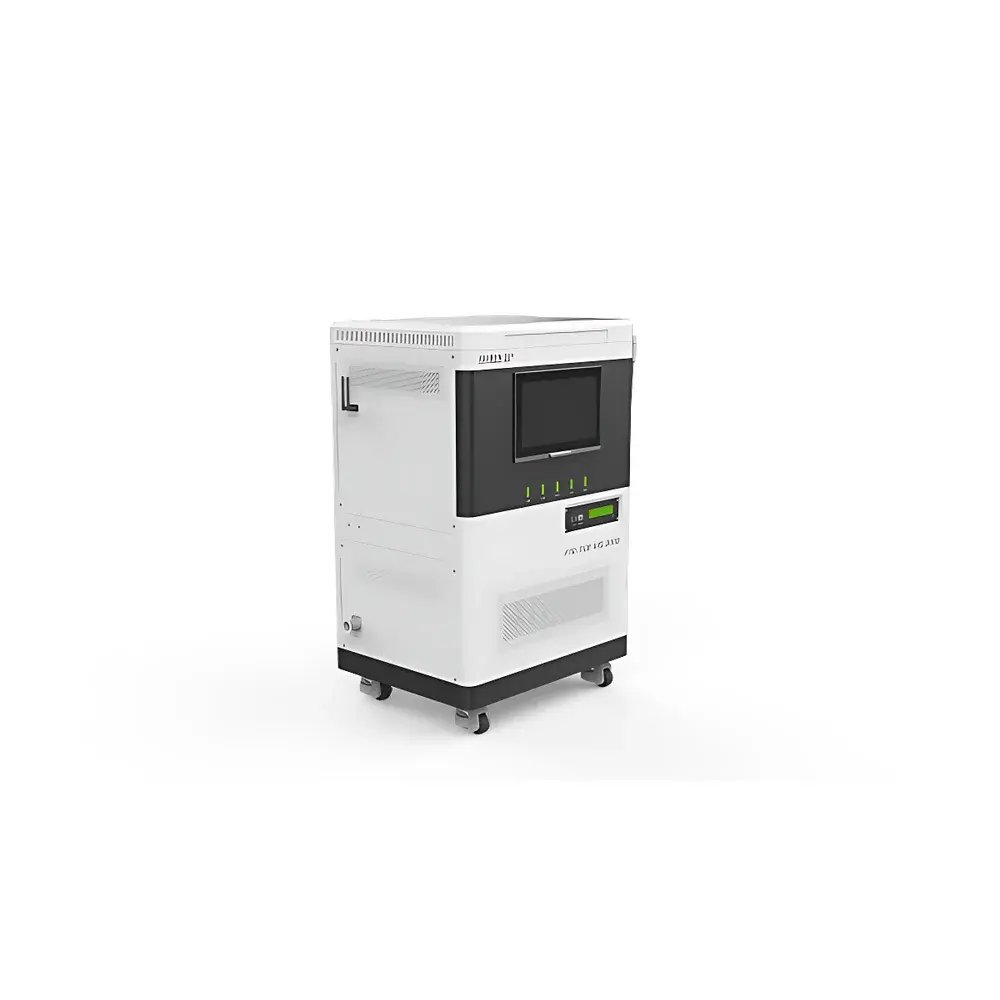
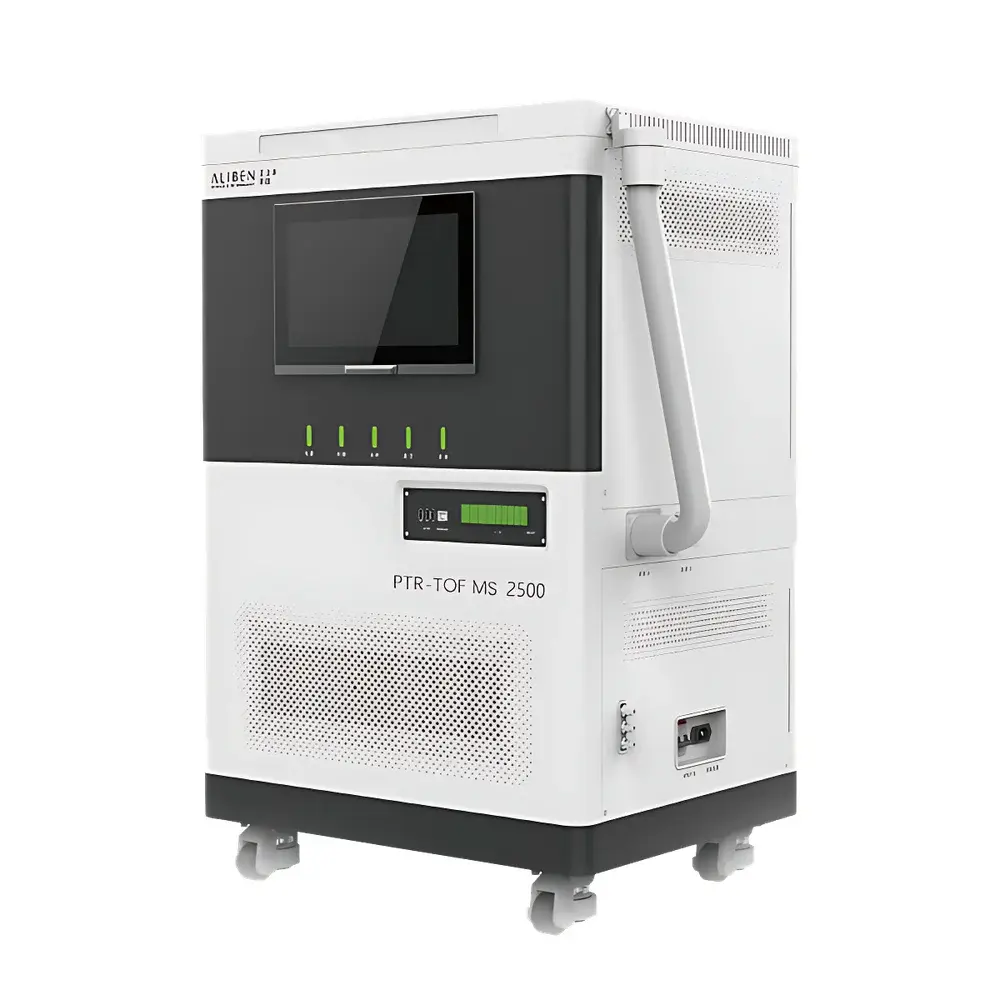
Aliben PTR-TOF MS 2500 Proton Transfer Reaction Time-of-Flight Mass Spectrometer
| Brand | Aliben |
|---|---|
| Origin | Sichuan, China |
| Manufacturer Type | Original Equipment Manufacturer (OEM) |
| Product Category | Domestic Instrument |
| Model | PTR-TOF MS 2500 |
| Detection Principle | Proton Transfer Reaction (H₃O⁺-based soft ionization) |
| Instrument Type | Online Real-Time Analyzer |
| Configuration | Integrated VOC Monitoring System |
| Mass Resolution (m/Δm) | ≥ 6,000 (FWHM at m/z 100) |
| Mass Range | m/z 10–300 |
| Detection Limit | < 10 pptv (for formaldehyde, 1 s integration) |
| Data Acquisition Rate | Up to 10 Hz full-spectrum |
| Vacuum System | Multi-stage differential pumping with turbomolecular pumps |
| Ion Source | RF-driven hollow cathode H₃O⁺ generator |
| Mass Analyzer | Orthogonal acceleration reflectron TOF |
| Software Platform | ALIBEN Control Suite v4.2 (GLP-compliant audit trail, 21 CFR Part 11 ready) |
Overview
The Aliben PTR-TOF MS 2500 is a high-performance, online proton transfer reaction time-of-flight mass spectrometer engineered for real-time, quantitative trace analysis of volatile organic compounds (VOCs) in complex gaseous matrices. It operates on the well-established principle of chemical ionization via proton transfer from hydronium reagent ions (H₃O⁺) to analyte molecules with proton affinity higher than water (≈691 kJ/mol), enabling soft, fragmentation-minimized ionization. Unlike GC-MS or sorbent-based methods, the PTR-TOF MS 2500 requires no pre-concentration, thermal desorption, or chromatographic separation—delivering sub-second spectral acquisition across m/z 10–300 with intrinsic mass accuracy (< 5 ppm RMS) and high mass resolution (≥6,000 FWHM). Its fully integrated vacuum architecture—comprising multi-stage differential pumping and orthogonal acceleration TOF geometry—ensures robust signal stability under fluctuating ambient pressure and humidity conditions typical in field-deployed environmental monitoring.
Key Features
- Real-time full-spectrum acquisition at up to 10 Hz, enabling dynamic process tracking and transient emission characterization.
- Ultra-low detection limits: sub-10 pptv (1-second integration) for key atmospheric VOCs including formaldehyde, acetaldehyde, and isoprene—validated per ISO 16000-6 and ASTM D6196 protocols.
- Integrated H₃O⁺ ion source with RF-driven hollow cathode design, delivering stable reagent ion current (>10⁸ cps) and negligible O₂⁺/NO⁺ interference.
- Onboard mass calibration using internal perfluorotributylamine (PFTBA) reference peaks, eliminating need for external standards during routine operation.
- Modular, vehicle-mountable chassis compliant with MIL-STD-810G shock/vibration specifications; operational temperature range: −10 °C to +40 °C.
- Zero consumables architecture: no filaments, no gas cylinders (H₂O vapor generated internally), and no replaceable ion optics—reducing total cost of ownership and field maintenance intervals.
Sample Compatibility & Compliance
The PTR-TOF MS 2500 accepts direct, unfiltered ambient air, stack gas, breath samples, or headspace vapors via standardized ¼″ Swagelok inlet with heated sample line (up to 180 °C). It is compatible with EPA Method TO-15A, EU Directive 2008/50/EC Annex IX (VOC monitoring), and ISO 16017-1 for indoor air quality assessment. All firmware and data handling modules comply with GLP and GMP requirements, including full 21 CFR Part 11 audit trails, electronic signature support, and role-based user access control. Calibration verification reports are auto-generated and timestamped, meeting ISO/IEC 17025 documentation standards for accredited laboratories.
Software & Data Management
ALIBEN Control Suite v4.2 provides unified instrument control, real-time spectral visualization, and automated compound identification via NIST/EPA/NIOSH mass spectral libraries (with retention-index-independent matching). The software supports batch processing of time-series datasets, export to netCDF/HDF5 formats for MATLAB/Python integration, and optional cloud synchronization with secure TLS 1.3 encryption. Quantitative workflows include internal standard correction (e.g., deuterated toluene), humidity compensation algorithms (per IUPAC kinetic models), and automatic background subtraction using dual-inlet alternating sampling mode. Raw data files retain full metadata—including vacuum status, ion transmission efficiency, and detector gain history—for full traceability in regulatory submissions.
Applications
- Environmental Monitoring: Mobile mapping of industrial plumes via vehicle-mounted deployment; source apportionment in urban atmospheres; real-time ozone precursor tracking (e.g., isoprene, monoterpenes).
- Indoor Air Quality: Continuous monitoring of building emissions (formaldehyde from adhesives, limonene from cleaners), compliance with WHO IAQ guidelines and LEED v4.1 credit MRc2.
- Industrial Process Control: In-line VOC leak detection in petrochemical refineries; catalyst deactivation monitoring via real-time hydrocarbon speciation in FCC off-gas streams.
- Food & Flavor Science: In-vivo nasal/oral aroma release profiling during mastication; headspace fingerprinting of fermentation batches; shelf-life degradation marker tracking (e.g., hexanal oxidation products).
- Medical Breath Research: Non-invasive exhaled breath condensate (EBC) analysis for biomarker discovery in asthma, COPD, and early-stage lung cancer—validated in accordance with ERS Task Force recommendations on breath biomarker standardization.
FAQ
Does the PTR-TOF MS 2500 require daily calibration?
No. The system employs continuous internal mass calibration using PFTBA fragment ions and maintains quantitative accuracy over 72-hour periods without manual intervention, as verified per ISO 17025 clause 5.9.2.
Can it distinguish isobaric compounds such as C₃H₆O isomers (acetone vs. propanal)?
Yes. With mass resolution ≥6,000 (FWHM), the instrument resolves m/z 59.049 (acetone) and 59.049 (propanal) at baseline, enabling confident isomer differentiation when combined with retention-time-agnostic collision-induced dissociation (CID) patterns.
Is remote diagnostics and software update supported?
Yes. Secure SSH-based remote access allows OEM engineers to perform firmware updates, spectral diagnostics, and vacuum performance evaluation without onsite visits—subject to customer-configured firewall policies.
What safety certifications does the system hold?
CE marking per EN 61010-1:2019 (electrical safety), EN 61326-1:2013 (EMC), and RoHS 2011/65/EU compliance. No radiation hazard classification required (no X-ray or beta sources).
How is data integrity ensured during power interruption?
All acquisitions are written to redundant NVMe storage with journaling filesystem; unsaved spectra are retained in battery-backed RAM (72-hour buffer) and auto-resumed upon reboot with zero data loss.
Related Products







