
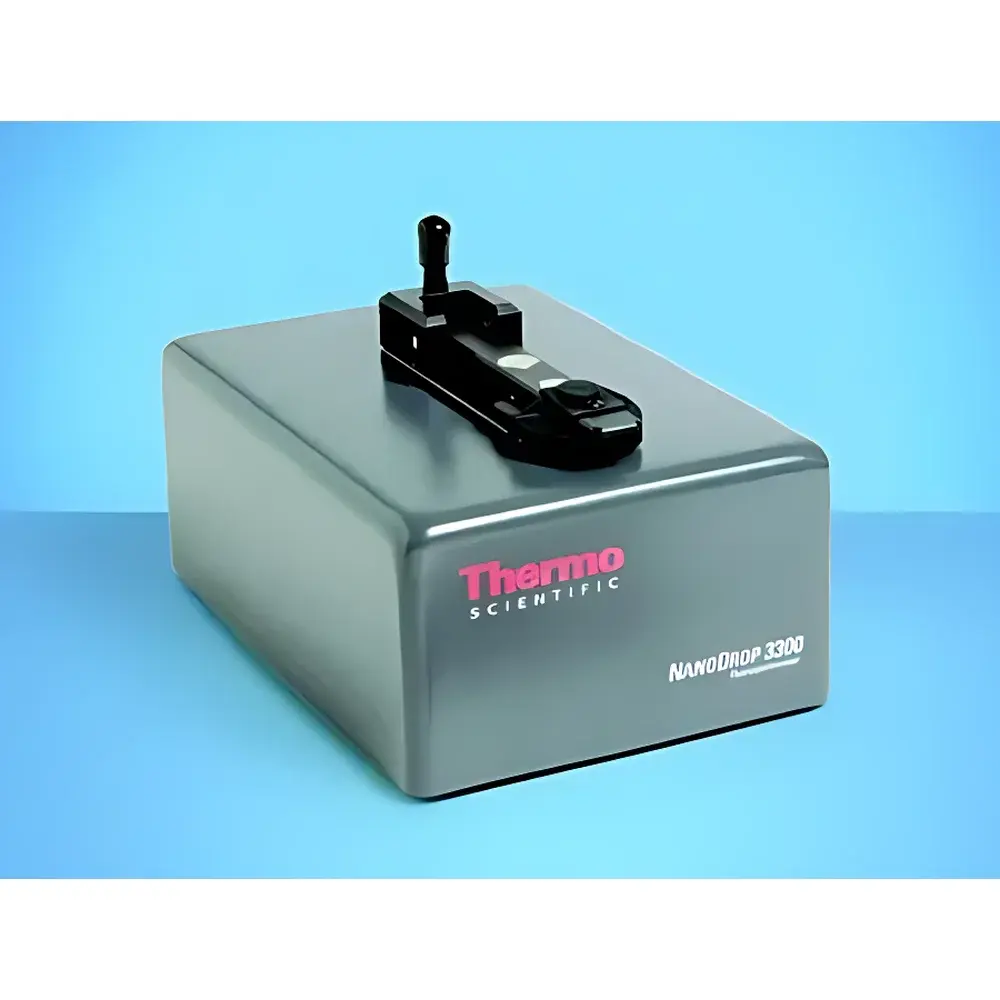
Thermo Fisher NanoDrop 3300 Molecular Fluorescence Spectrometer
| Brand | Thermo Fisher |
|---|---|
| Origin | USA |
| Manufacturer | Thermo Fisher Scientific |
| Product Type | Imported Instrument |
| Model | NanoDrop 3300 |
| Excitation Source | Filter-based LED array |
| Excitation Wavelength Range | 400–750 nm |
| Spectral Resolution | <3 nm FWHM (at Hg 546.1 nm) |
| Wavelength Accuracy | ±1 nm |
| Detection Mode | Full-spectrum fluorescence emission (400–750 nm) |
| Sample Volume | As low as 1 µL |
| Power Supply | USB-powered (no external power adapter required) |
| Cuvette-Free Operation | Yes |
Overview
The Thermo Fisher NanoDrop 3300 Molecular Fluorescence Spectrometer is a compact, filter-based fluorometer engineered for rapid, high-sensitivity quantification and spectral characterization of fluorescent analytes in minute sample volumes. Unlike conventional scanning fluorometers that rely on monochromators or mechanical filter wheels, the NanoDrop 3300 employs a fixed-array, multi-LED excitation system coupled with a high-throughput CCD detector to deliver full-emission spectra (400–750 nm) within seconds. Its optical architecture is based on fixed-wavelength excitation and broadband emission collection—optimized for reproducible detection of common nucleic acid dyes (e.g., PicoGreen, RiboGreen), protein labels (e.g., FITC, Hoechst), cyanine derivatives (Cy3, Cy5), Alexa Fluor conjugates (Alexa 555, Alexa 647), and semiconductor quantum dots. Designed for integration into high-throughput molecular biology and QC workflows, the instrument operates without cuvettes, alignment procedures, or external power sources—drawing operational power exclusively via USB 2.0 from a host PC.
Key Features
- Microvolume capability: Accurate fluorescence measurement from just 1 µL of undiluted sample—preserving precious biological material for downstream applications.
- Filter-based multi-LED excitation: Eight discrete, narrow-band LEDs covering 400–750 nm enable selective excitation without manual filter changes or wavelength calibration drift.
- Full-spectrum emission acquisition: Simultaneous detection across 400–750 nm at <3 nm spectral resolution (FWHM at Hg 546.1 nm), supporting multiplexed analysis of co-labeled samples.
- High wavelength fidelity: ±1 nm wavelength accuracy ensures traceable alignment with reference emission peaks—critical for method transfer and regulatory documentation.
- USB-powered operation: Eliminates reliance on AC adapters or battery packs; fully portable and compatible with standard laboratory PCs and laptops.
- Cuvette-free microfluidic path: Integrated sample retention zone minimizes surface adsorption and cross-contamination; cleaning requires only a single wipe with laboratory-grade ethanol or water.
Sample Compatibility & Compliance
The NanoDrop 3300 supports aqueous and low-viscosity organic solvent-based fluorescent solutions—including dsDNA, ssDNA, RNA, proteins, labeled antibodies, and nanoparticle suspensions. It is routinely deployed in academic core facilities, pharmaceutical development labs, and contract research organizations performing nucleic acid quantification per ISO/IEC 17025-accredited protocols. While not classified as a GLP/GMP instrument per se, its software supports audit-trail-enabled data capture compliant with FDA 21 CFR Part 11 when used with validated configurations (e.g., password-protected user accounts, electronic signatures, immutable data export). The instrument meets IEC 61010-1 safety standards for laboratory electrical equipment and conforms to RoHS and CE marking requirements for import into EU and North American markets.
Software & Data Management
Controlled via Thermo Scientific NanoDrop Software v3.x, the platform provides intuitive workflow-driven interfaces for assay setup, real-time spectral visualization, peak identification, and concentration calculation using preloaded dye-specific calibration curves. Raw spectral data are stored in vendor-neutral CSV and XML formats; metadata—including date/time stamps, operator ID, instrument serial number, and environmental conditions (if logged externally)—are embedded in each dataset. Batch processing, report generation (PDF/Excel), and LIMS-compatible data export (via ODBC or REST API plug-ins) support integration into enterprise-scale quality management systems. All software updates undergo internal verification per Thermo Fisher’s software development lifecycle (SDLC) framework aligned with ISO 13485 and ICH GCP guidelines.
Applications
- Quantitative dsDNA assessment at sub-pg/µL sensitivity—enabling accurate normalization prior to NGS library preparation.
- Validation of fluorescent labeling efficiency in antibody-drug conjugate (ADC) development.
- Characterization of quantum dot photostability under repeated excitation cycles.
- Routine QC of transfection reagents and viral vector preparations using dual-dye ratiometric assays.
- Educational use in undergraduate biochemistry labs for hands-on fluorescence spectroscopy principles.
- Environmental monitoring of polycyclic aromatic hydrocarbons (PAHs) in aqueous extracts via native fluorescence.
FAQ
Does the NanoDrop 3300 require routine wavelength calibration?
No. The fixed LED array and factory-aligned detector eliminate the need for user-performed wavelength calibration. Verification can be performed annually using a mercury-argon emission lamp (optional accessory) to confirm ±1 nm accuracy.
Can the instrument measure fluorescence anisotropy or lifetime?
No. The NanoDrop 3300 is optimized for intensity-based steady-state emission spectroscopy—not time-resolved or polarization-sensitive measurements.
Is it compatible with Mac OS or Linux operating systems?
Officially supported only on Windows 10/11 (64-bit) with .NET Framework 4.8 and USB 2.0 host controller. Virtualized environments are not validated.
What is the recommended maintenance schedule?
Daily wipe of the pedestal surface with lint-free tissue and 70% ethanol; annual performance verification by authorized Thermo Fisher service engineers is advised for regulated environments.
How does it handle highly autofluorescent matrices (e.g., cell lysates)?
Background subtraction algorithms are available within the software; however, users must acquire blank spectra under identical buffer and illumination conditions for reliable correction.





