
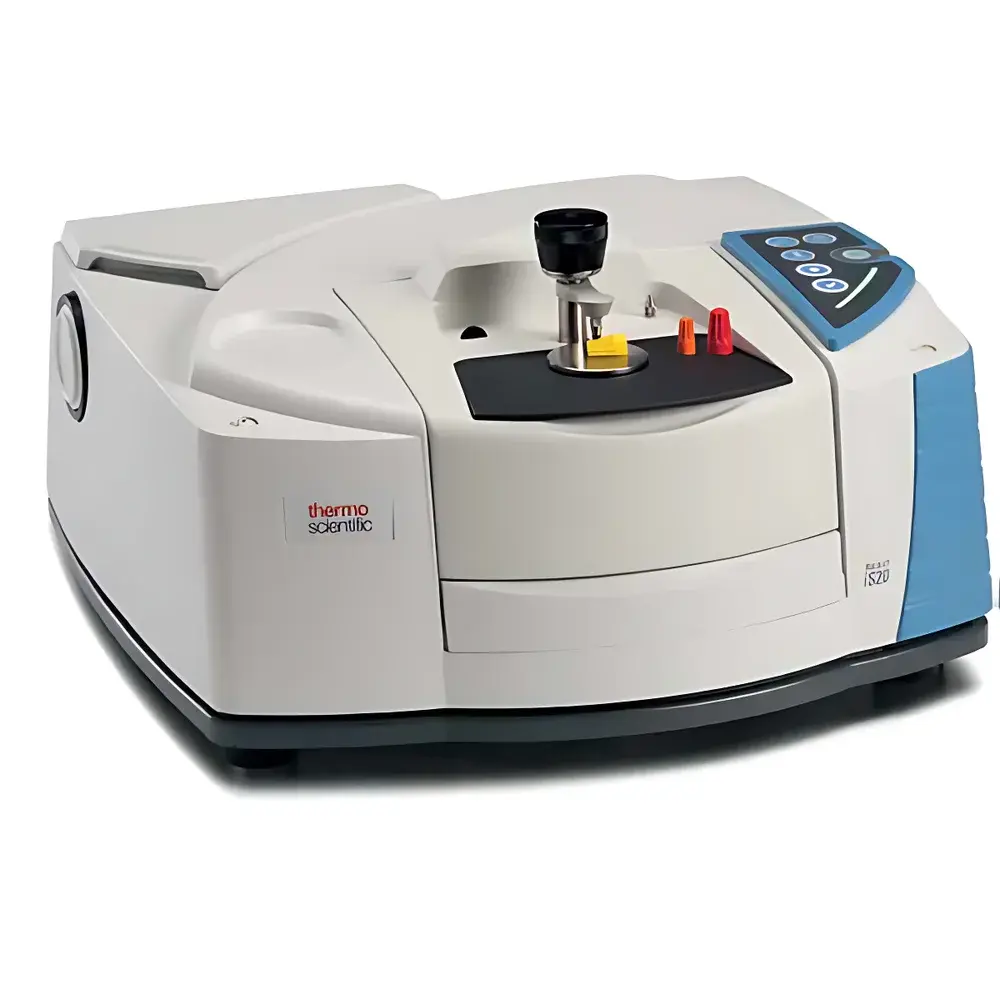
Thermo Scientific Nicolet iS20 Fourier Transform Infrared (FTIR) Spectrometer
| Brand | Thermo Fisher |
|---|---|
| Origin | USA |
| Manufacturer Type | Original Equipment Manufacturer (OEM) |
| Product Origin | Imported |
| Model | Nicolet iS20 |
| Instrument Type | Laboratory FTIR Spectrometer |
| Wavenumber Range | Not specified (custom-configurable per application) |
| Spectral Resolution | 0.25 cm⁻¹ |
| Signal-to-Noise Ratio (S/N) | 50,000:1 (at 4 cm⁻¹, 1 min scan, KBr beam splitter) |
| Wavenumber Accuracy | ±0.02 cm⁻¹ at 2000 cm⁻¹ |
| Optical Engine | LightDrive™ Interferometer Platform |
| Warranty | 10-year limited warranty on interferometer, laser, and IR source |
Overview
The Thermo Scientific Nicolet iS20 Fourier Transform Infrared (FTIR) Spectrometer is a purpose-built laboratory-grade analytical instrument engineered for high-fidelity molecular identification, quantitative analysis, and structural characterization across academic research, pharmaceutical quality control, polymer development, and materials science laboratories. Based on the Michelson interferometer architecture, the iS20 employs a phase-modulated, rapid-scanning optical design to convert time-domain interferograms into high-resolution wavenumber-domain spectra via Fast Fourier Transform (FFT) computation. Its core LightDrive™ optical engine integrates a thermally stabilized solid-state diode laser reference, a dynamically aligned moving-mirror interferometer, and a high-stability globar infrared source — collectively delivering exceptional spectral reproducibility, long-term baseline stability, and minimal drift over extended acquisition periods. Designed for compliance with international spectroscopic practice standards, the system supports traceable calibration protocols aligned with ASTM E1421 and ISO 17025 requirements for analytical instrument validation.
Key Features
- LightDrive™ optical platform featuring a maintenance-free solid-state diode laser reference, eliminating alignment sensitivity and reducing long-term wavelength drift.
- 0.25 cm⁻¹ nominal spectral resolution, enabling discrimination of closely spaced vibrational bands in complex organic matrices and crystalline polymorphs.
- Signal-to-noise ratio of 50,000:1 (measured at 4 cm⁻¹ resolution, 1-minute scan, KBr beamsplitter), supporting low-concentration detection and high-precision quantitation.
- Wavenumber accuracy of ±0.02 cm⁻¹ at 2000 cm⁻¹ — certified via NIST-traceable polystyrene film calibration — ensuring regulatory-grade data integrity.
- 10-year limited warranty on critical optical subsystems: interferometer, laser, and infrared source — reflecting proven mechanical robustness and thermal management architecture.
- Modular sample compartment accommodating standardized accessories including ATR, transmission cells, gas cells, and microsampling stages without realignment.
Sample Compatibility & Compliance
The Nicolet iS20 supports broad sample versatility through interchangeable sampling interfaces: diamond ATR for solids and viscous liquids; KBr pellet transmission for powders; liquid cells with CaF₂ or BaF₂ windows for solvent-based solutions; and purge-ready configurations for moisture- or CO₂-sensitive measurements. All optical paths are fully purged-compatible (dry air or nitrogen), minimizing atmospheric water vapor and carbon dioxide interference in the 4000–400 cm⁻¹ range. The instrument meets essential regulatory expectations for analytical instrumentation used in GLP and GMP environments: audit trail logging, user access controls, electronic signature support, and data integrity features compliant with FDA 21 CFR Part 11 when paired with OMNIC Enterprise software. Routine performance qualification (PQ) and operational qualification (OQ) procedures align with USP , EP 2.2.24, and ISO/IEC 17025:2017 Annex A.3 guidelines.
Software & Data Management
Controlled by Thermo Scientific OMNIC Specta software (v10.x or later), the iS20 provides intuitive workflow-driven operation—from method setup and automated background collection to spectral subtraction, peak integration, and multivariate analysis (PCA, PLS). OMNIC supports secure, role-based user authentication, encrypted project databases, and configurable audit trails that record all spectral processing steps, parameter changes, and user actions with timestamps. Raw interferogram and processed spectrum files (.spa, .spc) are stored in vendor-neutral formats compatible with third-party chemometric platforms (e.g., MATLAB, Unscrambler X, Pirouette). Data export options include CSV, XML, and JCAMP-DX for LIMS integration and cross-platform interoperability. Optional OMNIC Enterprise enables centralized instrument monitoring, remote diagnostics, and enterprise-wide spectral library management with version-controlled spectral metadata.
Applications
- Pharmaceutical: Identification of active pharmaceutical ingredients (APIs), excipient compatibility studies, polymorph screening, and cleaning validation residue analysis.
- Polymers & Plastics: Additive quantification, degradation assessment, copolymer composition analysis, and surface contamination detection via micro-ATR.
- Academic Research: Reaction monitoring, catalyst characterization, hydrogen-bonding studies, and vibrational mode assignment using DFT-calculated spectra overlays.
- Forensics & Materials: Fiber analysis, paint chip layer differentiation, counterfeit product verification, and corrosion product identification.
- Environmental: Microplastic identification in water filters, soil organic matter characterization, and airborne particulate functional group mapping.
FAQ
What is the typical wavenumber range supported by the Nicolet iS20?
The standard configuration covers 4000–400 cm⁻¹ using a KBr beamsplitter and DTGS detector. Optional configurations extend coverage to 7800–350 cm⁻¹ (with quartz beamsplitter) or 12,500–400 cm⁻¹ (with CsI beamsplitter), depending on detector and optics selection.
Is the instrument suitable for regulated QC environments?
Yes — when deployed with OMNIC Enterprise and configured with appropriate security policies, it satisfies key elements of FDA 21 CFR Part 11, EU Annex 11, and ISO/IEC 17025 for data integrity, electronic signatures, and audit trail generation.
Can the iS20 be integrated into an automated lab workflow?
It supports RS-232, USB, and Ethernet connectivity, and offers COM/DCOM and OPC-UA interfaces for integration with LIMS, ELN, and robotic sample handlers via Thermo’s Instrument Integration Framework.
How does LightDrive™ improve long-term measurement stability?
By replacing traditional HeNe lasers with a temperature-compensated solid-state diode laser and implementing dynamic mirror position feedback, LightDrive™ reduces sensitivity to thermal gradients and mechanical vibration, maintaining sub-pixel interferogram sampling consistency over years of operation.





