
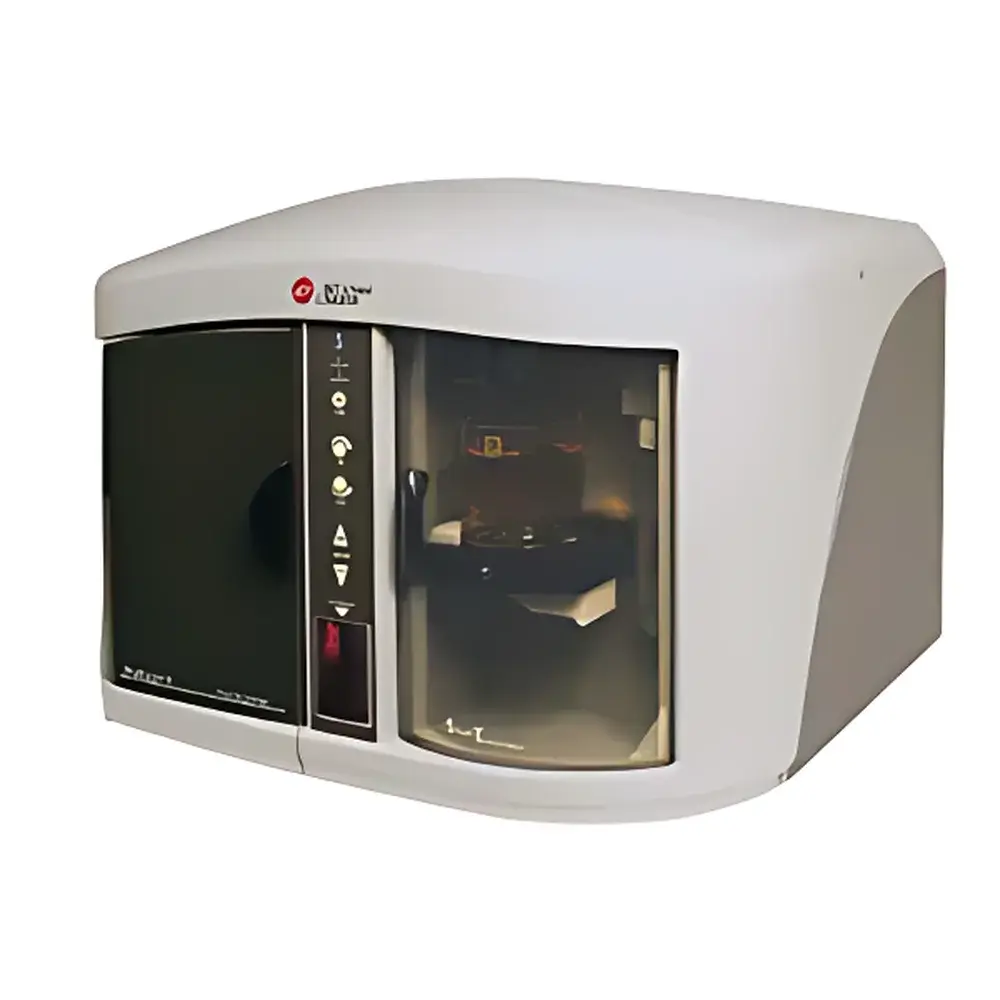
Beckman Coulter Multisizer 4e Coulter Counter Particle Analyzer
| Brand | Beckman Coulter |
|---|---|
| Origin | USA |
| Manufacturer Type | Original Equipment Manufacturer (OEM) |
| Import Status | Imported |
| Model | Multisizer 4e |
| Instrument Type | Electrical Sensing Zone (ESZ) Particle Analyzer |
| Measurement Principle | Coulter Principle (Electrical Sensing Zone) |
| Size Range | 0.4 µm – 1600 µm (diameter) |
| Volume Range | 0.033 fL – 2.145 × 10⁹ fL |
| Resolution | Up to 400 user-selectable channels |
| Compliance | ASTM D6913, ISO 13319, USP <788>, FDA 21 CFR Part 11, GLP/GMP-ready |
Overview
The Beckman Coulter Multisizer 4e is a high-precision Electrical Sensing Zone (ESZ) particle analyzer engineered for absolute particle counting and volumetric size distribution analysis across diverse sample matrices—including biological cells, pharmaceutical suspensions, industrial powders, and environmental particulates. Based on the foundational Coulter Principle—first patented in 1953—the instrument measures discrete electrical resistance pulses generated as individual particles traverse a precision-bored aperture under constant current. Each pulse amplitude is directly proportional to the displaced volume of the particle, enabling true volumetric equivalent diameter determination without optical assumptions or scattering models. Unlike light-based techniques (e.g., laser diffraction or dynamic light scattering), the Multisizer 4e delivers orthogonal, calibration-independent data rooted in first-principles physics: it reports not only distribution shape but also absolute concentration (particles/mL), total count, and volumetric metrics with traceable metrological rigor. Its design satisfies the stringent requirements of regulatory science, serving as a primary reference method in pharmacopeial monographs (USP , ) and ISO 13319–compliant laboratories.
Key Features
- True individual-particle measurement: Every detected event corresponds to one physical particle or cell—no ensemble averaging or statistical inference required.
- Digital Pulse Processing (DPP) architecture: Captures up to 525,000 data points per pulse, resolving sub-micron diameter differences with ±0.001 µm effective resolution.
- Configurable channel resolution: Select from 4 to 400 logarithmic or linear analysis channels within any user-defined size range (e.g., 1–10 µm or 50–500 µm).
- Integrated EZAccess fluidics system: Automatically detects sample cup volume (50–2000 µL), adjusts aperture positioning, and manages electrolyte flow to minimize carryover and maximize repeatability.
- Traceable calibration and verification: Onboard automated calibration routine validates aperture integrity, current stability, and volumetric delivery accuracy prior to each run.
- Multi-parameter reporting: Simultaneous output of number-, volume-, and surface-area-weighted distributions; absolute counts per mL; cumulative % undersize; pulse width/area kinetics for aggregation or dissolution monitoring.
- Regulatory-compliant operation: Full audit trail, electronic signatures, role-based access control, and data encryption aligned with FDA 21 CFR Part 11 and EU Annex 11 requirements.
Sample Compatibility & Compliance
The Multisizer 4e accommodates aqueous and non-aqueous suspensions, conductive and non-conductive media (with appropriate electrolyte conditioning), and samples ranging from intact mammalian cells (e.g., RBCs, leukocytes, stem cells) to abrasive ceramic powders and polymer microspheres. It is insensitive to particle morphology, refractive index, color, or optical turbidity—making it uniquely robust for complex formulations where optical methods fail. Apertures are available from nominal 20 µm to 2000 µm, supporting dynamic diameter ranges up to 1:40 and volumetric ranges exceeding 1:64,000. All measurements comply with ISO 13319 (characterization of particle size analyzers using the ESZ method), ASTM D6913 (soil particle size analysis), and USP chapters governing particulate matter in injectables and ophthalmics. The system supports GLP and GMP workflows through configurable SOP enforcement, instrument qualification templates (IQ/OQ/PQ), and secure, version-controlled data archiving.
Software & Data Management
Controlled via Beckman Coulter’s MultiSite™ software suite running natively on Windows 10/11 platforms, the Multisizer 4e provides end-to-end workflow integration—from method definition and real-time acquisition to advanced post-processing and report generation. Software features include live trend visualization (pulse rate, mean diameter, CV%), batch processing with customizable pass/fail criteria, and regeneration of raw pulse data without re-injection. All datasets retain full metadata: aperture ID, current setting, sample volume, temperature, operator ID, and timestamp. Export formats include CSV, XML, PDF, and native .M4E files compatible with third-party statistical packages. Audit trails record every parameter change, data export, and user login, satisfying 21 CFR Part 11 electronic record requirements. Optional LIMS integration enables automated result transfer to enterprise quality systems.
Applications
- Pharmaceutical development: Quantitative assessment of subvisible particles in biologics, vaccines, and sterile injectables per USP .
- Cell therapy QC: Viability-independent sizing and enumeration of therapeutic cells, exosomes, and extracellular vesicles.
- Materials science: Characterization of catalysts, pigments, toners, and battery electrode slurries where shape-insensitive volume equivalence is critical.
- Environmental monitoring: Enumeration and sizing of plankton, sediment fractions, and airborne particulate analogs in controlled suspension.
- Academic research: Longitudinal tracking of cellular swelling/shrinkage, nanoparticle aggregation kinetics, and dissolution profiles via time-resolved pulse distribution analysis.
FAQ
How does the Coulter Principle differ from optical particle sizing methods?
The Coulter Principle measures the volume displacement of individual particles in conductive fluid, yielding direct, calibration-free volumetric equivalent diameters. Optical methods infer size from scattered or diffracted light intensity, requiring assumptions about shape, refractive index, and homogeneity—introducing systematic bias in polydisperse or irregular samples.
Can the Multisizer 4e analyze non-aqueous samples?
Yes—provided the medium contains sufficient ionic conductivity (e.g., via added electrolyte or intrinsic ion content) to support stable current flow across the aperture. Common non-aqueous applications include hydrocarbon-based lubricants and organic solvent dispersions.
What validation documentation is provided for regulated environments?
Beckman Coulter supplies comprehensive qualification packages including Installation Qualification (IQ), Operational Qualification (OQ), and Performance Qualification (PQ) protocols, along with traceable calibration certificates for apertures and volumetric pumps.
Is data reprocessing possible after acquisition?
Yes—raw pulse data is stored in its entirety. Users may reapply different channel definitions, baseline corrections, or gating thresholds to archived runs without re-analyzing the physical sample.
How often does the aperture require cleaning or replacement?
Aperture lifetime depends on sample cleanliness and usage frequency. With proper filtration and routine rinsing, standard apertures typically operate >1,000 hours. Automated cleaning cycles and real-time clog detection minimize downtime and extend service intervals.



