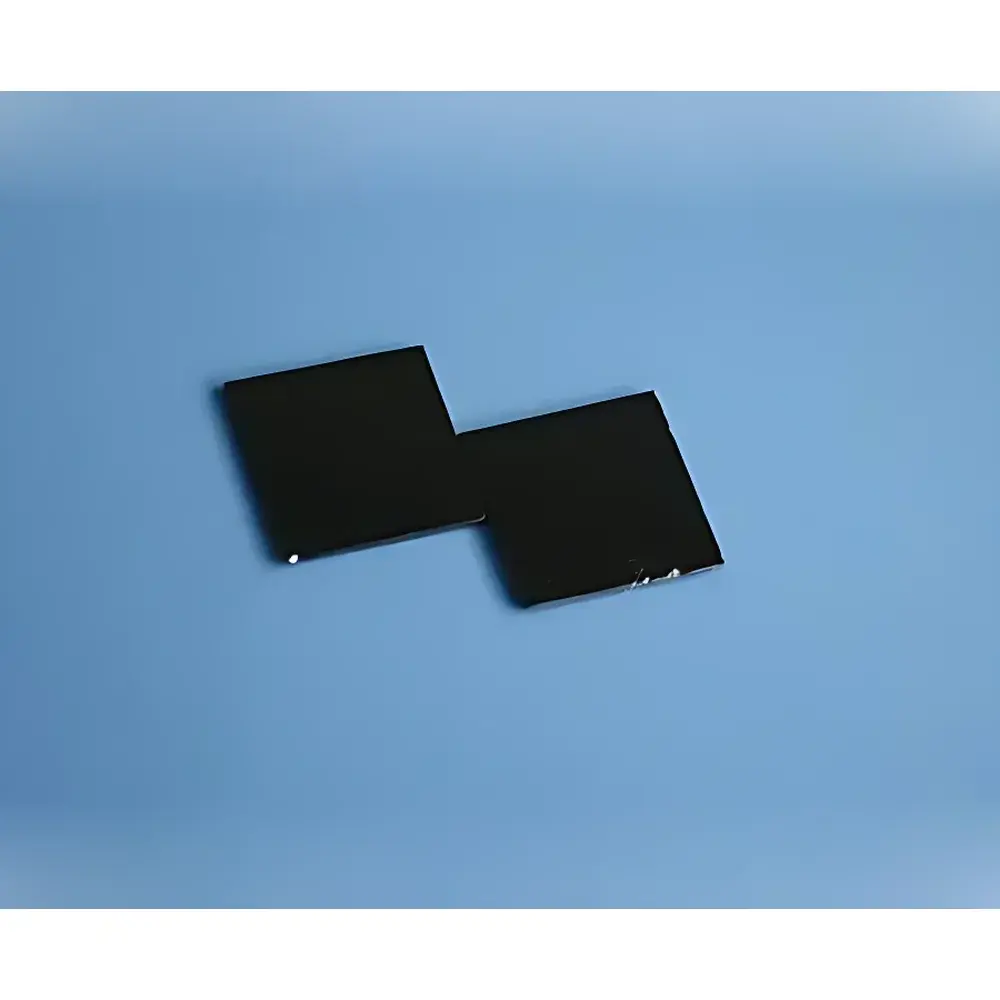
CdZnTe Crystal Substrates (合肥科晶 | Cd1−xZnxTe, Bridgman-Grown, or -Oriented)
| Brand | Hefei Kejing |
|---|---|
| Origin | Anhui, China |
| Manufacturer Type | Authorized Distributor |
| Origin Category | Domestic |
| Model | CdZnTe Crystal Substrates |
| Pricing | Available Upon Request |
Overview
CdZnTe (Cadmium Zinc Telluride) crystal substrates are single-crystal wafers engineered for high-performance infrared (IR) optoelectronic device fabrication—particularly as lattice-matched growth templates for mercury cadmium telluride (Hg1−yCdyTe or MCT) epitaxial layers. These substrates crystallize in the cubic zincblende structure and form a continuous solid solution across the CdTe–ZnTe binary system. By precisely tuning the Zn composition (typically x ≈ 0.04 ± 0.005), the lattice parameter is adjusted to 6.486 Å—enabling near-perfect (109 Ω·cm for semi-insulating variants), and strong X-ray/gamma-ray stopping power further support applications in radiation detection and nuclear spectroscopy.
Key Features
- High-purity, low-defect Bridgman-grown single crystals with rocking curve full-width at half-maximum (FWHM) < 30 arcseconds—verified by high-resolution X-ray diffraction (HRXRD)
- Controlled stoichiometry: Cd1−xZnxTe with x = 0.04 ± 0.005, ensuring reproducible lattice matching to HgCdTe compositions used in MWIR/LWIR detector architectures
- Surface quality: Etch pit density (EPD) < 1 × 105 cm−2, indicating low dislocation density and suitability for molecular beam epitaxy (MBE) and metalorganic chemical vapor deposition (MOCVD)
- Thermal stability: Coefficient of thermal expansion (CTE) = 5.0 × 10⁻⁶ K−1, closely matched to HgCdTe (≈ 5.8 × 10⁻⁶ K−1), reducing thermal stress during cooldown post-epitaxy
- Infrared transmission >60% across 2–25 µm spectral range (uncoated, 1 mm thickness), confirmed via Fourier-transform infrared (FTIR) spectroscopy
- Standard orientations: or , B-face polished, with angular tolerance ±0.5°; custom orientations (e.g., , off-axis) available upon request
Sample Compatibility & Compliance
These substrates are compatible with standard semiconductor wafer handling protocols—including automated load-lock chambers, vacuum chucks, and IR-transparent mask aligners. All wafers undergo final processing in ISO Class 6 (1000) cleanroom environments and are double-packaged: first in ISO Class 5 (100) cleanroom-grade polyethylene bags with nitrogen purge, then in rigid single-wafer cassettes or static-dissipative trays. While not certified to ISO 9001 or IATF 16949 at the distributor level, material traceability (batch ID, growth date, HRXRD report, EPD map) is provided per shipment. Substrates meet baseline requirements for ASTM F1527 (Standard Guide for Evaluating Semiconductor Wafer Surface Quality) and are routinely qualified for use in defense-grade IR imaging systems compliant with MIL-STD-883 and NASA EEE-INST-002.
Software & Data Management
No embedded firmware or proprietary software is associated with bare CdZnTe substrates. However, full metrology documentation—including HRXRD ω-scans, FTIR transmittance spectra, surface profilometry (Ra < 0.3 nm), and EPD maps—is delivered digitally in PDF and CSV formats. Data files adhere to FAIR principles (Findable, Accessible, Interoperable, Reusable) and include embedded metadata (crystallographic orientation, Zn composition, growth method, polishing sequence). For integration into automated fabrication workflows, ASCII-formatted coordinate files (for robotic handler alignment) and SEMI E142-compliant wafer map definitions can be supplied on request.
Applications
- HgCdTe-based infrared photodetectors (MWIR: 3–5 µm; LWIR: 8–12 µm; VLWIR: up to 15 µm)
- Mercury zinc telluride (HgZnTe) and HgCdZnTe ternary alloy heterostructures
- Room-temperature X-ray and gamma-ray spectrometers (e.g., CZT detectors for medical imaging and nuclear safeguards)
- Substrate-level testing of epitaxial defect propagation using cross-sectional TEM and cathodoluminescence
- Bench-scale evaluation of novel passivation schemes (e.g., atomic layer deposited Al2O3 or SiO2) for surface state control
FAQ
What Zn composition is used in these CdZnTe substrates, and how is it verified?
The nominal composition is Cd0.96Zn0.04Te (x = 0.04 ± 0.005), confirmed by energy-dispersive X-ray spectroscopy (EDS) and lattice parameter calibration via HRXRD.
Are substrates available with anti-reflection (AR) coatings?
Standard substrates are uncoated. Custom broadband AR coatings (e.g., ZnS/YF3 multilayer for 2–14 µm) can be applied by third-party vendors; specifications and lead time must be coordinated separately.
What surface finish options are offered beyond standard B-face polish?
Options include mechanical polish (Ra < 0.5 nm), chemical-mechanical polish (Ra < 0.2 nm), and atomically flat etched surfaces (via bromine-methanol or iodine-ethanol etchants); all require advance specification.
Do you provide wafer-level metrology reports with each shipment?
Yes—each lot includes a Certificate of Conformance with HRXRD rocking curve data, EPD map, FTIR transmission curve, and surface roughness profile.
Can substrates be supplied with pre-patterned alignment marks or fiducials?
Laser-scribed alignment grooves (5–10 µm width, 1 µm depth) or oxide-based fiducials are available under NRE agreement; minimum order quantity applies.
Related Products