
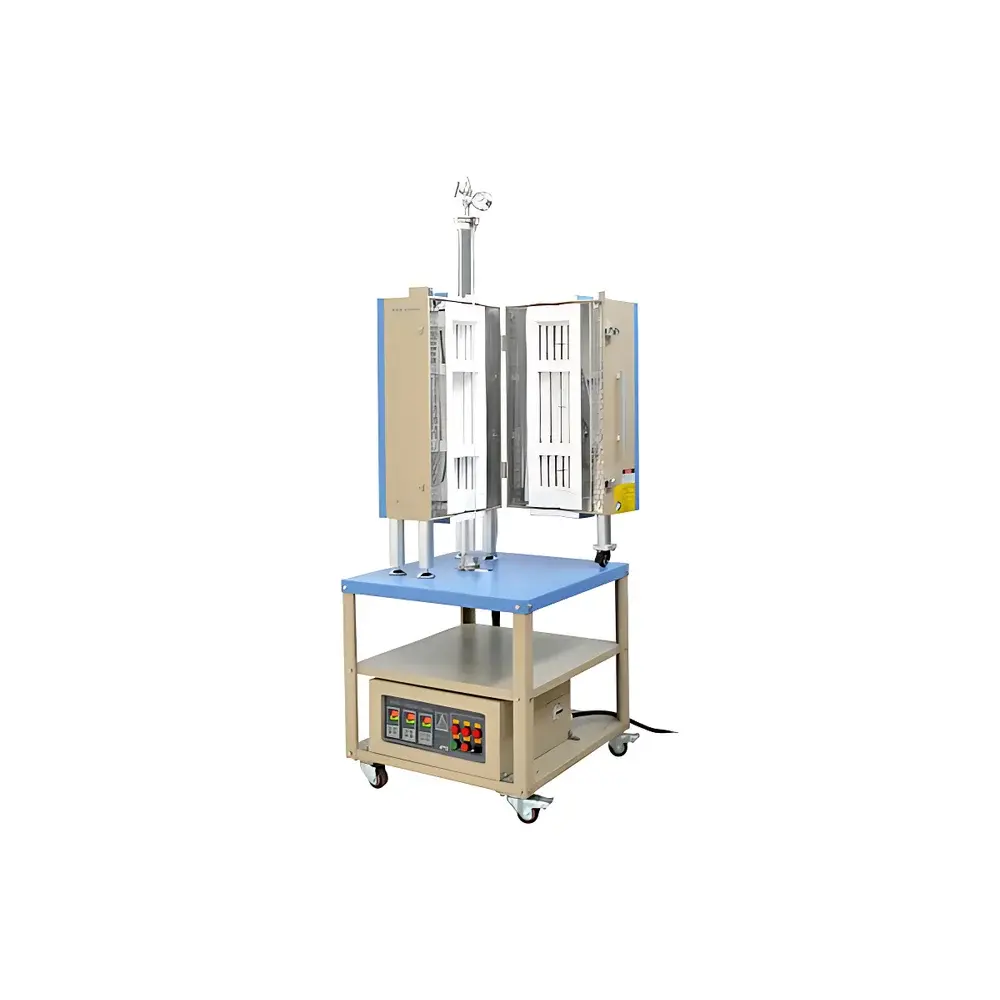
OTF-1200X-III-VT Vertical Triple-Zone Tube Furnace by MTI Corporation
| Brand | MTI Corporation |
|---|---|
| Origin | Hefei, Anhui, China |
| Model | OTF-1200X-III-VT |
| Max Temperature | 1200 °C |
| Continuous Operating Temperature | 1100 °C |
| Temperature Uniformity | ±1 °C over 400 mm (isothermal zone) |
| Heating Rate | ≤20 °C/min (to max temp) |
| Temperature Control | Triple independent PID controllers, 30-segment programmable ramp/soak profiles per zone |
| Furnace Tube | High-purity quartz, OD 50 mm × ID 44 mm × L 1200 mm (also available in OD 60 mm and OD 80 mm variants) |
| Heating Zones | Top (135 mm), Center (260 mm), Bottom (135 mm) |
| Power Supply | AC 208–240 V, 1Φ, 50/60 Hz |
| Max Power Consumption | 4.8 kW (requires 30 A circuit breaker) |
| Cooling | Dual-layer air-cooled steel shell |
| Insulation | High-purity alumina fiber core with high-temperature alumina coating |
| Heating Elements | Mo-doped Fe–Cr–Al alloy wire with zirconia protective coating |
| Vacuum Compatibility | 10⁻² Torr (mechanical pump), 10⁻⁵ Torr (turbo-molecular pump) |
| Sealing System | Stainless steel flanges with integrated mechanical pressure gauge and stainless steel shut-off valve |
| Safety Features | Over-temperature cutoff, K-type Omega armored thermocouples, fail-safe thermal interlock |
| Certifications | CE-marked |
| Weight | ~115 kg |
| Dimensions (L×W×H) | 700 mm × 700 mm × 1680 mm |
| Warranty | 12 months parts and labor (excludes consumables: furnace tube, O-rings, heating elements) |
Overview
The OTF-1200X-III-VT is a vertically oriented, triple-zone tube furnace engineered for precise thermal processing under controlled atmosphere or vacuum conditions. Designed around the fundamental principles of conductive and radiative heat transfer within a sealed quartz tube environment, it enables reproducible high-temperature treatments—including rapid thermal annealing, quenching, chemical vapor deposition (CVD), physical vapor deposition (PVD), and controlled-atmosphere sintering—across a wide range of materials science and thin-film research applications. Its vertical orientation facilitates gravity-assisted sample quenching, while the independently controllable three-zone architecture allows for precise thermal gradient establishment (e.g., for crystal growth, zone refining, or thermal diffusion studies). The furnace operates up to 1200 °C for short-duration cycles and maintains stable continuous operation at 1100 °C, supported by a robust dual-shell air-cooled enclosure and high-emissivity alumina fiber insulation.
Key Features
- Triple independent PID temperature control systems—one per heating zone—each supporting up to 30 programmable ramp/soak segments for complex thermal profiles.
- High-precision ±1 °C temperature uniformity across a 400 mm isothermal zone when zones are set to identical setpoints, verified per ASTM E220 calibration standards.
- Vertical configuration with motorized or manual sample drop mechanism (electromagnetic release optional) enabling repeatable, time-synchronized quenching for kinetic studies.
- Dual-layer steel housing with forced-air cooling ensures external surface temperature remains below 60 °C during sustained operation at maximum temperature.
- High-purity quartz tube (OD 50 mm × ID 44 mm × L 1200 mm) rated for long-term use ≤1100 °C; alternative sizes (OD 60 mm, OD 80 mm) available for larger samples or gas flow optimization.
- Integrated stainless steel flange assembly with mechanical pressure gauge, stainless steel isolation valve, and optional digital vacuum gauge interface for real-time process monitoring.
- Mo-doped Fe–Cr–Al heating elements coated with stabilized zirconia enhance oxidation resistance and extend service life beyond 2,000 hours at 1100 °C.
- Comprehensive safety architecture including redundant K-type Omega armored thermocouples, hardware-based over-temperature cut-off, and thermal interlock logic compliant with IEC 61000-6-2 EMC requirements.
Sample Compatibility & Compliance
The OTF-1200X-III-VT accommodates diverse sample geometries—including powders, pellets, wafers, fibers, and crucibles—within its 1200 mm-long quartz tube. It supports inert (N₂, Ar), reducing (H₂/N₂ mixtures), oxidizing (O₂), and reactive (NH₃, SiH₄) atmospheres, subject to gas compatibility with quartz and system pressure limits (max 0.02 MPa absolute). Vacuum operation down to 10⁻⁵ Torr (with turbo-molecular pump) enables ultra-clean processing for semiconductor-grade film deposition. All electrical subsystems (>24 V) carry UL/MET/CSA certification; the full unit bears CE marking per EU Machinery Directive 2006/42/EC and Low Voltage Directive 2014/35/EU. Design and documentation align with GLP-compliant lab practices, supporting audit-ready records when paired with optional computer-controlled data logging modules.
Software & Data Management
While the standard configuration features front-panel PID controllers with intuitive membrane-keypad interface, an optional RS485/USB-enabled temperature controller module permits full remote operation via Windows-based software. This module supports real-time temperature logging at user-defined intervals (100 ms–60 s), automated profile execution, and export of timestamped CSV datasets compatible with MATLAB, Python (pandas), or LabVIEW environments. Audit-trail functionality—including operator ID, parameter changes, and alarm events—is available to meet FDA 21 CFR Part 11 requirements when deployed in regulated QC/QA workflows. Firmware updates are delivered via secure HTTPS portal, ensuring traceable version control.
Applications
- Controlled-atmosphere annealing of battery cathode materials (e.g., NMC, LFP) and solid-state electrolytes.
- Growth of 2D transition metal dichalcogenides (TMDs) via sulfurization/selenization CVD.
- Thermal treatment of metal–organic frameworks (MOFs) for porosity tuning and activation.
- Rapid quenching experiments to study phase transformation kinetics in shape-memory alloys and metallic glasses.
- HPCVD (hybrid physical–chemical vapor deposition) integration for graded heterostructure synthesis.
- Atmospheric-pressure brazing and transient liquid-phase bonding of ceramic–metal composites.
- Calibration reference furnaces for thermocouple validation per ISO/IEC 17025-accredited labs.
FAQ
What is the maximum safe operating pressure inside the quartz tube?
The quartz tube must not exceed 0.02 MPa (absolute) internal pressure. Always use a calibrated pressure-reducing regulator on gas supply lines; MTI recommends regulators with 0.01–0.1 MPa output range.
Can the furnace be operated under vacuum above 1000 °C?
No. Quartz tubes become mechanically unstable under high vacuum at temperatures >1000 °C. Maintain near-atmospheric pressure (±10 kPa) during high-temperature vacuum hold cycles.
Is the isothermal zone length affected when using different temperature setpoints across zones?
Yes. The specified 400 mm ±1 °C uniformity applies only when all three zones are set to the same temperature. Gradient modes reduce effective isotherm length but enable directional thermal processing.
What maintenance intervals are recommended for consumables?
Quartz tubes should be inspected visually before each high-temperature run; replace if clouding, devitrification, or microcracks are observed. O-rings require replacement every 6–12 months depending on thermal cycling frequency and atmosphere type.
Does the system support integration with third-party gas delivery or mass flow controllers?
Yes. Standard 1/4″ VCR ports on the flange allow direct connection to MFCs, gas manifolds, or residual gas analyzers (RGAs) via compatible stainless steel tubing and fittings.



