
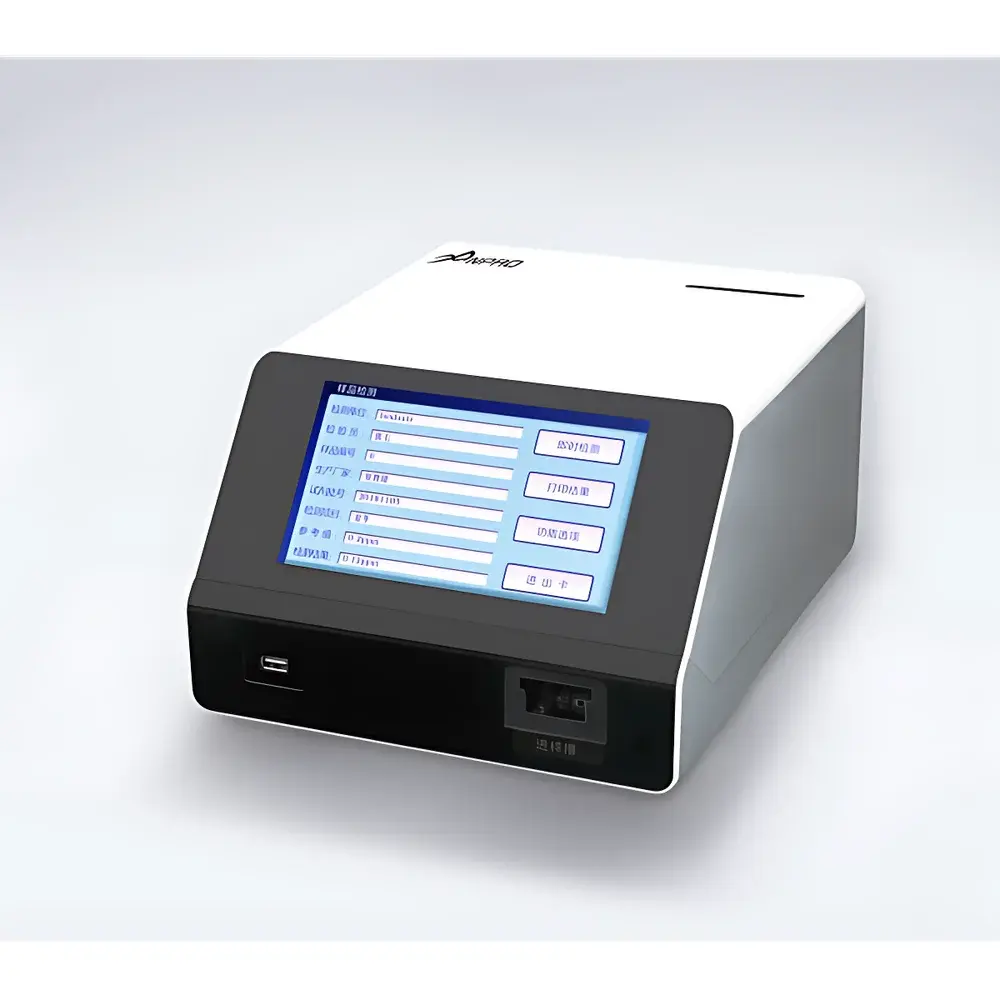
ANPRO APN-R Dairy Heavy Metal Rapid Quantitative Analyzer (Pb/Cr)
| Brand | ANPRO |
|---|---|
| Origin | Sichuan, China |
| Manufacturer Type | Direct Manufacturer |
| Region Classification | Domestic (China) |
| Model | APN-R |
| Detection Targets | Lead (Pb), Chromium (Cr), and Multi-analyte Screening in Milk & Dairy Products |
| Automation Level | Semi-automatic |
| Throughput | 60 Samples/Hour |
| Detection Range (Pb) | 0–1 ppm (mg/kg) |
| Detection Range (Cr) | 0–5 ppm (mg/kg) |
| Repeatability (CV) | <3% |
| Accuracy | >80% |
| Onboard Storage | 2 GB |
| LOD (Pb in raw/pasteurized/UHT milk) | 0.001 ppm |
| LOD (Pb in other dairy matrices) | 0.01 ppm |
| LOD (Cr) | 0.1 ppm |
| Assay Time | 6 min per test |
| Reaction Temperature | 37 °C |
| Calibration | Pre-loaded multi-point standard curves for Pb, Cr, and 12+ additional analytes (e.g., Aflatoxin M1, Chloramphenicol, Melamine) |
Overview
The ANPRO APN-R Dairy Heavy Metal Rapid Quantitative Analyzer is a semi-automated optical reader engineered for high-throughput, field-deployable quantification of priority contaminants—including lead (Pb) and chromium (Cr)—in raw milk, pasteurized milk, UHT milk, fermented dairy, and recombined dairy products. It operates on the principle of lateral flow immunoassay (LFIA) coupled with colloidal gold nanoparticle signal amplification. The instrument optically measures the absorbance intensity of the test line (T-line) on certified lateral flow strips, comparing it against pre-installed, matrix-matched calibration curves to deliver quantitative results in parts per trillion (ppt) to parts per million (ppm) ranges. Designed specifically for dairy quality control laboratories, regulatory inspection units, and dairy processing facilities, the APN-R complies with the functional requirements of rapid screening methods referenced in ISO 15239 (lateral flow assay validation), AOAC Official Method 2014.01 (colloidal gold-based assays), and China’s GB 5009.12-2023 (determination of lead in foods). Its architecture prioritizes operational robustness under variable ambient conditions, with thermal stabilization for consistent 37 °C incubation during strip development.
Key Features
- Optimized optical detection module with dual-wavelength (630 nm/850 nm) reflectance measurement to minimize background interference from milk fat or protein residues
- Pre-calibrated, lot-specific standard curves embedded in firmware for Pb (0.001–0.1 ppm in raw/pasteurized/UHT milk; 0.01–1 ppm in whey, cream, and powdered milk) and Cr (0.1–5 ppm)
- Semi-automated workflow: integrated barcode scanner for test strip lot tracking, auto-timing of 6-minute reaction window, and one-touch result export
- On-device data management: 2 GB internal storage supports ≥100,000 test records with timestamp, operator ID, sample ID, and strip lot number
- Dairy-specific extraction protocol compatibility: validated with ANPRO’s four-component extraction kit (Reagents A–D) and sample diluent for efficient chelation and matrix interference mitigation
- GLP-ready audit trail: all calibrations, maintenance logs, and user actions are time-stamped and non-erasable
Sample Compatibility & Compliance
The APN-R accepts liquid and reconstituted dairy matrices including raw bovine milk, buffalo milk, pasteurized and ultra-high-temperature (UHT) treated milk, flavored milk, fermented dairy (yogurt, kefir), whey permeate, and skim milk powder (reconstituted at 12% w/v). It does not support direct analysis of high-fat cheeses (>30% fat) or condensed milk without prior solvent-assisted defatting. All test protocols align with national food safety standards: GB 5009.12-2023 (Pb), GB 5009.123-2014 (Cr), and GB 5009.24-2016 (Aflatoxin M1). Method performance meets AOAC Performance Tested Methods (PTM) criteria for rapid screening: specificity >95%, false negative rate <2% at action limits, and linearity R² ≥0.995 across calibrated ranges. Instrument firmware supports optional 21 CFR Part 11-compliant user authentication and electronic signature modules upon configuration.
Software & Data Management
The APN-R runs on embedded Linux OS with proprietary ANPRO DairyScan™ firmware (v3.2+). Data export is supported via USB 2.0 and optional Wi-Fi (802.11n) to LIMS or ERP systems using CSV or ASTM E1384-compliant structured format. Built-in software includes curve fitting algorithms (4-parameter logistic regression), outlier detection (Dixon’s Q-test), and automatic flagging of results exceeding critical thresholds (e.g., Pb >0.023 mg/kg = positive, <0.017 mg/kg = negative). Audit logs record all calibration events, firmware updates, and user logins with SHA-256 hashing. Remote diagnostics and over-the-air (OTA) firmware updates are available through ANPRO’s secure customer portal—accessible only to registered laboratory administrators.
Applications
- Routine incoming raw milk screening at dairy collection centers for Pb/Cr compliance against Codex Alimentarius STAN 282-2013 limits (Pb ≤0.02 mg/kg, Cr ≤0.01 mg/kg)
- QC release testing of finished dairy products prior to distribution, supporting HACCP prerequisite programs
- Regulatory surveillance by provincial food and drug administrations conducting market monitoring campaigns
- Multi-residue verification: simultaneous method validation for Pb, Cr, aflatoxin M1, chloramphenicol, melamine, and 10+ veterinary drug residues using shared extraction and strip platforms
- Root cause investigation during non-conformance events, enabling rapid triage between farm-level contamination and processing line cross-contact
FAQ
What sample preparation is required before analysis?
Raw or processed milk samples require centrifugation (3000 × g, 5 min), followed by extraction using ANPRO’s proprietary four-reagent system (A–D) and chelating diluent. Total hands-on time is <4 minutes per sample.
Can the APN-R quantify both Pb and Cr in a single run?
No—each test uses analyte-specific lateral flow strips. Pb and Cr must be tested separately using dedicated strips; however, the same extracted supernatant may be used for both assays after appropriate dilution.
Is external calibration required before daily use?
No. The instrument performs automatic self-checks at power-on and validates optical path integrity. Only strip lot-specific calibration curves (pre-loaded at factory or updated via USB) are required.
Does the system support integration with enterprise LIMS?
Yes—via configurable CSV export or ASTM E1384-compliant HL7 messaging when paired with ANPRO’s optional DataBridge Gateway module.
What is the shelf life of the Pb and Cr test strips?
18 months from manufacture when stored at 4–30 °C in sealed aluminum pouches with desiccant; stability verified per ISO 8655-6 for diagnostic consumables.






