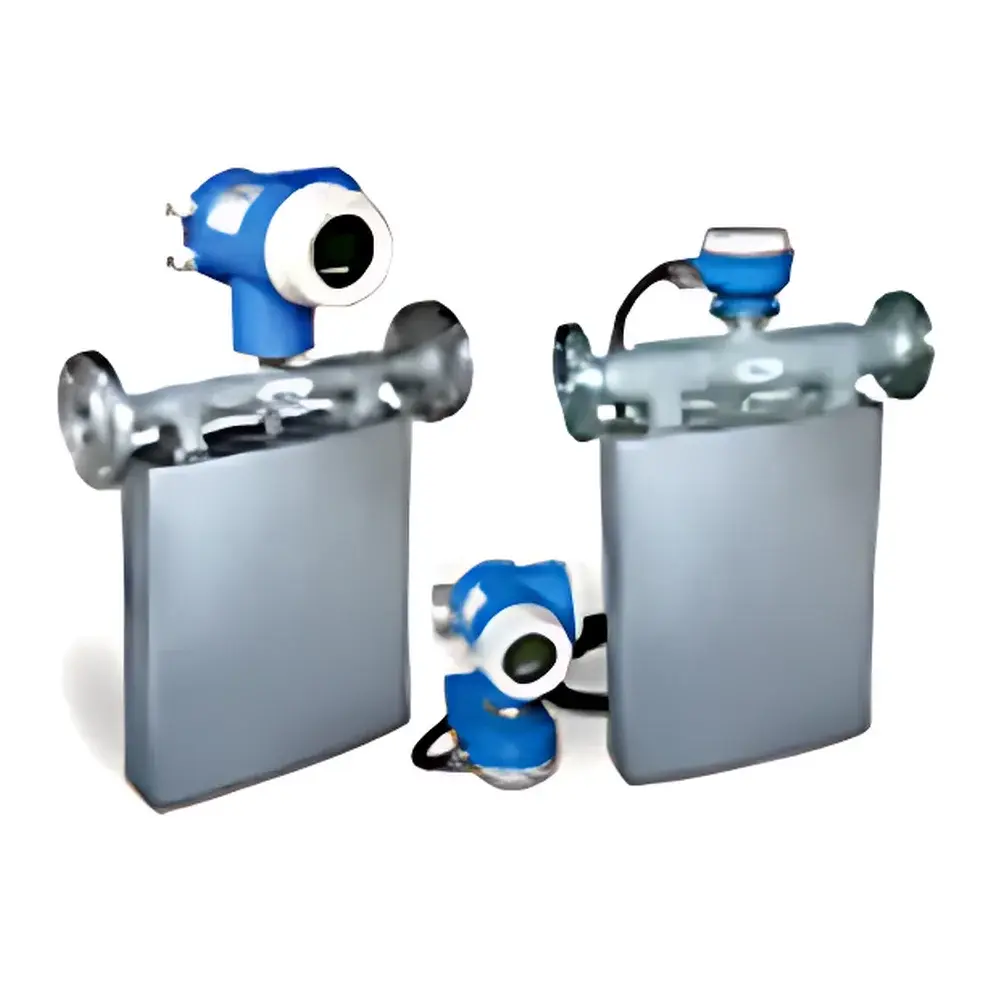
Coriolis Mass Flow Meter CMF-440
| Origin | Beijing, China |
|---|---|
| Manufacturer Type | Authorized Distributor |
| Origin Category | Domestic (PRC) |
| Model | CMF-440 |
| Pricing | Available Upon Request |
| Measurement Principle | Coriolis Effect |
| Accuracy | ±0.2% of reading |
| Flow Range Ratio | 1:20 |
| Nominal Pipe Size | DN15–DN125 |
| Pressure Rating | 4.0 MPa |
| Operating Temperature (Fluid) | –60 °C to +180 °C |
| Ambient Temperature | –20 °C to +55 °C |
| Electrical Supply | AC 85–265 V / DC 18–36 V |
| Power Consumption | <12 W |
| Output Signals | 4–20 mA, 0–10 kHz frequency, RS485 serial interface |
| Enclosure Rating | IP65 |
| Explosion Protection | Exd[ib]ib IIB T5 |
| Sensor Wetted Materials | 316L stainless steel, 1Cr18Ni9Ti |
| Configuration Options | Integral, Remote Wall-Mount, Remote Panel-Mount |
| Maximum Sensor-to-Transmitter Cable Length | 200 m |
Overview
The Coriolis Mass Flow Meter CMF-440 is an industrial-grade, direct mass flow measurement instrument engineered for high-accuracy, real-time quantification of gas and liquid mass flow rates under demanding process conditions. It operates on the fundamental principle of the Coriolis effect: as fluid flows through a vibrating U-shaped or straight-tube sensor, inertial forces induce measurable phase shifts and frequency changes in the tube’s oscillation—proportional to mass flow rate. Unlike volumetric meters, the CMF-440 delivers true mass flow output independent of fluid density, temperature, pressure, or viscosity variations—making it especially suitable for multiphase, non-Newtonian, or compositionally variable streams common in chemical processing and energy applications.
Key Features
- Simultaneous measurement of mass flow, fluid temperature, and derived density—enabling real-time process characterization without auxiliary instrumentation.
- High metrological performance with ±0.2% of reading accuracy over a 1:20 turndown ratio, validated per ISO 10790 and ASTM D7467 protocols for Coriolis flowmeters.
- Robust mechanical architecture featuring dual-sensor tube designs with 316L stainless steel or 1Cr18Ni9Ti wetted components, rated for sustained operation at up to 4.0 MPa and fluid temperatures from –60 °C to +180 °C.
- Flexible installation configuration: integral (sensor + transmitter integrated), remote wall-mount, or remote panel-mount variants—accommodating space-constrained or hazardous-area layouts.
- Comprehensive intrinsic safety and explosion protection: certified to Exd[ib]ib IIB T5 per GB 3836.1–2010 and IEC 60079-0/11, enabling deployment in Zone 1/2 classified areas without additional barriers.
- Low-maintenance design with no moving parts, no internal obstructions, and immunity to upstream flow profile disturbances—eliminating the need for straight-pipe runs or flow conditioners.
- Wide ambient operating range (–20 °C to +55 °C) and IP65-rated enclosure ensure reliable field performance in outdoor, dusty, or washdown environments.
Sample Compatibility & Compliance
The CMF-440 supports a broad spectrum of process media—including corrosive liquids (e.g., acids, caustics), cryogenic gases (e.g., LNG, nitrogen), steam, slurries, and food-grade fluids—without recalibration. Its material compatibility and pressure/temperature ratings conform to GB/T 9119–2010 (flange standards) and ASME B16.5 Class 300 equivalents. The device meets electromagnetic compatibility (EMC) requirements per GB/T 18268.1–2010 (IEC 61326-1) and functional safety guidelines aligned with SIL 2 per IEC 61508. For regulated industries, its analog and digital outputs support integration into systems compliant with FDA 21 CFR Part 11 (when paired with audit-trail-capable SCADA or DCS platforms) and GLP/GMP data integrity frameworks.
Software & Data Management
The embedded firmware supports standardized communication protocols including HART (on 4–20 mA loop), Modbus RTU over RS485, and pulse/frequency output for legacy PLC interfacing. Optional configuration software enables parameter setup, diagnostics logging, and zero calibration via USB or Ethernet connection. All configuration changes are timestamped and logged locally; critical events (e.g., sensor fault, out-of-range temperature) trigger configurable alarm outputs. Data export formats include CSV and XML, facilitating traceability and batch record generation in accordance with ISO/IEC 17025 and ASTM E2500 validation practices.
Applications
The CMF-440 is deployed across heavy and process industries where mass-based custody transfer, feedstock control, or emissions monitoring demand metrological rigor. Typical use cases include: mass-balanced feed control in ethylene cracking furnaces (petrochemical); real-time slurry mass flow monitoring in mineral processing tailings pipelines; steam mass flow verification in district heating networks; compressed air allocation tracking in automotive manufacturing plants; bulk liquid dosing in beverage blending lines (compliant with 3-A Sanitary Standards when equipped with hygienic flanges); and biogas mass flow quantification in anaerobic digestion facilities. Its stability across wide temperature gradients also supports thermal energy metering in combined heat and power (CHP) systems.
FAQ
Does the CMF-440 require periodic recalibration?
Coriolis flowmeters inherently maintain long-term stability; however, annual zero calibration under no-flow conditions is recommended per ISO/TR 20785 and manufacturer guidelines to ensure continued accuracy.
Can the CMF-440 measure two-phase flow accurately?
While not designed for homogeneous two-phase mixtures (e.g., gas-liquid slug flow), it reliably measures mass flow in entrained-gas or high-viscosity suspensions typical in pulp & paper or wastewater dewatering—provided the gas volume fraction remains below 5% and flow regime is stable.
Is the RS485 interface compatible with Modbus TCP networks?
The native RS485 port implements Modbus RTU; integration with Modbus TCP infrastructure requires a protocol gateway or industrial Ethernet converter supporting Modbus RTU-to-TCP bridging.
What is the maximum allowable cable length between sensor and transmitter in hazardous areas?
In intrinsically safe or flameproof configurations, the maximum shielded twisted-pair cable length remains 200 m—subject to voltage drop verification per IEC 60079-14 and local area classification authority approval.
How does the CMF-440 handle low-flow conditions near zero?
With a minimum measurable flow corresponding to ≤0.5% of full scale and advanced digital signal processing, it maintains repeatability down to 0.01 kg/h (dependent on nominal size), supported by dynamic zero-stabilization algorithms.