
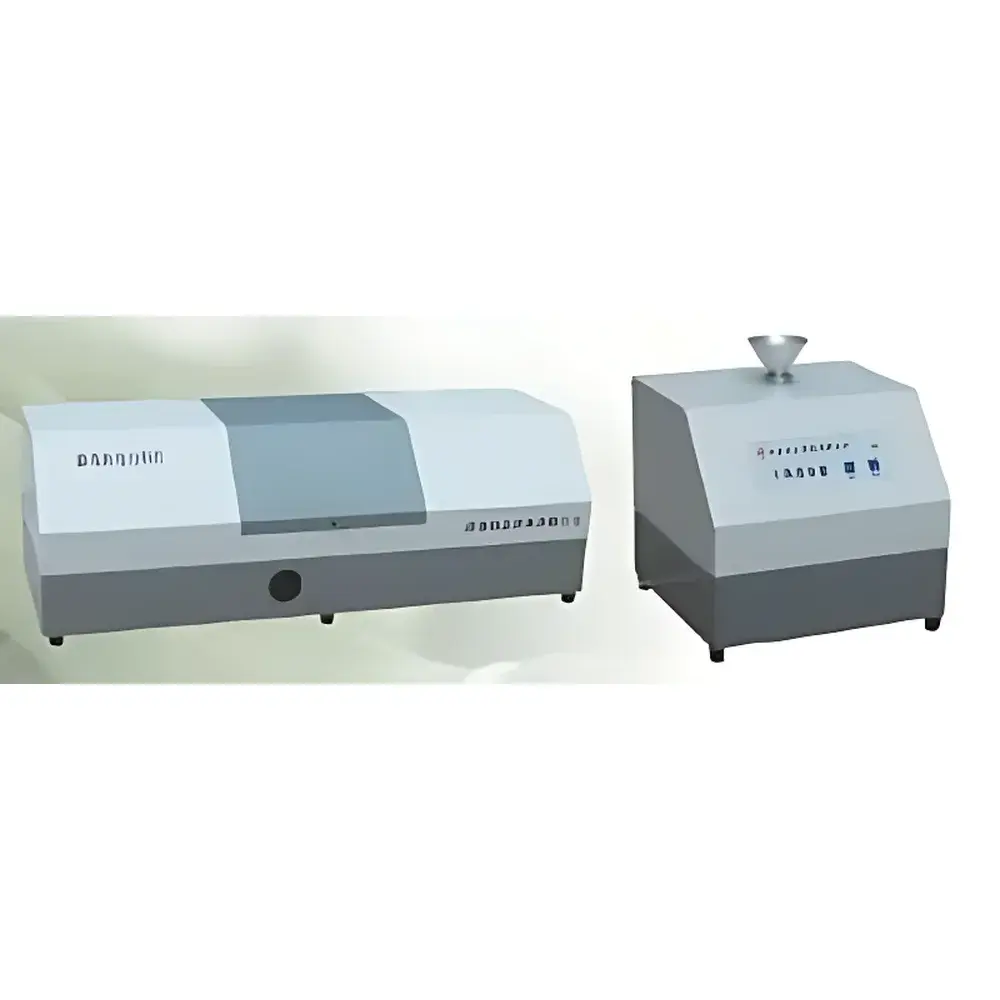
Rise-2018 Dry-Dispersion Laser Diffraction Particle Size Analyzer
| Measurement Range | 0.1–1200 µm |
|---|---|
| Accuracy Error | < ±1% (D50, NIST-traceable standard reference materials) |
| Repeatability | < ±1% (D50, same sample, repeated measurements) |
| Laser Source | He-Ne, 632.8 nm, >25,000 h lifetime |
| Power Supply | AC 220 V ±10%, 50 Hz, 200 W |
| Dimensions | 950 × 330 × 300 mm |
| Weight | 40 kg |
| Detector Array | Non-uniform, cross-aligned 3D扇-shaped matrix, max detection angle 135° |
| Optical Design | Single-range convergent beam Fourier optics, alignment-free |
| Software | PADMAS v5.x (Particle Diameter Measure & Analysis System) |
Overview
The Rise-2018 Dry-Dispersion Laser Diffraction Particle Size Analyzer is an industrial-grade instrument engineered for rapid, reproducible, and metrologically traceable particle size distribution (PSD) analysis of dry powders. It operates on the fundamental principle of Mie scattering theory—fully accounting for particle refractive index, absorption coefficient, and dispersion medium optical properties—to invert angular light intensity distributions into volumetric PSD data across a continuous 0.1–1200 µm range. Unlike simplified Fraunhofer approximations, the Rise-2018 implements rigorous, unconstrained inverse scattering computation: no prior assumptions (e.g., log-normal or Rosin-Rammler distributions) are imposed during data reconstruction. This ensures fidelity to true sample morphology, critical for regulatory submissions, process validation, and material qualification where bias from distributional assumptions must be eliminated.
Key Features
- Stable He-Ne laser source: 632.8 nm wavelength, narrow linewidth (<0.002 nm), long-term power stability (25,000 h operational lifetime—providing consistent illumination essential for inter-laboratory comparability and GLP-compliant trending.
- Advanced detector architecture: A non-uniform, cross-aligned 3D扇-shaped (fan-shaped) photodiode array with 130 discrete channels, covering scattering angles up to 135°. This geometry maximizes signal capture across both forward and wide-angle regimes, enabling high-resolution differentiation of submicron fines and coarse agglomerates within a single measurement.
- Convergent-beam Fourier optical design: Eliminates multi-lens Fourier transform assemblies, reducing alignment sensitivity and optical loss. The single-range, alignment-free configuration maintains calibration integrity across the full dynamic range without mechanical recalibration or range switching.
- Integrated dry dispersion system: Comprising an automated dry powder feeder, oil-free silent air compressor (7 bar output), refrigerated air dryer, and high-efficiency venturi disperser. Particles undergo simultaneous shear (wall friction), collisional breakup (inter-particle impact), and turbulent acceleration—achieving deagglomeration without solvents, surfactants, or ultrasonication.
- Real-time measurement kinetics: From sample introduction to final PSD report generation: ≤60 seconds. Data acquisition, inversion, and statistical reporting occur in a single uninterrupted workflow—enabling high-throughput QC screening in production environments.
Sample Compatibility & Compliance
The Rise-2018 is validated for free-flowing, non-cohesive, and moderately cohesive dry powders—including metal alloys, ceramics, pharmaceutical excipients, catalysts, toners, and mineral fillers. It excludes highly fibrous, hygroscopic, electrostatic-prone, or thermally labile materials requiring wet dispersion. Instrument performance complies with ISO 13320:2020 (Particle size analysis — Laser diffraction methods) for optical design, detector response linearity, and uncertainty quantification. Measurement accuracy is verified against NIST-traceable silica and polystyrene latex standards (e.g., NIST SRM 1963, 1690). Full audit trail capability—including user login, parameter change logs, raw scattering pattern archives, and timestamped reports—is configurable to meet FDA 21 CFR Part 11 requirements for electronic records and signatures when paired with validated PADMAS software deployment.
Software & Data Management
PADMAS v5.x is a CE-marked, Windows-based analytical platform supporting ISO/IEC 17025-aligned data handling. It provides dual-mode inversion (Mie and Fraunhofer), customizable binning (1–130 classes across 0.02–2000 µm), and seven distribution formats: differential volume %, cumulative volume %, RRB, log-normal, user-defined sieve cuts, mesh-based grading (US Standard Sieve Series), and number-weighted distribution. Key outputs include D10, D50, D90, span, specific surface area (volume- and mass-based), and polydispersity index. All reports export natively to Excel (.xlsx), PDF, PNG, and EMF; header/footer templates are editable; print preview supports multi-page layout. Raw scattering patterns (.dat) and processed results (.pdm) are stored in structured directories with SHA-256 checksums for data integrity verification. Optional modules support SPC charting, batch comparison statistics (ANOVA, t-test), and LIMS integration via ASTM E1384-compliant XML export.
Applications
- Pharmaceutical solid dosage development: API crystallinity assessment, blend uniformity monitoring, and inhaler formulation aerodynamic particle size distribution (APSD) pre-screening.
- Cement and additive manufacturing powders: Quality control of sintering feedstocks, flowability correlation studies (Hausner ratio vs. D50), and contamination detection via fine fraction spikes.
- Electronics materials: Metal paste rheology precursor characterization, solder sphere size consistency, and dielectric ceramic powder grading for tape-casting slurry stability prediction.
- Food & agriculture: Spray-dried dairy powder reconstitution behavior modeling, flour milling efficiency optimization, and pesticide granule dissolution rate correlation.
- Environmental monitoring: Airborne particulate matter (PM10/PM2.5) surrogate testing, soil texture classification, and ash residue analysis from combustion processes.
FAQ
Does the Rise-2018 require periodic recalibration with reference standards?
Yes—annual verification using NIST-traceable PSL or silica standards is recommended per ISO 13320 Annex B. Factory calibration certificates include uncertainty budgets at D10, D50, and D90.
Can the instrument measure nanoparticles below 100 nm in dry mode?
No—dry dispersion physics limit reliable detection to ≥0.1 µm (100 nm). Sub-100 nm analysis requires wet dispersion with ultrasonic energy and refractive index-matched liquids.
Is the air compressor integrated or external?
The oil-free, <55 dB(A) compressor and refrigerated dryer are supplied as a dedicated subsystem but housed separately for thermal isolation and service access.
What dispersion pressure ranges are supported?
Operating air pressure is adjustable from 1–6 bar via precision needle valve; optimal settings are empirically determined per material using the built-in pressure feedback monitor.
How is data security managed for regulated environments?
PADMAS supports role-based access control (RBAC), electronic signatures, and immutable audit trails compliant with 21 CFR Part 11 when deployed on domain-joined Windows Server with Group Policy enforcement.



