
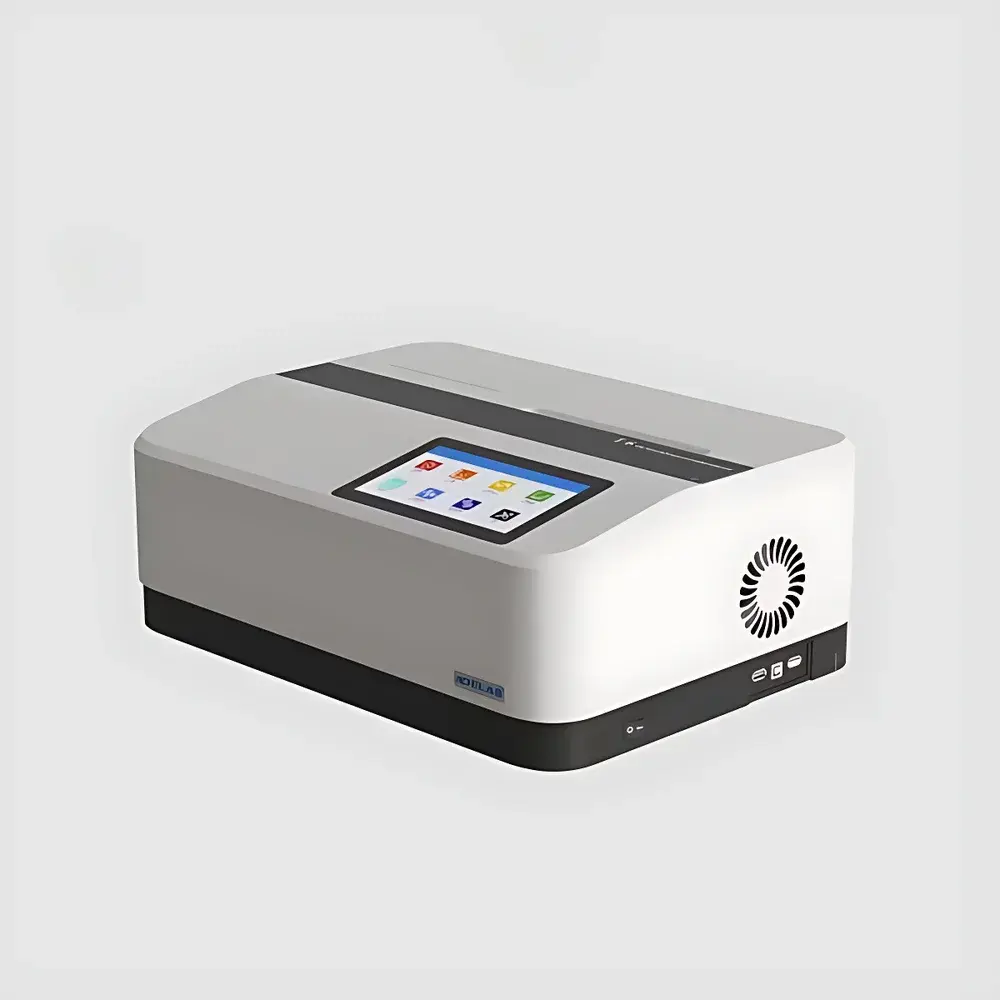
AOE T6 Ultraviolet-Visible Spectrophotometer
| Brand | AOE |
|---|---|
| Origin | Shanghai, China |
| Manufacturer Type | Authorized Distributor |
| Country of Origin | China |
| Model | T6 |
| Price Range | USD 2,800–4,300 (FOB Shanghai) |
| Optical Design | Pseudo-Double-Beam |
| Detector Type | Silicon Photocell |
| Wavelength Range | 190–1100 nm |
| Wavelength Scanning Mode | Motorized Auto-Scanning |
| Spectral Bandwidth | 1.8 nm (±1.6 nm) |
| Wavelength Accuracy | ±0.4 nm (±0.3 nm at 546.1 nm) |
| Wavelength Repeatability | ≤0.2 nm |
| Stray Light | ≤0.04% T (at 220 nm and 360 nm) |
| Absorbance Noise | ±0.0005 Abs (0–0.5 Abs), ±0.0004 Abs (0.5–1.0 Abs) |
| Display | 7-inch TFT LCD Touchscreen (1024 × 800 resolution) |
| Data Interface | USB 2.0, Wi-Fi 802.11 b/g/n, Bluetooth 4.2 |
| Sample Holder | Integrated 6-position Automatic Cuvette Changer (supporting 1–5 cm pathlength cells) |
| Software Compliance | Audit Trail Enabled, 21 CFR Part 11 Ready (User Authentication, Electronic Signature Support, Immutable Log History) |
Overview
The AOE T6 Ultraviolet-Visible Spectrophotometer is a precision optical instrument engineered for quantitative and qualitative analysis across pharmaceutical, environmental, biochemical, and academic laboratories. It operates on the principle of Beer–Lambert law-based absorption spectroscopy, utilizing a pseudo-double-beam optical architecture to compensate for source intensity drift and detector sensitivity variation during measurement. The system employs a high-efficiency holographic grating (1200 lines/mm) coupled with a silicon photocell detector, delivering stable photometric performance across the full UV-Vis range (190–1100 nm). Its sealed optical compartment prevents dust ingress and thermal drift, ensuring long-term baseline stability and measurement reproducibility—critical for GLP-compliant routine testing and method validation.
Key Features
- Robust mechanical construction using reinforced sheet-metal chassis to maintain optical alignment under transit and daily laboratory handling.
- Integrated 7-inch high-resolution TFT touchscreen (1024 × 800) enabling standalone operation—no external PC required for basic absorbance, transmittance, concentration, or kinetic measurements.
- Pseudo-double-beam optical design with real-time reference beam monitoring, minimizing errors from lamp aging or ambient temperature fluctuations.
- Motorized automatic wavelength scanning with ±0.3 nm accuracy at mercury line (546.1 nm), supporting rapid spectral acquisition and peak identification.
- Low-stray-light optical path (<0.04% T at 220 nm and 360 nm) ensures reliable quantitation of highly absorbing samples and accurate detection of trace analytes in UV-sensitive matrices.
- Multi-interface connectivity: native USB host port for flash-drive data export; optional Wi-Fi and Bluetooth modules enable wireless instrument control and remote report generation.
- Comprehensive cuvette handling: built-in 6-position automatic changer accommodating standard 1 cm, 2 cm, 3 cm, 4 cm, and 5 cm pathlength cells—ideal for dilute and concentrated sample analysis without manual repositioning.
Sample Compatibility & Compliance
The T6 accommodates standard quartz, glass, and plastic cuvettes (10 mm to 50 mm pathlength), including matched pairs for dual-beam referencing. Its sealed optical chamber eliminates contamination risk from airborne particulates or solvent vapors—essential for volatile organic solvent analysis and cleanroom applications. The instrument meets key international performance benchmarks: ISO 9001-certified manufacturing processes; ASTM E275-21 for spectrophotometer verification; and USP requirements for wavelength accuracy and photometric linearity. Software audit trail functionality—including timestamped user logins, parameter change records, and immutable result history—supports compliance with FDA 21 CFR Part 11 and EU Annex 11 for regulated environments.
Software & Data Management
Bundled AOE SpectraPro software provides full instrument control, spectral acquisition, quantitative analysis (single/multi-point calibration, equation-based concentration calculation), and kinetic time-course modeling. All software updates are provided free-of-charge for the instrument’s operational lifetime. The application enforces role-based access control (RBAC), electronic signature capture, and tamper-evident audit logs—each entry cryptographically time-stamped and linked to user ID. Raw spectral data exports in CSV, TXT, and JCAMP-DX formats ensure interoperability with LIMS, ELN, and statistical analysis platforms (e.g., JMP, OriginLab). Data integrity is preserved via write-protected storage and automatic backup to USB media.
Applications
- Pharmaceutical QC: Assay of active pharmaceutical ingredients (APIs), excipient purity screening, dissolution profile analysis per USP .
- Environmental testing: Nitrate/nitrite, phosphate, COD, and heavy metal (e.g., Cr(VI), Fe²⁺) quantification in water per EPA Methods 353.2 and 365.2.
- Biochemical research: Protein quantification (Bradford, Lowry, BCA), nucleic acid purity assessment (A260/A280 ratio), enzyme kinetics (NADH/NADPH monitoring at 340 nm).
- Materials science: Thin-film transmittance/absorbance mapping, semiconductor bandgap estimation, dye degradation studies under UV irradiation.
- Food & beverage: Color index (CIE L*a*b*), antioxidant capacity (DPPH assay), preservative (sorbate/benzoate) content determination.
FAQ
Does the T6 support GMP/GLP-compliant workflows?
Yes—the embedded software includes full 21 CFR Part 11 functionality: user authentication, electronic signatures, and an immutable, searchable audit trail with event-level granularity.
What is the maximum pathlength supported by the automatic cuvette changer?
The integrated 6-position changer accepts cuvettes with 1 cm, 2 cm, 3 cm, 4 cm, and 5 cm optical pathlengths—enabling direct measurement of low-concentration samples without dilution.
Can spectral data be exported directly to LIMS without third-party middleware?
Yes—CSV and JCAMP-DX exports are natively supported; optional API integration enables automated push-to-LIMS via secure HTTPS endpoints.
Is the instrument suitable for use with aggressive solvents such as chloroform or THF?
The sealed optical chamber and chemically resistant sample compartment gasketing allow safe operation with common organic solvents—provided appropriate cuvette material (e.g., quartz) is used and vapor containment protocols are followed.
How often does the wavelength calibration require verification?
Per ISO/IEC 17025 recommendations, wavelength accuracy should be verified at installation, after major maintenance, and at least annually using NIST-traceable holmium oxide or didymium filters.






