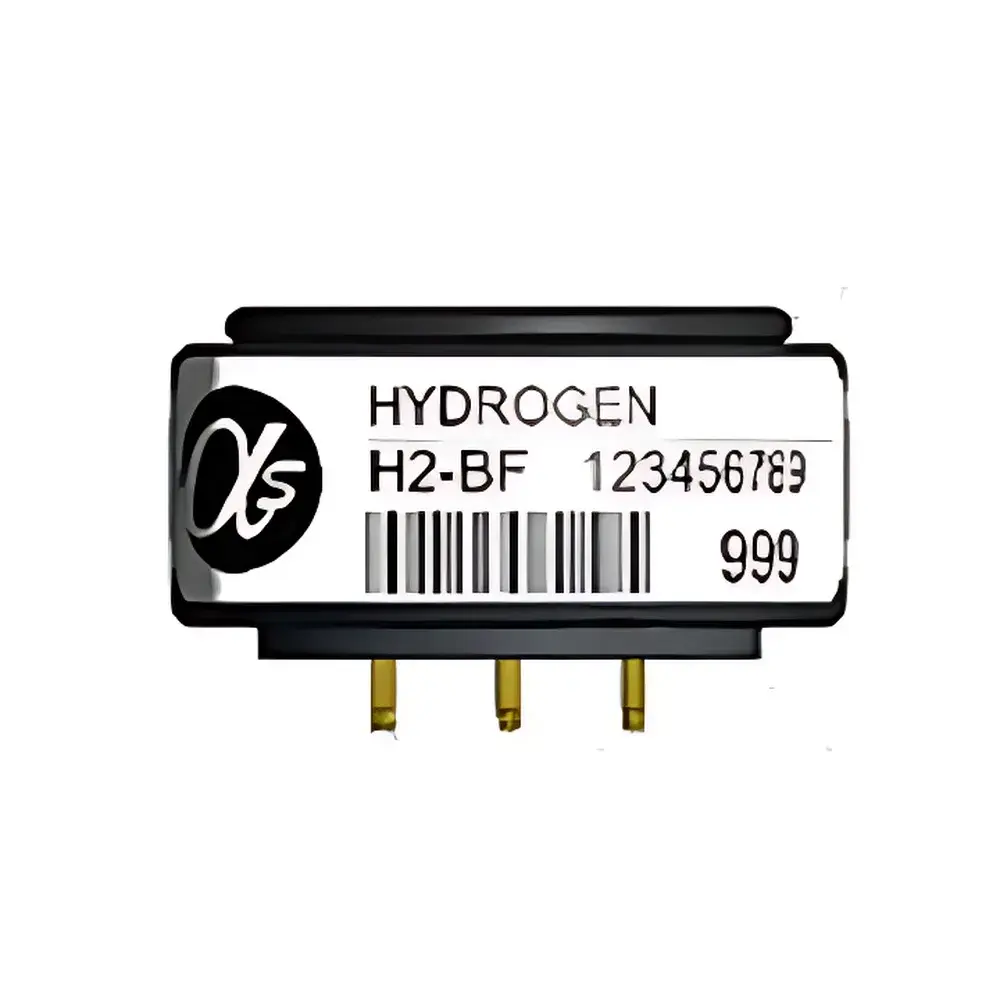
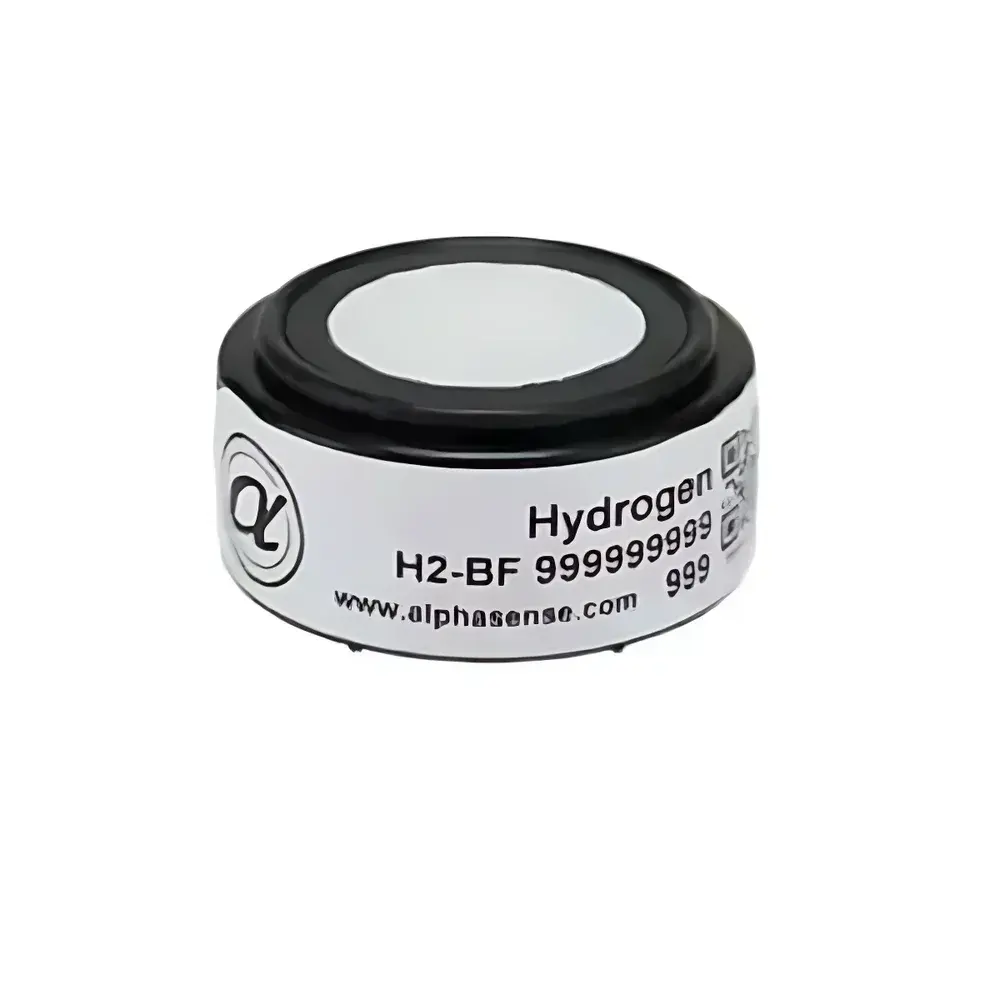
Alphasense H2-BF Electrochemical Hydrogen Gas Sensor
| Brand | Alphasense (UK) |
|---|---|
| Origin | United Kingdom |
| Model | H2-BF |
| Detection Range | 0–5000 ppm H₂ |
| Overload Limit | 20,000 ppm |
| Response Time (t₉₀) | <100 s |
| Resolution | 2 ppm |
| Zero Offset | ±10 ppm |
| Sensitivity | 12–25 nA/ppm |
| Dimensions | Ø32.3 × 16.5 mm |
Overview
The Alphasense H2-BF is a precision electrochemical gas sensor engineered for reliable, low-power detection of hydrogen (H₂) in ambient air across industrial safety, process monitoring, and laboratory applications. Based on three-electrode amperometric transduction, the sensor operates via controlled oxidation of H₂ at the working electrode, generating a current proportional to gas concentration. Its optimized catalyst layer and proprietary electrolyte formulation ensure stable baseline performance, minimal cross-sensitivity to common interferents (e.g., CO, NO₂, SO₂), and long-term signal reproducibility under varying temperature and humidity conditions (15–35 °C, 15–85% RH non-condensing). Designed for integration into fixed gas detection systems, portable monitors, and OEM instrumentation, the H2-BF complies with IEC 60079-29-1 requirements for combustible gas sensing and meets functional safety considerations aligned with SIL 2-capable system architectures when deployed within certified host electronics.
Key Features
- Three-electrode electrochemical cell architecture for enhanced stability and reduced zero drift
- Linear current output (12–25 nA/ppm) compatible with standard 4–20 mA or 0–5 V signal conditioning circuits
- Fast t₉₀ response time of less than 100 seconds—critical for early leak detection in hydrogen infrastructure
- High resolution of 2 ppm enables precise quantification near lower explosive limit (LEL) thresholds (4.0% v/v = 40,000 ppm)
- Robust mechanical design with stainless-steel mesh filter and hydrophobic PTFE membrane for particulate and moisture rejection
- Operational lifetime rated at ≥24 months in clean air; extended service life achievable with periodic zero calibration and storage in inert atmosphere
- No external power required for biasing—the sensor operates passively with only load resistor and amplifier circuitry
Sample Compatibility & Compliance
The H2-BF is intended for continuous measurement of hydrogen in ambient air or sample streams with oxygen content ≥10% v/v (required for electrochemical reaction kinetics). It is not suitable for use in inert or reducing atmospheres (e.g., N₂-purged enclosures) without supplemental air injection. The sensor exhibits negligible interference from carbon monoxide (<2% signal deviation at 500 ppm CO), nitrogen dioxide (<1.5% at 5 ppm NO₂), and sulfur dioxide (<3% at 2 ppm SO₂) under standard test conditions per EN 45544-2. It conforms to RoHS Directive 2011/65/EU and REACH Annex XVII restrictions on hazardous substances. While the sensor itself is not CE-marked as a standalone device, it is widely integrated into CE- and UKCA-compliant gas detection systems meeting BS EN 50194-1, EN 62061, and ISO 13849-1 functional safety requirements.
Software & Data Management
As an analog transducer, the H2-BF does not incorporate embedded firmware or digital communication protocols. Signal conditioning, linearization, temperature compensation, and diagnostic functions—including end-of-life (EOL) estimation and sensor health monitoring—are implemented externally by host system firmware. When paired with Alphasense’s recommended evaluation boards (e.g., AFE-01 series), users gain access to calibrated digital outputs via UART or I²C, full audit trails for calibration events, and configurable alarm thresholds compliant with FDA 21 CFR Part 11 data integrity principles where applicable. Integration with SCADA platforms (e.g., Ignition, Siemens Desigo CC) supports historical trend logging, automated calibration scheduling, and GLP/GMP-aligned electronic record retention.
Applications
- Hydrogen refueling station safety monitoring (ISO/TS 19880-1, SAE J2601)
- In-situ leakage detection in PEM electrolyzer and fuel cell stack enclosures
- Process gas purity verification in semiconductor manufacturing tooling (SEMI F21)
- Confined space entry pre-checks per OSHA 1910.146 and HSE INDG384 guidelines
- Research-grade H₂ flux studies in catalysis and materials science laboratories
- OEM integration into battery energy storage system (BESS) thermal runaway detection modules
FAQ
What is the recommended operating temperature range for the H2-BF?
The sensor is specified for continuous operation between 15 °C and 35 °C. Extended exposure above 40 °C accelerates electrolyte evaporation and degrades long-term baseline stability.
Does the H2-BF require a zero-gas calibration?
Yes—periodic zero calibration using certified nitrogen or synthetic air is essential to maintain accuracy; intervals depend on application severity but typically range from weekly (harsh environments) to quarterly (controlled labs).
Can the H2-BF be used in explosive atmospheres?
No—the sensor itself is not intrinsically safe. It must be installed within an approved explosion-proof housing or associated with a certified safety barrier per IEC 60079-11 when deployed in Zone 1/2 hazardous areas.
Is sensitivity temperature-compensated internally?
No—temperature compensation must be applied externally using either a dedicated thermistor channel or host-system lookup tables based on the published tempco coefficient (−0.15%/°C typical).
What is the expected shelf life before installation?
When stored sealed in original packaging at 20 °C and 50% RH, the H2-BF retains full specification for up to 12 months from date of manufacture.