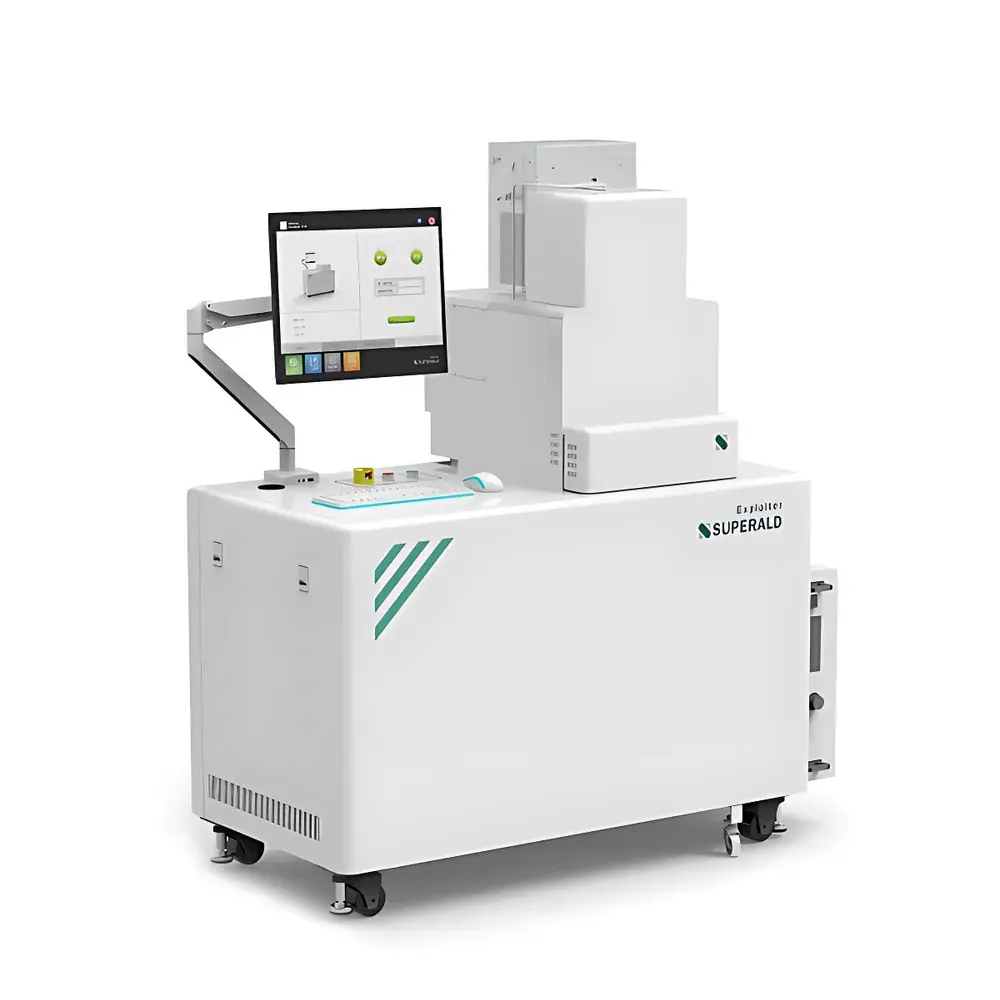
SUPERALD PEALD E200SP Plasma-Enhanced Atomic Layer Deposition System
| Brand | SUPERALD |
|---|---|
| Origin | Guangdong, China |
| Manufacturer Type | Authorized Distributor |
| Product Origin | Domestic (China) |
| Model | PEALD E200SP |
| Substrate Size | 200 mm (8 inch) diameter (customizable) |
| Process Temperature Range | Room Temperature to 500 °C (customizable) |
| Precursor Channels | Up to 6 independent precursor lines (solid & liquid sources, customizable) |
| Reactant Gas Lines | 2 (customizable) |
| Carrier Gas | N₂ with MFC flow control (customizable) |
| Plasma Gas Lines | 4 (customizable) |
| RF Power | 0–1000 W |
| Pressure Measurement | Dual corrosion-resistant capacitance manometers (0.005–1000 Torr) |
| Base Vacuum | <5 × 10⁻³ Torr |
| Vacuum System | Standard oil-sealed rotary vane pump |
| Control System | 19-inch industrial touch-enabled HMI, embedded IPC, Windows 7 OS, PLC-based real-time control |
| Source Bottle Heating | RT–200 °C (independent modules) |
Overview
The SUPERALD PEALD E200SP is a fully integrated, plasma-enhanced atomic layer deposition (PEALD) system engineered for high-precision, conformal thin-film synthesis on 200 mm (8-inch) wafers and other planar or high-aspect-ratio substrates. Unlike thermal ALD, PEALD utilizes low-temperature plasma activation to extend the process window—enabling robust film growth at reduced thermal budgets (RT–500 °C), enhanced reaction kinetics, improved step coverage on nanostructured surfaces, and access to chemistries otherwise inaccessible via thermally driven surface reactions. The system implements true self-limiting surface reactions through sequential, pulsed delivery of precursors and plasma-activated reactants, ensuring sub-nanometer thickness control, exceptional uniformity (<±0.8% across 200 mm), and atomic-scale reproducibility—critical for advanced semiconductor nodes, MEMS packaging, solid-state battery interfaces, and biofunctional coatings.
Key Features
- Modular 6-channel precursor delivery system supporting both volatile liquid and sublimable solid precursors, each with individually programmable temperature-controlled source bottles (RT–200 °C)
- Dual-reactant gas manifold with MFC-controlled N₂ carrier and configurable plasma gas inputs (Ar, O₂, N₂, NH₃, etc.)
- High-stability 13.56 MHz RF plasma generator (0–1000 W) with impedance-matching network and real-time forward/reflected power monitoring
- Dual-range, corrosion-resistant capacitance manometer suite (0.005–1000 Torr) enabling accurate pressure profiling during purge, dose, and plasma phases
- Ultra-low base vacuum (<5 × 10⁻³ Torr) achieved via oil-sealed rotary vane pump with integrated cold trap and automated vent/purge sequencing
- Industrial-grade control architecture combining deterministic PLC logic, Windows 7-based HMI, and Ethernet-based I/O synchronization for sub-second timing resolution
- Ergonomic 19-inch rotatable touchscreen interface with multi-user permission levels, audit-trail-enabled recipe management, and full IO interlock mapping
- “One-Touch Deposition” workflow automation—including auto-pumpdown, temperature ramping, cycle execution, cooldown, and venting—with optional manual override per valve and stage
Sample Compatibility & Compliance
The PEALD E200SP accommodates standard 200 mm silicon wafers, quartz, sapphire, flexible polymer foils (e.g., PI, PET), and MEMS devices with topography up to 10:1 aspect ratio. Its low-thermal-budget operation enables processing of temperature-sensitive substrates including OLED backplanes, lithium-ion battery separators (PP/PE), and biodegradable polymers. The system complies with industrial safety standards (IEC 61000-6-2/6-4, UL 61010-1), supports GLP/GMP-aligned data integrity protocols (electronic signatures, change history, audit trail export), and meets key semiconductor fabrication requirements for traceable process documentation under ISO 9001 and SEMI S2/S8 guidelines.
Software & Data Management
The embedded control software provides full-cycle recipe definition—including pulse durations, purge times, RF duty cycles, temperature ramps, and plasma ignition delays—with version-controlled storage and CSV/Excel export for offline analysis. All operational events (valve actuations, pressure transients, RF power logs, temperature profiles) are timestamped and archived with SHA-256 hashing for integrity verification. User access is role-based (Operator, Engineer, Administrator), with password-protected parameter locks and mandatory electronic sign-off for critical operations. The system supports OPC UA connectivity for integration into factory MES platforms and offers optional FDA 21 CFR Part 11 compliance packages with electronic audit trails, biometric authentication, and e-signature validation.
Applications
- Semiconductor Manufacturing: High-κ dielectrics (Al₂O₃, HfO₂, ZrO₂), metal gates (TiN, TaN, Ru), diffusion barriers (WNₓ), and MTJ tunneling layers with atomic-level stoichiometry control
- Energy Storage: Al₂O₃ or Li₃PO₄ coatings on cathodes (NMC, LCO), artificial SEI layers on Si anodes, dendrite-suppressing interphases on Li-metal, and thermally stable encapsulation of PP/PE separators
- Optoelectronics: Hermetic, conformal encapsulation of OLED emitters and micro-LED arrays; high-index waveguide layers (TiO₂, Ta₂O₅); anti-reflective and passivation stacks for perovskite solar cells
- Catalysis & Sensors: Single-atom catalysts (Pt, Pd, Ir on CeO₂/Al₂O₃), core-shell nanoparticles (Pt@SiO₂), and selective functionalization of MOF scaffolds via spatially resolved ALD
- Biomedical Devices: Antibacterial TiN/ZrN coatings on orthopedic implants; hemocompatible DLC/Al₂O₃ bilayers on stents; and moisture-barrier films for implantable electronics and drug-eluting microparticles
FAQ
What substrate sizes does the PEALD E200SP support?
Standard configuration supports 200 mm (8-inch) wafers; custom chambers are available for 100 mm, 150 mm, or non-circular substrates (e.g., rectangular glass, flexible foils).
Can the system deposit both metallic and oxide films?
Yes—compatible with metal precursors (e.g., TMA, TEMAHf, Cp₂Mg), oxidants (H₂O, O₃, O₂ plasma), nitridation agents (NH₃ plasma), and reducing plasmas (H₂, N₂/H₂) to synthesize oxides, nitrides, carbides, metals, and multilayer heterostructures.
Is remote monitoring or predictive maintenance supported?
The system includes built-in Ethernet diagnostics and optional MQTT/OPC UA telemetry modules for real-time chamber health monitoring, consumables tracking (e.g., precursor depletion), and scheduled maintenance alerts.
How is process repeatability ensured across multiple runs?
Repeatability is maintained through hardware-level interlocks (pressure/temperature safety thresholds), software-enforced recipe locking, automated calibration routines for MFCs and manometers, and full-cycle logging with cryptographic hash verification.
Does the system meet cleanroom compatibility requirements?
Yes—the frame uses anodized aluminum with low-outgassing finishes; all internal wetted surfaces are electropolished stainless steel or ceramic; and the vacuum architecture minimizes hydrocarbon contamination via cold trapping and inert gas purging sequences.