
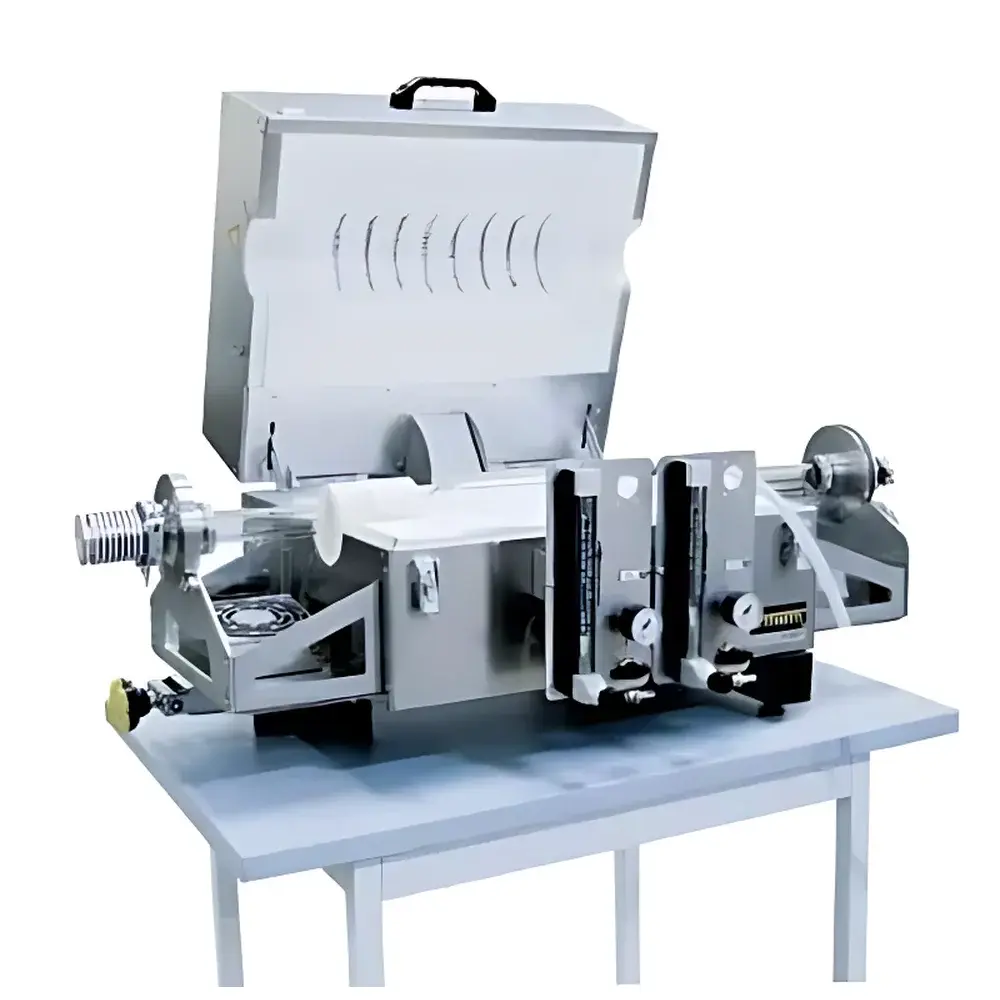
Nabertherm RSR Series Rotating Tube Furnace
| Brand | Nabertherm |
|---|---|
| Origin | Germany |
| Model | RSR 80-500/11, RSR 80-750/11, RSR 120-500/11, RSR 120-750/11 |
| Max Temperature | 1100 °C |
| Chamber Dimensions (L × I × D) | up to 1390 mm × 525 mm × 440 mm |
| Uniformity Zone (ΔT ≤ 10 K) | up to 750 mm length |
| Tube ID | 76 mm or 106 mm |
| Tube Wall Thickness | 34 mm |
| Motor Speed | 1–20 rpm (infinitely adjustable) |
| Power Supply | 1-phase or 3-phase, 3.4–6.3 kW |
| Weight | 100–120 kg |
| Thermocouple Type | K-type |
| Gas Inlet/Outlet | Dual-side for thorough purging |
| Optional Features | Vacuum-compatible rotary feedthrough, tri-zone temperature control, auxiliary thermocouple for tube internal measurement, gas cooling unit, non-return valve at exhaust |
Overview
The Nabertherm RSR Series Rotating Tube Furnace is an engineered solution for thermal processing applications requiring uniform heat treatment, controlled atmosphere operation, and mechanical homogenization of particulate or granular materials. Unlike static tube furnaces, the RSR integrates continuous rotational motion of the process tube—driven by a precisely regulated AC motor—enabling consistent exposure of all sample surfaces to the thermal and gaseous environment. This design is especially critical in calcination, drying, roasting, and precursor decomposition where preservation of individual particle morphology, avoidance of sintering agglomeration, and reproducible mass transfer kinetics are essential. The furnace operates up to 1100 °C using high-stability K-type thermocouples and features a robust ceramic fiber insulation system with optimized thermal gradient management across the heated zone. Its horizontal orientation, compact benchtop footprint, and hinged front door allow rapid access to the reaction tube without disassembly—reducing downtime and improving workflow efficiency in R&D and pilot-scale laboratories.
Key Features
- Infinitely adjustable rotation speed (1–20 rpm) via precision AC motor drive, ensuring optimal tumbling dynamics for diverse powder flow characteristics
- Three-zone independent temperature control option for enhanced axial thermal uniformity (ΔT ≤ 10 K over up to 750 mm)
- Dual-side gas inlet/outlet configuration enabling complete, laminar purging of the reaction volume with inert, reducing, or reactive atmospheres
- Vacuum-compatible rotary feedthrough assembly available for integration into sealed or low-pressure systems (e.g., <1 mbar)
- Interchangeable quartz reaction tubes (ID 76 mm or 106 mm, wall thickness 34 mm) certified for thermal shock resistance and chemical inertness
- Integrated auxiliary K-type thermocouple port for direct in-tube temperature monitoring—critical for validating process-relevant thermal profiles
- Gas cooling unit and non-return valve on exhaust line to prevent ambient air ingress during cooling cycles or pressure transitions
- Hinged, fully opening front housing with quick-release clamping mechanism for tool-free tube insertion and removal
Sample Compatibility & Compliance
The RSR series accommodates powders, pellets, catalysts, battery electrode precursors, metal oxides, and ceramic granules—particularly those sensitive to localized overheating or compaction-induced density gradients. Its rotational geometry minimizes particle segregation and promotes uniform residence time distribution. All models comply with EN 61000-6-3 (EMC emission standards) and EN 61000-6-2 (immunity), and meet CE marking requirements for laboratory equipment within the EU Machinery Directive 2006/42/EC. When equipped with optional tri-zone controllers and audit-trail-capable software interfaces, the system supports GLP and GMP-aligned workflows, including traceable calibration records per ISO/IEC 17025 and temperature mapping per ASTM E220 or ICH Q5C guidelines.
Software & Data Management
While the base RSR operates with analog or digital single-loop controllers (e.g., Nabertherm THERM 200 series), optional digital controllers support RS485 Modbus RTU or Ethernet TCP/IP communication for integration into centralized lab automation platforms. Data logging intervals down to 1 second are achievable, with timestamped records of setpoint, actual temperature (furnace and optional tube interior), rotation speed, and gas flow status. Audit trails—including user login, parameter changes, and alarm events—are configurable to satisfy FDA 21 CFR Part 11 requirements when paired with validated electronic signature modules and role-based access control.
Applications
- Controlled-atmosphere calcination of Li-ion cathode precursors (e.g., NMC, LFP) with minimized lithium loss and phase segregation
- Thermal stabilization of MOFs and porous carbons under nitrogen or argon to preserve surface area and pore structure
- Stepwise pyrolysis of biomass-derived chars with real-time off-gas analysis coupling
- Oxidation/reduction cycling of supported metal catalysts (e.g., Ni/Al₂O₃, Pt/C) under dynamic gas switching protocols
- Drying and pre-sintering of spray-dried ceramic slurries without crust formation or particle fusion
- Heat treatment of optical fiber preforms and specialty glass rods requiring radial symmetry and minimal thermal stress
FAQ
What is the maximum recommended operating temperature for continuous use?
The RSR series is rated for continuous operation at 1100 °C; intermittent excursions to 1150 °C are permissible with reduced thermal cycle frequency and verified tube integrity.
Can the furnace be used under vacuum conditions?
Yes—when equipped with the optional vacuum-rated rotary feedthrough and sealed tube end caps, the system supports pressures down to 10⁻² mbar with compatible pumping stations.
Is temperature uniformity validated across the entire heated length?
Uniformity (ΔT ≤ 10 K) is specified over the declared hot zone length (e.g., 500 mm or 750 mm); full validation per ASTM E220 requires user-performed sensor mapping with NIST-traceable thermocouples.
How is gas flow rate controlled and monitored?
Mass flow controllers (MFCs) are integrated externally; the furnace provides standardized 6 mm OD gas ports and pressure-tight sealing interfaces compatible with standard Swagelok or VCR fittings.
Are replacement quartz tubes supplied with certification?
All factory-supplied quartz tubes include material test reports (MTRs) specifying OH-content, bubble count, and annealing history per DIN ISO 719 and DIN ISO 10523.



