
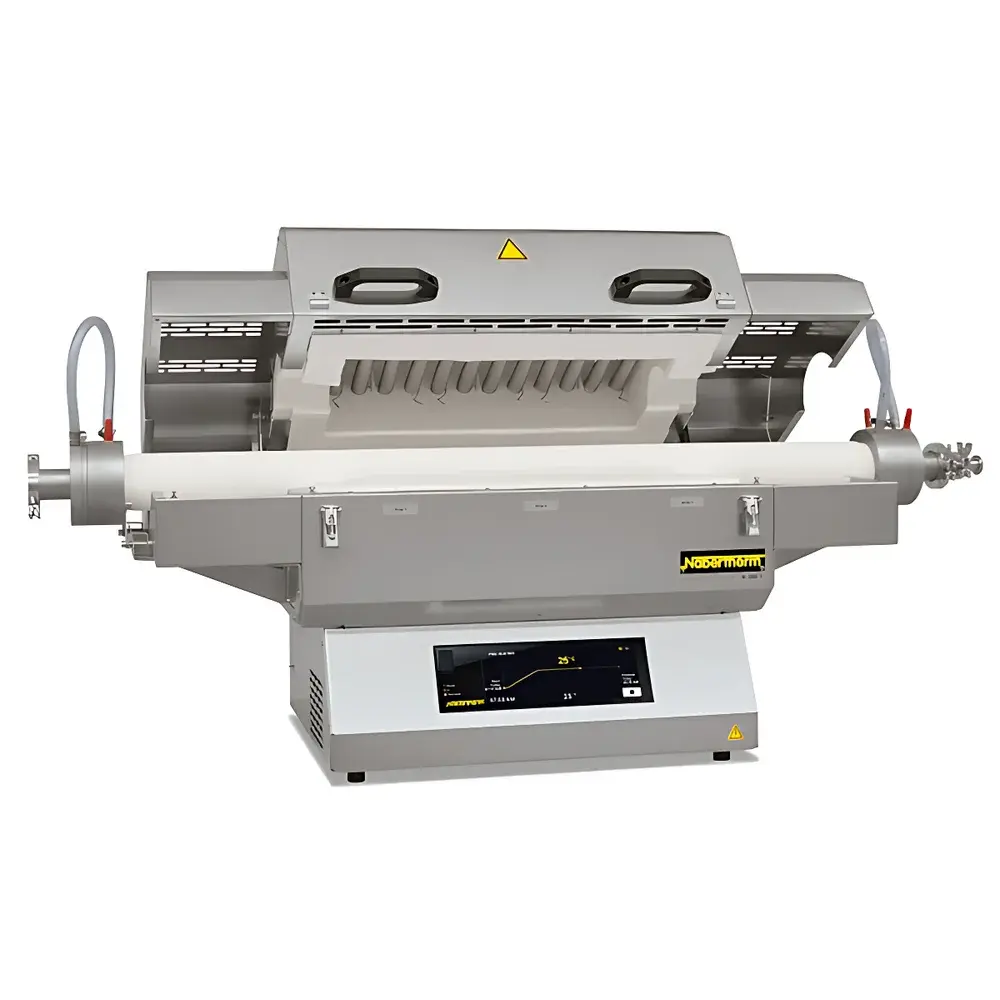
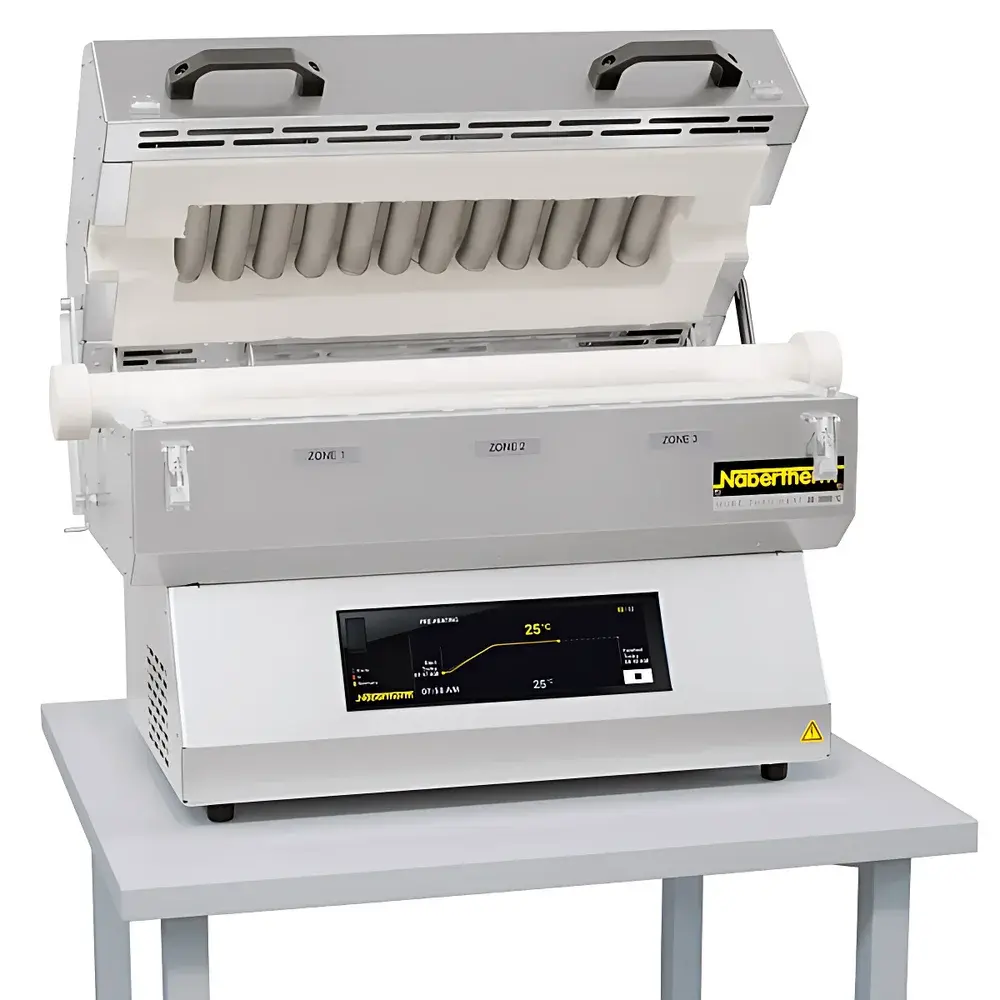
Nabertherm RSH 50/500 Horizontal Split-Tube Furnace
| Brand | Nabertherm |
|---|---|
| Origin | Germany |
| Model | RSH 50/500 |
| Maximum Temperature | 1300 °C |
| Temperature Control Accuracy | ±3 °C |
| Heating Power | 3400 W |
| Heating Method | Resistive Wire Heating |
| Internal Tube Diameter | 50 mm |
| Configuration | Horizontal, Top-Hinged Split Design |
| Thermocouple Type | S-type (for 1300 °C) |
| Controller | Integrated Nabertherm NTLog with USB Data Logging |
| Optional | Multi-zone (3-zone) Control, Vacuum/Atmosphere-Compatible Gas Manifolds, VCD Software & NCC Integration |
| Compliance | Designed for GLP/GMP-aligned thermal processing environments |
Overview
The Nabertherm RSH 50/500 is a horizontally oriented, top-hinged split-tube furnace engineered for precise, repeatable high-temperature thermal treatment under controlled atmospheres. Based on resistive wire heating architecture and optimized radiant heat transfer geometry, it operates via a robust ceramic-insulated tube chamber mounted within a rigid stainless-steel housing (brushed finish). Its defining mechanical feature—a hinged upper half that lifts vertically—enables rapid, tool-free access to the working tube without disturbing furnace alignment or insulation integrity. This configuration supports efficient loading/unloading of samples, calibration standards, or reaction vessels, particularly where sequential batch processing or frequent tube exchange is required. The furnace is thermally rated to 1300 °C, utilizing an S-type platinum-rhodium thermocouple for stable, traceable temperature measurement in accordance with IEC 60584-2 and ASTM E230 standards. All structural and thermal design elements comply with EN 61000-6-3 (EMC) and EN 61000-6-4 for laboratory-grade electromagnetic compatibility.
Key Features
- Horizontal split-tube architecture with vertical hinge mechanism for unobstructed tube access and minimal thermal disturbance during operation
- High-strength C 530 alumina-silica ceramic working tube (standard supply), rated for continuous air atmosphere use up to 1300 °C
- Three-zone optional heating configuration (RSH-3Z variant) enabling axial temperature profiling and improved uniformity (±5 °C over 200 mm hot zone)
- Modular gas interface system supporting inert (N₂, Ar), reducing (H₂/N₂), oxidizing (O₂), vacuum (<10⁻² mbar), and reactive gas environments via certified manifold kits
- Integrated Nabertherm NTLog controller with real-time PID regulation, USB-based process data logging (timestamped T°C, setpoint, power %, alarm status), and firmware-upgradable architecture
- Separate wall-mounted control cabinet housing relay logic, safety interlocks (door-open cutoff, overtemperature shutdown per EN 60519-2), and mains isolation
- Optional VCD software suite or Nabertherm Control Center (NCC) for remote supervision, multi-furnace orchestration, and 21 CFR Part 11-compliant audit trails
Sample Compatibility & Compliance
The RSH 50/500 accommodates cylindrical samples, crucibles, catalyst beds, and thin-film substrates up to 50 mm in diameter and 500 mm in length. Its open-tube geometry permits direct insertion of thermocouples, quartz viewports, or gas sampling probes into the working tube. Standard C 530 tubes are compatible with air, nitrogen, and argon; alternative tubes—including high-purity quartz (for <1100 °C), SiC (for rapid cycling), or recrystallized alumina (for halogen resistance)—are available per application requirements. The system meets essential safety and performance criteria outlined in ISO/IEC 17025 for accredited laboratories, supports GLP documentation workflows, and facilitates validation protocols aligned with USP and ASTM E1112 for thermal process qualification.
Software & Data Management
Process data acquisition is natively supported through the NTLog controller’s embedded USB interface, recording temperature, power output, and event flags at user-defined intervals (1–60 s). For advanced deployment, the VCD (Virtual Control Device) software enables script-driven ramp-soak programs, live graphing, and CSV export with metadata tagging. When integrated with NCC (Nabertherm Control Center), the furnace becomes part of a networked thermal infrastructure—supporting centralized alarm management, electronic batch records, electronic signatures, and full 21 CFR Part 11 compliance including role-based access control, operator audit logs, and immutable data archiving.
Applications
This furnace serves critical roles in materials synthesis (e.g., solid-state reaction of oxides, carbothermal reduction), catalyst activation and regeneration, semiconductor precursor annealing, ceramic sintering pre-tests, ashing of organic matrices (ASTM D3174), and thermal gravimetric method development. Its configurable atmosphere capability makes it suitable for redox-controlled calcination, nitridation, and controlled oxidation studies. Academic and industrial R&D labs routinely deploy the RSH platform for DOE-based thermal protocol optimization, while QC laboratories utilize its reproducibility for reference material stabilization and inter-laboratory calibration transfers.
FAQ
What tube materials are compatible with the RSH 50/500 at 1300 °C?
Standard C 530 ceramic tubes are rated for continuous operation at 1300 °C in air or inert gas. Quartz tubes are limited to ≤1100 °C; SiC or recrystallized alumina alternatives are recommended for aggressive chemistries or thermal cycling.
Can the furnace be operated under vacuum?
Yes—vacuum compatibility requires optional vacuum-rated flanges, a diffusion pump or turbomolecular pumping station, and a dedicated vacuum manifold kit (see Nabertherm Catalog Section 44). Base pressure <10⁻² mbar is achievable with proper sealing and outgassing protocols.
Is 3-zone temperature control available as a factory option?
Yes—the RSH-3Z configuration provides independent power regulation across front, center, and rear heating zones, improving axial uniformity and enabling gradient thermal treatments.
Does the NTLog controller support external thermocouple inputs for sample temperature monitoring?
Yes—optional dual-input configurations allow simultaneous measurement of furnace chamber temperature (S-type) and internal tube/sample temperature (via auxiliary K- or S-type thermocouple), with independent PID loops available.
How is compliance with FDA 21 CFR Part 11 ensured?
Full Part 11 compliance requires NCC software deployment with configured electronic signatures, audit trail activation, and validated installation—performed by Nabertherm-certified service engineers during commissioning.
Related Products



