
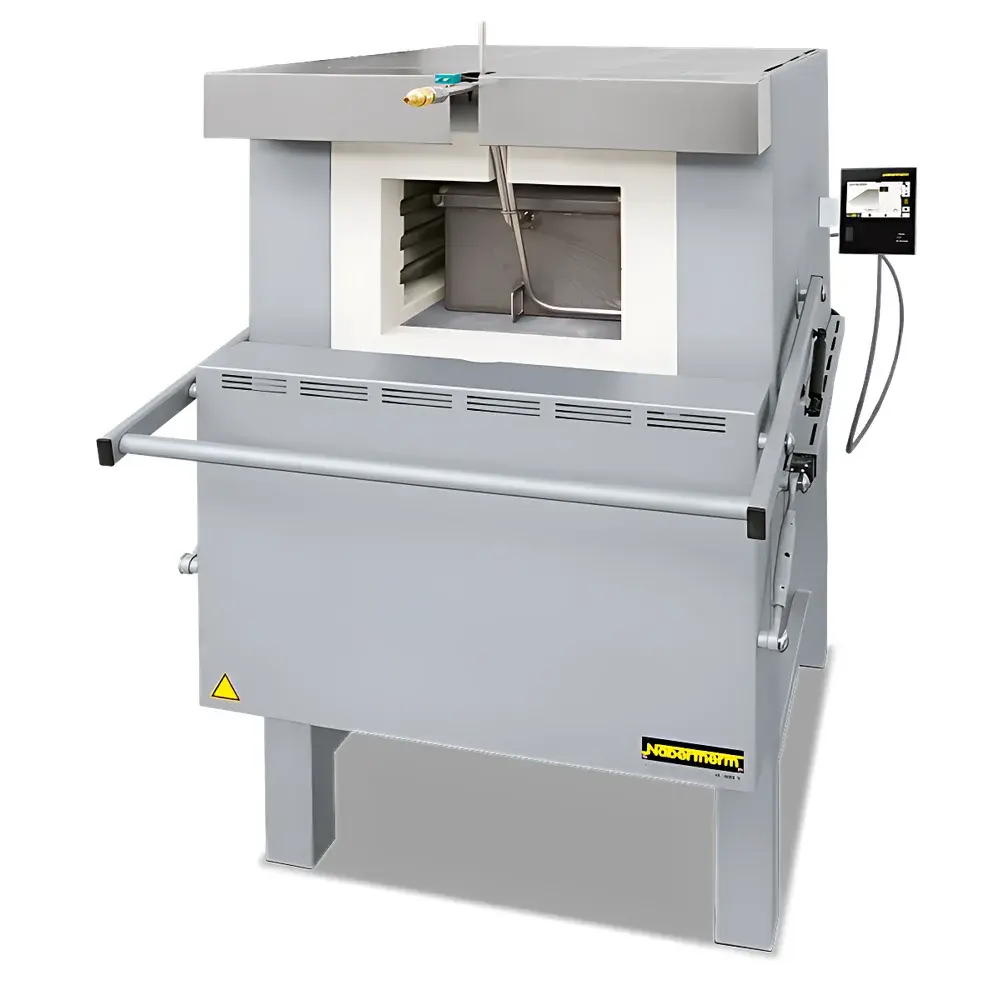
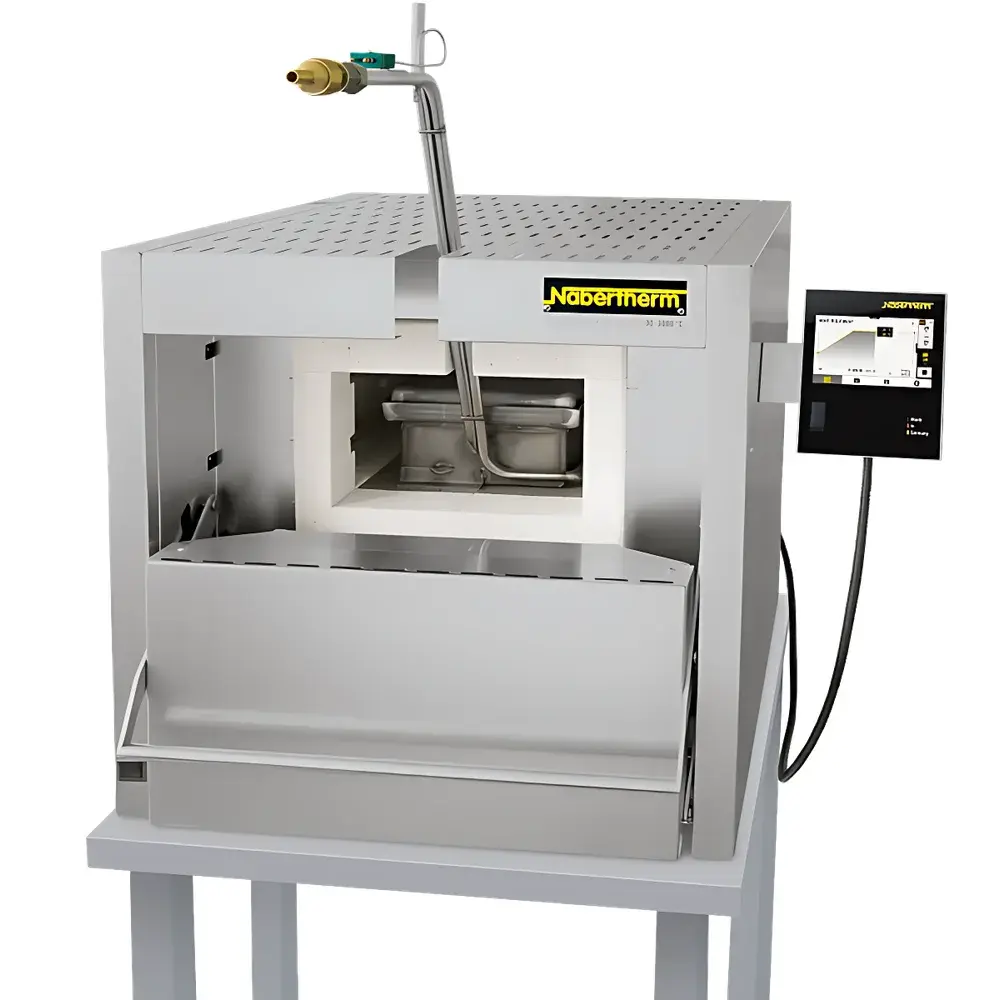
Nabertherm N 41/H High-Temperature Box Furnace for Annealing, Quenching, and Brazing
| Brand | Nabertherm |
|---|---|
| Origin | Germany |
| Model | N 41/H |
| Maximum Temperature | 1280 °C |
| Temperature Uniformity | ±3 °C |
| Rated Power | 15 kW |
| Heating Time to Max Temp | 120 min |
| Heating Method | Electric (SiC heating elements) |
| Internal Dimensions | 350 × 500 × 250 mm (W × D × H) |
| External Dimensions | 418 × 400 × 1160 mm (W × D × H) |
| Weight | 260 kg |
| Phase Configuration | 3-phase |
| Insulation | Multi-layer lightweight refractory brick structure |
Overview
The Nabertherm N 41/H is a high-precision, laboratory-grade box furnace engineered for controlled thermal processing of metallic and ceramic materials under demanding research and quality control conditions. Designed around the principles of uniform radiant heat transfer and thermal stability, it operates on a robust SiC (silicon carbide) heating element architecture—mounted on support tubes and heated from three sides (left, right, and bottom)—to ensure exceptional temperature homogeneity across its 350 × 500 × 250 mm chamber. With a maximum operating temperature of 1280 °C and a certified temperature uniformity of ±3 °C at setpoint, the furnace meets the stringent thermal consistency requirements for annealing of titanium alloys, stress-relief treatments of tool steels, vacuum-compatible brazing preheats, and controlled-atmosphere sintering protocols. Its structural integrity derives from a multi-layer insulation system composed of lightweight, low-conductivity refractory bricks—optimized to minimize standby heat loss while maintaining rapid thermal response during ramp-hold-cool cycles.
Key Features
- Triple-sided electric heating (two lateral walls + floor) with SiC heating elements mounted on ceramic support tubes for extended service life and consistent radiant output
- Bottom heating zone protected by a silicon carbide heat-resistant plate, preventing mechanical degradation and thermal shock damage
- Multi-layer refractory insulation design reduces energy consumption by up to 30% compared to conventional single-layer muffle configurations
- Vertically downward-opening door with parallel-guided motion and gas-spring dampers—eliminates upward radiation exposure during loading/unloading and ensures ergonomic operation
- Rear-mounted exhaust port (standard from N 31/H onward) facilitates integration with fume extraction or inert gas purge systems
- Sturdy base-mounted frame (not benchtop) enhances stability during high-temperature cycling and accommodates optional accessories such as quenching stations or protective atmosphere retorts
Sample Compatibility & Compliance
The N 41/H supports diverse sample geometries—including crucibles, trays, rods, and fabricated components—up to 250 mm in height and 350 mm in width. Its deep chamber and open-hearth layout allow direct placement of samples on the furnace floor or within custom fixtures (e.g., stainless steel annealing boxes, alumina boats, or graphite susceptors). The furnace is compatible with inert (N₂, Ar), reducing (H₂/N₂), and vacuum-compatible atmospheres when used with auxiliary gas manifolds or vacuum pumps (not included). It conforms to IEC 61000-6-3 (EMC emission standards) and IEC 61000-6-2 (immunity), and its construction complies with EN 60519-1 for safety in industrial electroheating equipment. When operated under documented SOPs, it supports GLP-compliant thermal validation studies per ASTM E220 and ISO/IEC 17025 calibration traceability requirements.
Software & Data Management
The furnace integrates with Nabertherm’s THERMOCOM® control platform (optional upgrade), enabling programmable multi-step temperature profiles, real-time data logging (±0.1 °C resolution), and export of CSV-formatted time-temperature datasets. The standard controller features password-protected parameter access, event logging with timestamped alarms (e.g., overtemperature, door-open, power failure), and audit trail functionality compliant with FDA 21 CFR Part 11 when paired with validated software modules. All temperature readings are referenced to a calibrated Pt100 sensor embedded in the chamber wall near the load zone—ensuring metrological traceability to national standards.
Applications
- Controlled annealing of biomedical titanium alloys (e.g., Ti-6Al-4V) to achieve partial recrystallization without grain coarsening
- Quench-hardening of high-carbon steels using integrated cooling stations with oil or polymer baths
- Brazing of aluminum heat exchangers and stainless steel assemblies under nitrogen-rich atmospheres
- Pre-sintering of oxide ceramics (Al₂O₃, ZrO₂) prior to HIP or hot pressing
- Thermal aging studies for aerospace superalloys (Inconel 718, Waspaloy) per AMS 2750E pyrometry requirements
- Calibration reference furnaces for thermocouple verification labs operating under ISO/IEC 17025
FAQ
What is the recommended maintenance interval for the SiC heating elements?
Under normal laboratory usage (≤10 cycles/week at ≤1200 °C), inspection is advised every 12 months; replacement is typically required after 5,000–8,000 operational hours depending on thermal cycling frequency and atmosphere.
Can the N 41/H be retrofitted with a vacuum system?
Yes—Nabertherm offers factory-certified vacuum flange kits (KF-40 or CF-63) and compatible diffusion pump interfaces; however, vacuum-rated insulation and door seals must be specified at time of order.
Is the furnace suitable for use in cleanroom environments?
While not ISO Class 5 certified, its sealed chamber design, low outgassing refractory lining, and absence of internal lubricants make it compatible with ISO Class 7–8 cleanrooms when installed with HEPA-filtered air supply and proper venting.
Does the controller support external SCADA integration?
Yes—the optional RS485 Modbus RTU interface enables bidirectional communication with LabVIEW, Ignition, or Siemens S7 PLC systems for centralized process monitoring and alarm forwarding.
What safety certifications does the N 41/H carry?
It bears CE marking per Machinery Directive 2006/42/EC and Low Voltage Directive 2014/35/EU, and carries TÜV Rheinland Type Examination Certificate No. R 50215121 for electrical safety and thermal hazard mitigation.



