
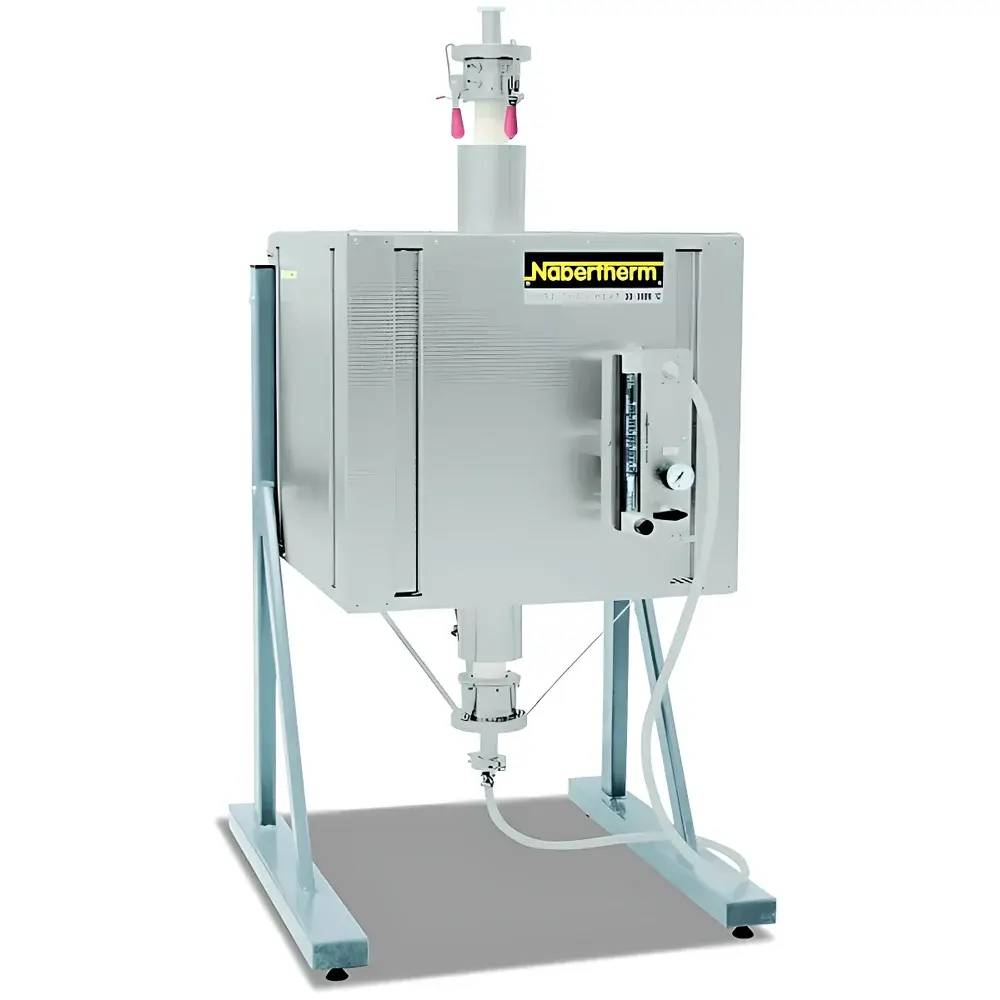
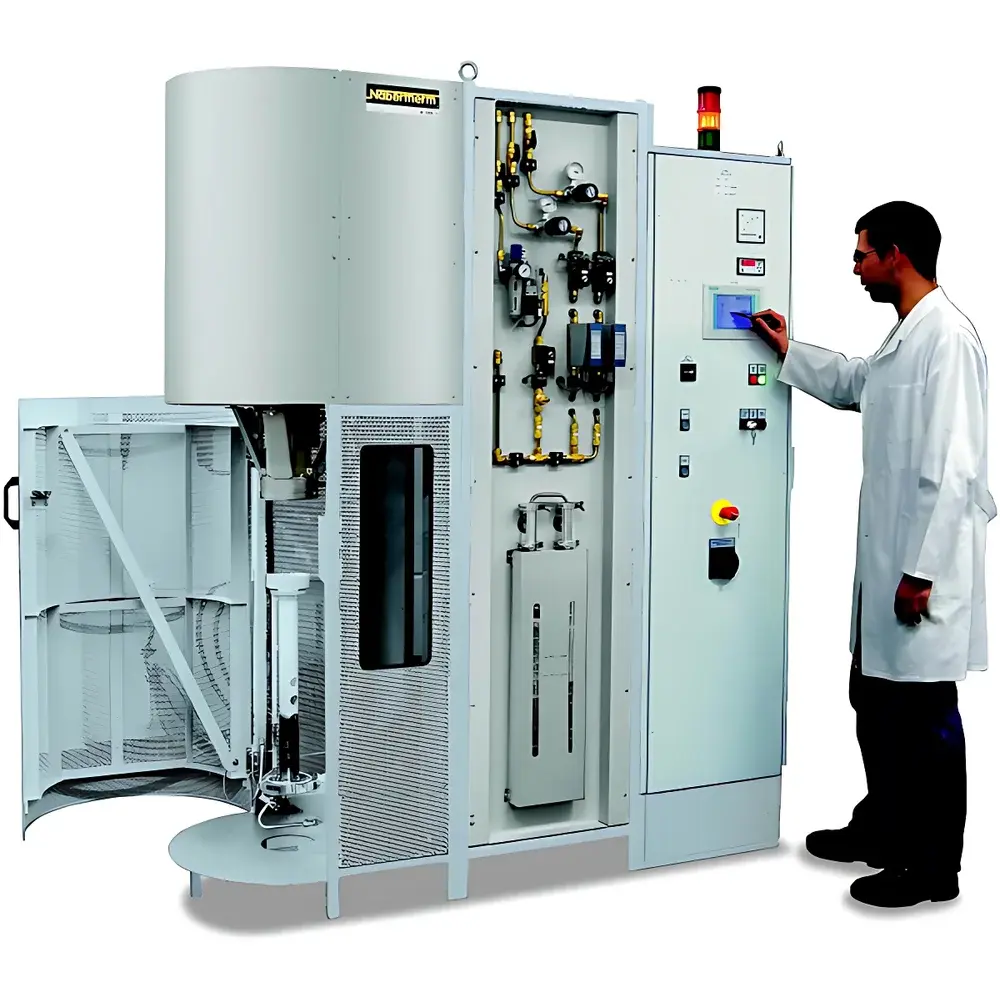
Nabertherm RHTV Series Vertical High-Temperature Tube Furnace
| Brand | Nabertherm |
|---|---|
| Origin | Germany |
| Model | RHTV 120/600/.. |
| Maximum Temperature | 1800 °C |
| Temperature Control Accuracy | ±3 °C |
| Heating Element | MoSi₂ (Molybdenum Disilicide) Rods |
| Internal Diameter | 120 mm |
| Maximum Power | 19 kW |
| Insulation | Vacuum-Formed Ceramic Fiber Boards |
| Configuration | Vertical Operation with Support Stand |
| Compliance | EN 60519-2 (Temperature Protection Class II) |
| Controller | Separated Cabinet-Mounted Unit with NTLog Data Logging (USB), Optional VCD Software or NCC Integration |
Overview
The Nabertherm RHTV Series is a precision-engineered vertical high-temperature tube furnace designed for demanding laboratory and pilot-scale thermal processing applications requiring stable, repeatable operation up to 1800 °C. Unlike horizontal configurations, the RHTV’s vertical orientation enables gravity-assisted sample loading, improved gas flow dynamics in reactive or inert atmospheres, and enhanced safety during high-temperature handling of volatile or dense materials. Its core thermal architecture employs suspended MoSi₂ heating elements—resistant to oxidation and capable of long-term stability at extreme temperatures—integrated with vacuum-formed ceramic fiber insulation. This low-thermal-mass insulation delivers rapid heat-up rates, minimal energy storage, and superior thermal efficiency while maintaining low external surface temperatures (<60 °C at ambient conditions), complying with occupational safety requirements per EN 60519-2.
Key Features
- Vertical configuration with integrated support stand for ergonomic sample insertion and removal under high-temperature conditions
- MoSi₂ heating elements mounted in suspension—mechanically decoupled from the furnace shell to minimize thermal stress and extend service life
- Vacuum-formed alumina-silica ceramic fiber insulation (Ceramic Grade C799-compatible) ensuring low thermal conductivity (<0.15 W/m·K at 1000 °C) and high dimensional stability
- Triple-layer thermal barrier design: hot-face fiber board, intermediate insulating layer, and outer stainless-steel casing with structured grooves for passive convection cooling
- Separately housed control cabinet containing a programmable temperature controller, thyristor-based power regulator with low-voltage transformer, and dual-stage overtemperature protection (EN 60519-2 Class II)
- Standard inclusion of high-purity ceramic work tube (material C799), fiber end plugs for air operation, and B-type thermocouple for furnace chamber monitoring
Sample Compatibility & Compliance
The RHTV accommodates cylindrical samples and crucibles up to 120 mm in diameter and 600 mm in active heating zone length. It supports operation under ambient air, inert (Ar, N₂), reducing (H₂/N₂ mixtures), oxidizing (O₂-enriched), or vacuum environments (down to 10⁻² mbar with optional vacuum flange and pump interface). All gas-tight configurations utilize metal-sealed flanges compliant with ISO-KF and CF standards. The furnace meets essential EU directives including the Machinery Directive 2006/42/EC, Electromagnetic Compatibility Directive 2014/30/EU, and Low Voltage Directive 2014/35/EU. For regulated environments (GMP/GLP laboratories), optional configurations include 21 CFR Part 11–compliant audit trails via NCC software, calibrated thermocouple inputs traceable to DIN EN ISO/IEC 17025, and configurable process alarms with event logging.
Software & Data Management
The standard NTLog function records time-stamped temperature, power, and setpoint data directly to USB flash drives at user-defined intervals (1 s to 60 min resolution). For advanced process control, the optional VCD (Vacuum & Controlled Atmosphere Device) software package enables multi-step ramp-soak programs, real-time gas flow synchronization, and automated pressure/vacuum sequencing. When integrated with the Nabertherm Control Center (NCC), the RHTV becomes part of a networked thermal infrastructure supporting remote monitoring, centralized alarm management, historical trend analysis, and electronic batch record generation. All digital interfaces comply with Modbus TCP and OPC UA protocols for seamless integration into LIMS or MES platforms.
Applications
- Sintering of advanced ceramics (e.g., SiC, AlN, ZrO₂) and refractory metals under controlled partial pressures
- Thermal treatment of battery cathode precursors (e.g., LiCoO₂, NMC) with precise oxygen partial pressure control
- Graphitization and annealing of carbon nanomaterials in inert or reducing atmospheres
- Crystal growth support furnaces requiring axial thermal gradients and contamination-free zones
- Calibration of high-temperature reference standards traceable to national metrology institutes (e.g., PTB, NIST)
- Materials testing per ASTM E1113 (high-temperature creep), ISO 80000-5 (thermophysical quantities), and DIN 51742 (ceramic sintering behavior)
FAQ
What atmosphere options are supported by the RHTV series?
The RHTV operates in ambient air, inert gases (Ar, N₂), reactive gases (H₂, CO), oxidizing mixtures, and vacuum down to 10⁻² mbar using optional vacuum-rated flanges and sealing kits.
Is three-zone temperature control available for the vertical RHTV model?
No—three-zone control is exclusive to the horizontal RHTH series; the RHTV features a single optimized heating zone with ±5 K uniformity over 600 mm length.
Can the furnace be integrated into an automated production line?
Yes—via Modbus TCP or OPC UA interfaces, the RHTV supports PLC-level integration, recipe-based scheduling, and alarm forwarding to SCADA systems.
What maintenance is required for MoSi₂ heating elements?
MoSi₂ elements require no periodic replacement under normal operation; however, visual inspection every 200 operating hours and resistance measurement every 1000 hours are recommended per DIN EN 62058.
Does the system support independent measurement of sample temperature inside the work tube?
Yes—optional dual thermocouple inputs allow simultaneous monitoring of furnace chamber temperature and internal work-tube temperature using a second B-type or S-type thermocouple routed through an auxiliary port.



