
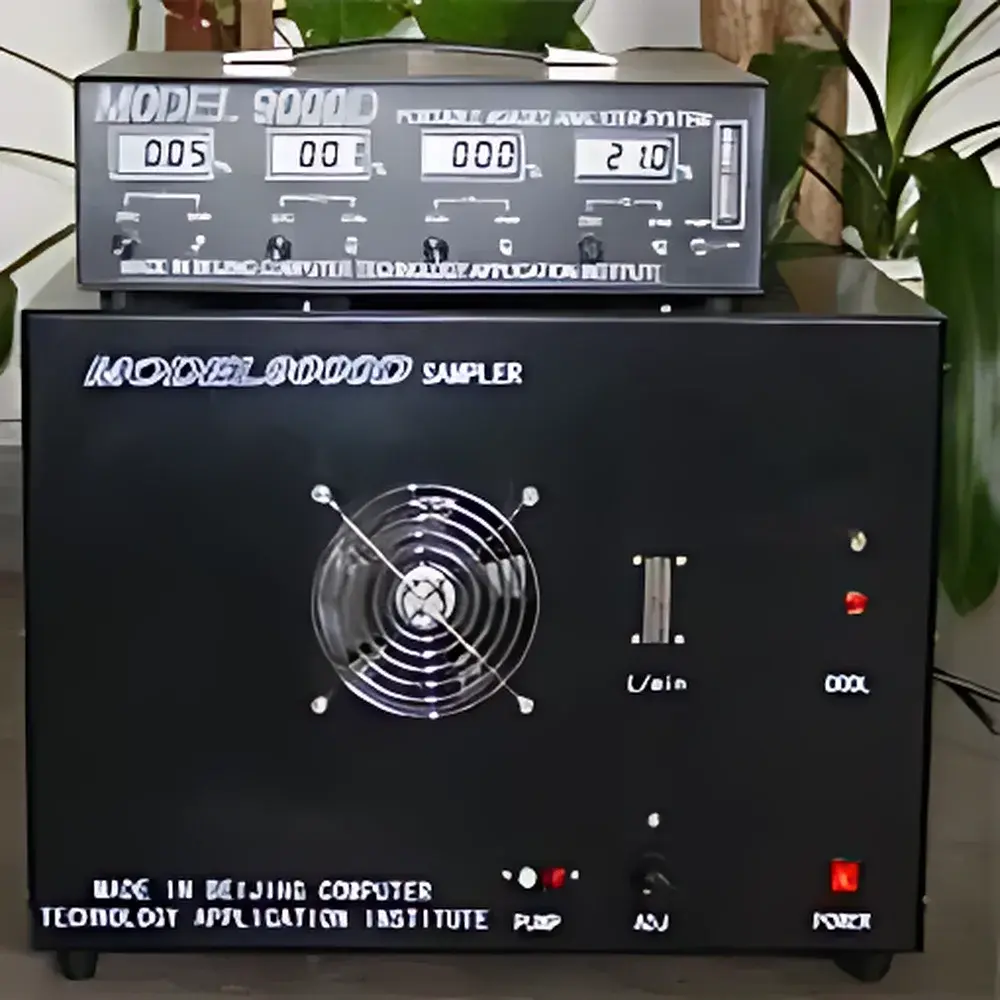
Portable 4-Channel Infrared Gas Analyzer System Model 9000D
| Origin | Beijing, China |
|---|---|
| Manufacturer Type | Authorized Distributor |
| Origin Category | Domestic (PRC) |
| Model | 9000D |
| Price | USD 13,800 (FOB Beijing) |
| Measurement Principle | Non-Dispersive Infrared (NDIR) Absorption Spectroscopy |
| Gas Channels | CO, CO₂, CH₄, O₂ |
| Display | Four 3½-digit LCDs (simultaneous real-time concentration readouts) |
| Response Time | T₀–T₉₀ ≤ 15 s |
| Linearity | ≤ ±2% FS |
| Repeatability | ≤ 1% FS |
| Zero Drift | ≤ ±2% FS / 4 h |
| Operating Environment | −10 °C to +50 °C, 20–95% RH (non-condensing) |
| Power Supply | 24 V DC (internal rechargeable Li-ion battery + AC adapter) |
| Weight | 4.2 kg (portable configuration) |
| IP Rating | IP54 |
Overview
The Portable 4-Channel Infrared Gas Analyzer System Model 9000D is an engineered field-deployable instrument designed for simultaneous, real-time quantification of carbon monoxide (CO), carbon dioxide (CO₂), methane (CH₄), and oxygen (O₂) in landfill gas (LFG) streams. It operates on the principle of non-dispersive infrared (NDIR) absorption spectroscopy—each target gas exhibits characteristic fundamental vibrational absorption bands in the mid-infrared region (e.g., CO at 4.6 µm, CO₂ at 4.26 µm, CH₄ at 3.3 µm), enabling selective detection without cross-interference when optical filters and detector configurations are rigorously optimized. The system integrates a robust sampling probe, heated sample line (optional), particulate filtration, condensate removal via Peltier-cooled trap, mass-flow-controlled gas delivery, and temperature/pressure-compensated NDIR sensor modules. Its compact architecture supports extended unattended operation in ambient outdoor conditions typical of landfill perimeter monitoring, leachate collection points, or biogas extraction wells.
Key Features
- Four independent NDIR optical channels with factory-calibrated, temperature-stabilized detectors—no shared optics or sequential scanning, ensuring true parallel measurement and temporal synchronization.
- Integrated sample conditioning subsystem: stainless-steel particulate filter (5 µm cutoff), thermoelectric condensate trap (−5 °C dew point suppression), and precision laminar flow controller (±1% full-scale accuracy) to maintain consistent residence time and minimize adsorption artifacts.
- Field-ruggedized enclosure (IP54-rated) with shock-absorbing elastomer housing, integrated handle, and dual power mode—rechargeable lithium-ion battery (≥8 h continuous operation) plus universal AC/DC adapter (100–240 VAC input).
- Real-time digital display: four independent 3½-digit LCDs showing instantaneous %v/v concentrations for each gas, updated every 1.2 seconds; no menu navigation required for primary readout.
- Zero and span calibration ports accessible via front-panel quick-connect fittings; supports manual two-point calibration using certified standard gases traceable to NIST SRMs.
- Embedded diagnostics: continuous self-check of detector signal-to-noise ratio, reference cell integrity, flow rate deviation, and battery health—logged with timestamps for GLP-compliant recordkeeping.
Sample Compatibility & Compliance
The Model 9000D is validated for direct analysis of raw, humid, particulate-laden landfill gas without pre-treatment beyond onboard conditioning. It accommodates gas matrices containing up to 1,000 ppm H₂S (non-corrosive to internal wetted materials: 316L SS, PTFE, FKM seals). All sensors meet IEC 61000-6-2/6-3 immunity and emission requirements. Data acquisition complies with ISO 14064-3 verification protocols for GHG emissions monitoring and satisfies ASTM D7727–19 criteria for field-portable LFG analyzers. While not intrinsically safe (Class I, Div 2 rated upon request with optional ATEX-certified variant), its design conforms to UL 61010-1 safety standards for portable electrical measurement equipment.
Software & Data Management
The system includes USB-C interface and optional Bluetooth 5.0 module for wireless telemetry. PC software (Windows/macOS/Linux compatible) enables configuration, firmware updates, and time-synchronized data export in CSV/Excel format with metadata (GPS coordinates, operator ID, calibration history). Raw analog outputs (0–5 V DC per channel) support integration into SCADA or PLC-based environmental control systems. Audit trail functionality records all parameter changes, calibration events, and alarm triggers with user authentication—fully compliant with FDA 21 CFR Part 11 requirements when used in regulated landfill closure reporting under EPA Subtitle D guidelines.
Applications
- Landfill gas migration monitoring along site boundaries and adjacent soil gas probes.
- Performance evaluation of active gas extraction wells and passive venting systems.
- Feasibility assessment of landfill gas-to-energy (LFGTE) projects—including CH₄ recovery potential and combustion air ratio optimization.
- Regulatory compliance reporting per EPA Method 21, ASTM D5287, and EU Landfill Directive 1999/31/EC Annex II.
- Post-closure care verification during long-term stewardship phases (e.g., 30-year monitoring plans).
- Academic research on anaerobic digestion kinetics and microbial community gas metabolism profiles.
FAQ
Can the Model 9000D be used for continuous unattended monitoring?
Yes—when powered by AC mains or connected to a solar-charged battery bank, it supports 24/7 operation with automatic zero drift compensation activated every 24 hours.
Is calibration traceable to international standards?
All factory calibrations use NIST-traceable certified gas mixtures (±1% uncertainty); calibration certificates include uncertainty budgets and metrological chain documentation.
What maintenance intervals are recommended?
Particulate filter replacement every 3 months under typical landfill conditions; condensate trap cleaning weekly; full system verification annually per ISO/IEC 17025 accredited labs.
Does the system support external data logging without a PC?
Yes—the internal microSD card (pre-installed 16 GB) stores timestamped concentration data at user-selectable intervals (1 s to 60 min), with automatic rollover and password-protected access.
How is cross-sensitivity between CH₄ and CO₂ mitigated?
Through spectral deconvolution algorithms trained on >200 multi-component gas matrix validations and hardware-level bandpass filtering with <5 nm FWHM bandwidths centered on each target absorption peak.







