
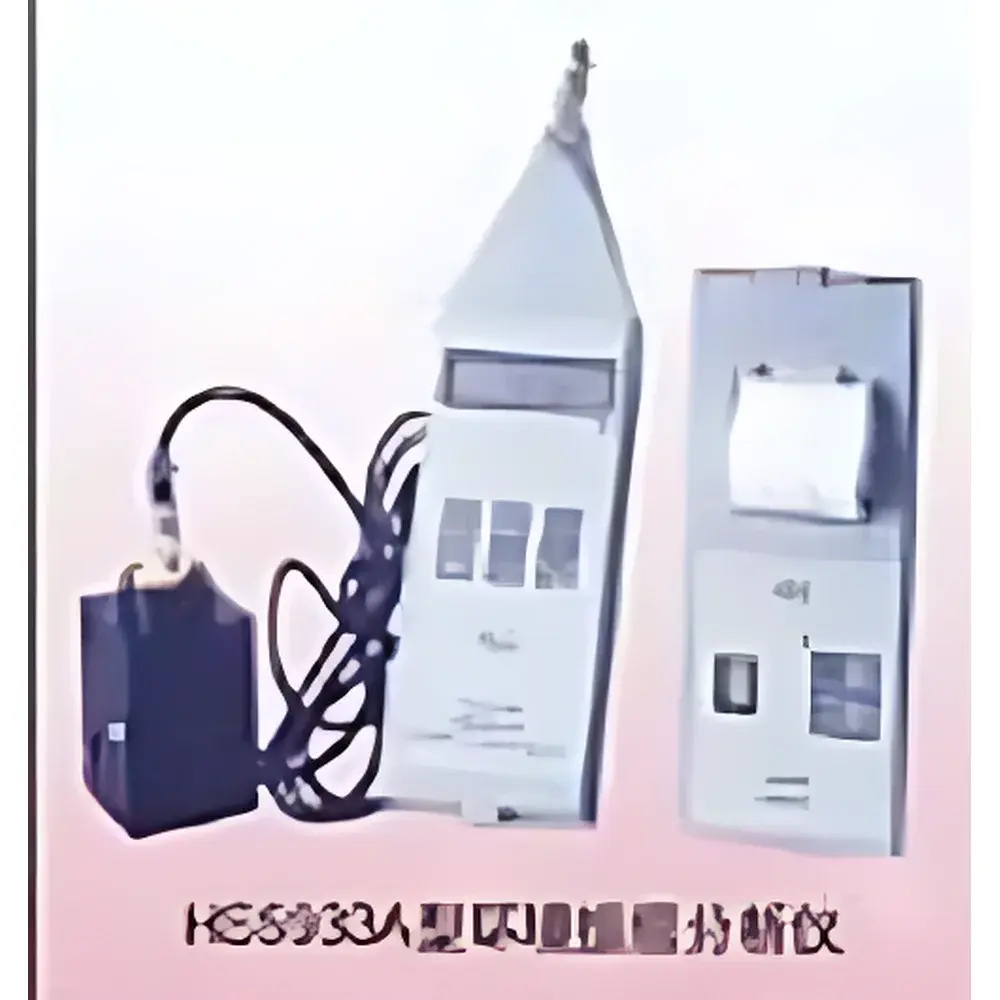
HS5933A Environmental Vibration Meter
| Origin | China |
|---|---|
| Type | Portable |
| Measurement Range | 60–140 dB (re 10⁻⁶ m/s²) |
| Frequency Range | 1–80 Hz |
| Frequency Weightings | Whole-body vertical (VLz), whole-body horizontal (VLx-y), linear (VAL) |
| Dimensions (main unit) | 24 × 8.1 × 3.1 cm |
| Weight (main unit) | 0.4 kg |
| Data Storage Capacity | 127 measurement sets |
| Compliance | ISO 2631-1, ISO 5349-1, and IEC 61260 Class 2 requirements for vibration meters |
Overview
The HS5933A Environmental Vibration Meter is a portable, microprocessor-based instrument engineered for precise assessment of human-exposed mechanical vibration in occupational, residential, and urban environments. It operates on the principle of acceleration transduction using a piezoelectric sensor, converting mechanical vibration into proportional electrical signals for real-time digital processing. Designed to meet the performance criteria specified in ISO 2631-1 (Evaluation of human exposure to whole-body vibration), ISO 5349-1 (Hand-arm vibration), and IEC 61260:2014 Class 2 for octave-band and 1/3-octave-band filter implementation, the HS5933A delivers traceable, repeatable measurements across its full operational bandwidth (1–80 Hz). Its dynamic range of 60–140 dB (referenced to 10⁻⁶ m/s²) supports evaluation of low-amplitude ambient floor vibrations as well as high-intensity industrial or transportation-induced excitations. The device is calibrated per ISO 16063-21 for primary accelerometer calibration traceability and is suitable for field deployment where battery-powered portability, rapid setup, and regulatory-compliant data acquisition are essential.
Key Features
- Compliance with international standards including ISO 2631-1, ISO 5349-1, and IEC 61260 Class 2 for frequency weighting and filter accuracy
- Three selectable frequency weightings: VLz (whole-body vertical), VLx-y (whole-body horizontal), and linear VAL for unweighted analysis
- Flexible measurement modes: manual start/stop, timed intervals (10 s, 1/5/10/20 min), and extended logging (1/8/24 h) for Leq (equivalent continuous vibration level) calculation
- Statistical output capability: VL₁₀, VL₅₀, VL₉₀, peak acceleration (Vpeak), and standard deviation (SD) — all computed in accordance with ISO 5349-1 Annex B protocols
- Integrated thermal printer for immediate hard-copy reporting; supports on-site verification without external devices
- Non-volatile memory stores up to 127 complete measurement records, each containing time-stamped VLeq, statistical parameters, weighting mode, and duration
- Compact form factor (24 × 8.1 × 3.1 cm, 0.4 kg) with integrated lithium-ion rechargeable power system enabling >12 hours of continuous operation
Sample Compatibility & Compliance
The HS5933A is optimized for measuring vibration transmitted through floors, walls, and seating surfaces to assess human biodynamic response. It accommodates triaxial mounting configurations via standardized 10–32 UNF threaded interface on the supplied vibration transducer. Sensor coupling follows ISO 5349-1 guidelines for hand-arm applications and ISO 2631-1 Annex C for seat-pad or floor-mounted whole-body exposure assessments. All measurement algorithms implement digital filtering conforming to IEC 61260 Class 2 tolerances. Calibration verification is supported via built-in self-test and external reference shaker systems traceable to national metrology institutes (e.g., NIM, NPL, PTB). The instrument satisfies documentation requirements for GLP-aligned environmental impact assessments and meets minimum technical specifications for municipal noise and vibration ordinances in EU Member States and North America.
Software & Data Management
While the HS5933A operates autonomously for field use, it supports optional PC-based data export via RS-232 serial interface (cable included). Raw time-history data and summary statistics can be transferred to compliant analysis software for spectral decomposition, time-series correlation, or integration into enterprise environmental management systems (EMS). Exported datasets include UTC timestamps, measurement mode flags, weighting selection, and full statistical arrays — structured for direct ingestion into MATLAB, Python (pandas), or commercial tools such as Brüel & Kjær Pulse or HEAD Acoustics ArtemiS SUITE. Audit trails, user-defined project IDs, and password-protected configuration settings ensure data integrity under ISO/IEC 17025 and FDA 21 CFR Part 11–compatible workflows when paired with validated host software.
Applications
- Urban planning: Assessment of ground-borne vibration from rail transit, construction pile driving, and highway traffic near sensitive receptors (schools, hospitals, historic buildings)
- Workplace safety: Monitoring operator exposure to whole-body vibration in agricultural machinery, earthmoving equipment, and marine vessels per OSHA Technical Manual Section III: Chapter 5
- Building diagnostics: Quantifying structural transmission paths and identifying resonance anomalies in low-frequency building envelopes
- Environmental impact reporting: Generating legally defensible vibration reports for EIA submissions under NEPA, EIA Directive 2011/92/EU, or local municipal codes
- Research & development: Field validation of vibration isolation systems, damping material efficacy, and predictive finite element models
FAQ
What standards does the HS5933A comply with for vibration measurement?
It conforms to ISO 2631-1 (whole-body), ISO 5349-1 (hand-arm), and IEC 61260 Class 2 for analog/digital filter performance.
Can the instrument measure both hand-arm and whole-body vibration?
Yes — via appropriate sensor mounting and selection of VLz (seated standing), VLx-y (horizontal), or VAL (unweighted) weightings.
Is calibration certificate included with shipment?
A factory calibration report traceable to national standards is provided; periodic recalibration is recommended annually per ISO/IEC 17025 guidelines.
How is data exported for regulatory reporting?
Via RS-232 to PC; exported CSV files contain all required metadata for inclusion in official environmental compliance documentation.
Does the device support real-time spectral analysis?
No — it provides time-domain RMS and statistical metrics only; octave-band spectral analysis requires optional external FFT modules or post-processing.
Related Products







